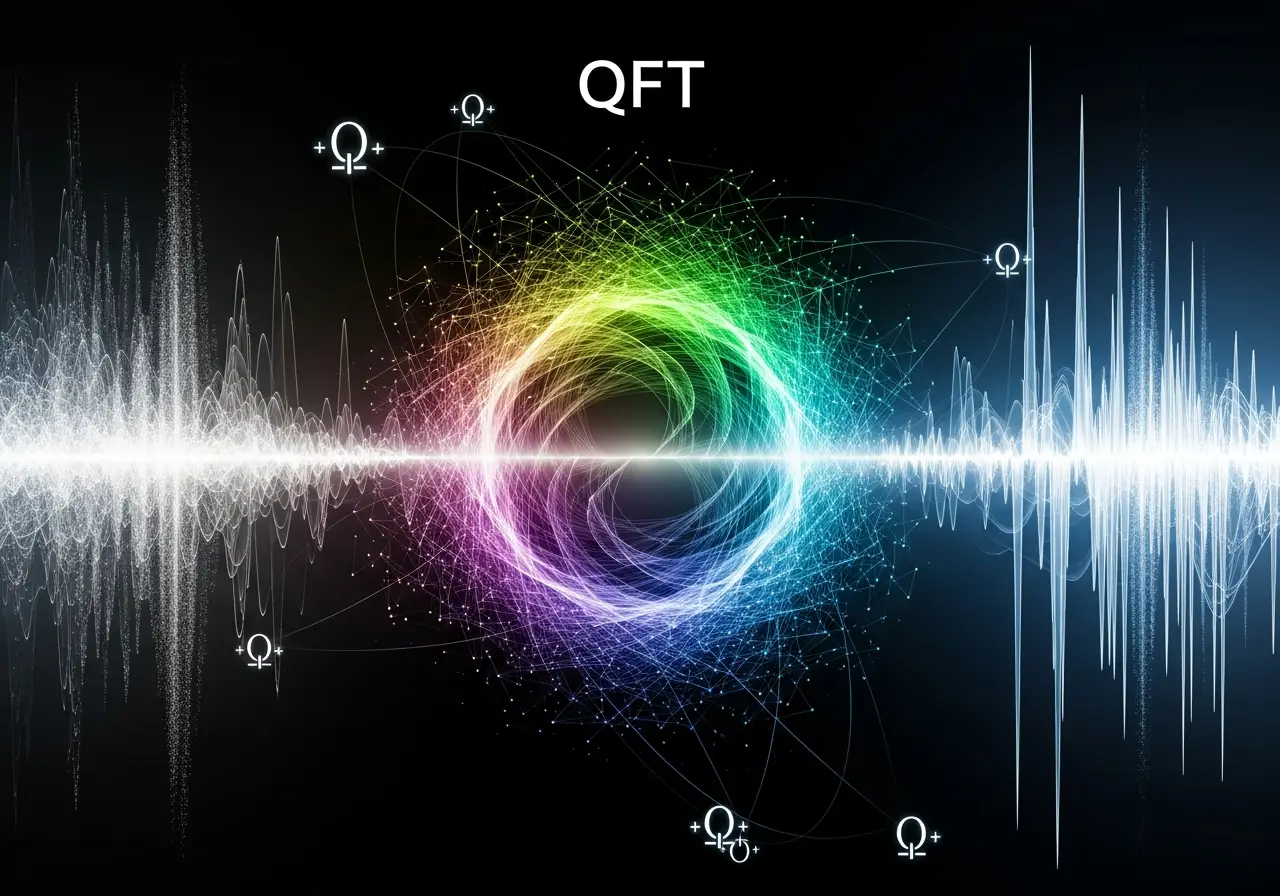

In a world where data is as abundant as the air we breathe, untangling its complexities and uncovering hidden patterns can feel overwhelming. The Quantum Fourier Transform (QFT) steps onto this stage, not as a grand illusion but as a tool for clarity and insight. This algorithm transforms the way we analyze data, moving away from the laborious classical processes towards a more streamlined, lightning-fast method.
Think of QFT as a new musical instrument in the orchestra of data analysis. Where traditional methods painstakingly extract each frequency one by one, QFT plays multiple notes simultaneously, enabling us to hear the symphony of data with newfound precision. This isn’t just about speed—it’s about reaching depths we previously couldn’t fathom.
The magic of QFT lies in quantum mechanics, where qubits replace traditional bits, allowing for a level of parallel processing that defies conventional expectations. It’s not just about faster computations; it’s about uncovering insights that were previously beyond reach. Imagine finding hidden patterns in financial markets or predicting health outcomes with greater accuracy—all possible because QFT makes it feasible to explore these complex datasets thoroughly and swiftly.
Yet, the promise of QFT isn’t limited by its current challenges, such as the difficulty in constructing stable quantum computers. With ongoing research and innovation, the potential to harness quantum powers is drawing significant attention and investment.
The implications for industries are vast: finance, healthcare, telecommunications, and beyond stand on the verge of transformation with QFT. As the technology matures, the possibilities for faster, more precise data analysis grow exponentially, offering solutions once thought impossible.
In embracing QFT, we step into a realm where the ordinary boundaries of data exploration dissolve, revealing the extraordinary. It’s about transforming not just data, but our understanding of it, allowing us to craft narratives that make sense of our increasingly complex world.
As we navigate this frontier, QFT offers more than just a technical advantage—it presents an opportunity to redefine our relationship with data itself. The journey won’t be without its hurdles, but the rewards promise to reshape our analytical landscape. Now, the question remains: are you ready to explore this new dimension of data analysis and unlock its latent potential?