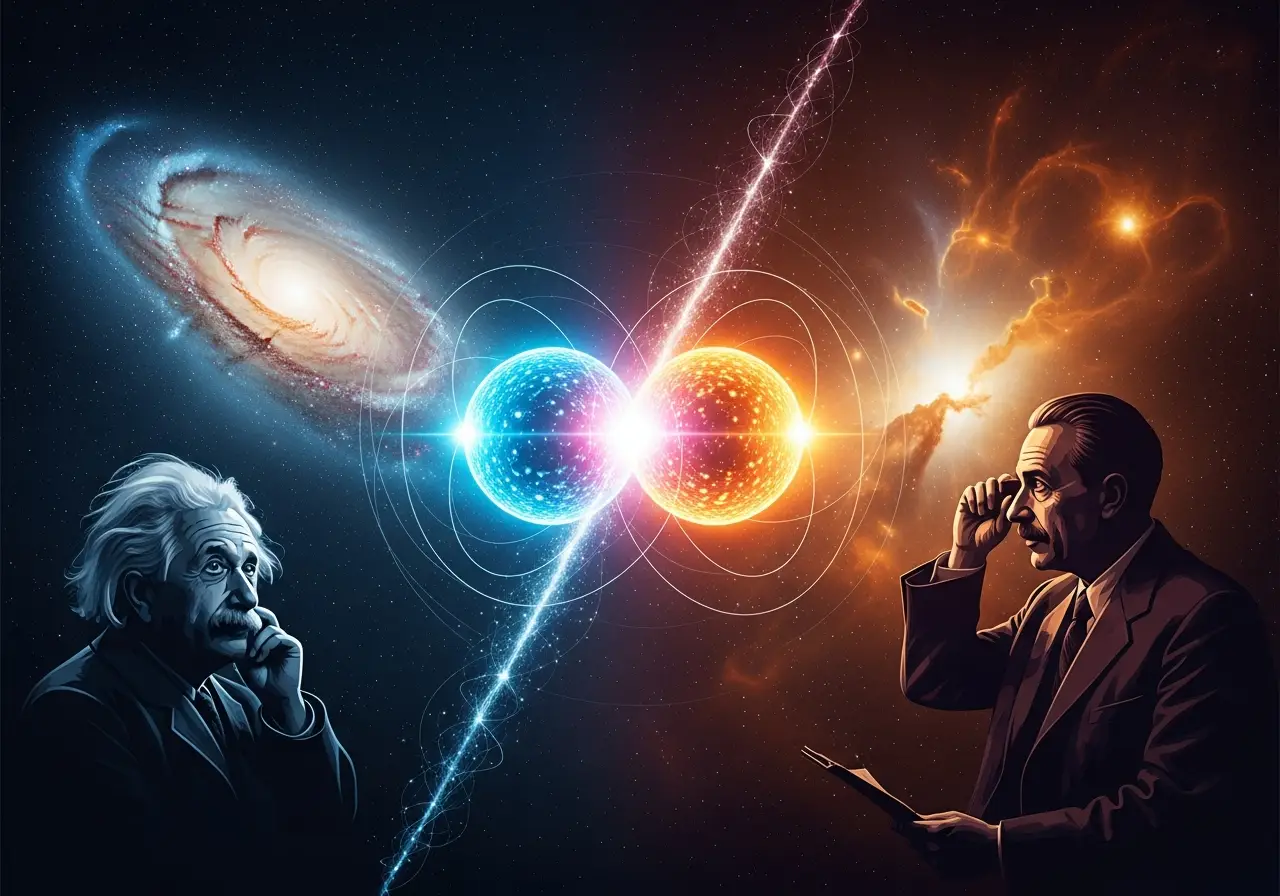

In the tapestry of our universe, the tale of two particles—Alice and Bob—sparks a fascinating exploration into quantum mechanics through the Einstein-Podolsky-Rosen (EPR) paradox. Imagine a world where these particles, separated by galaxies, still influence each other in an instant. This isn’t just a plot from a science fiction novel; it’s a genuine puzzle that challenges our understanding of space, time, and reality itself.
Back in 1935, when Einstein, Podolsky, and Rosen introduced this paradox, they questioned whether quantum mechanics was a complete theory. Could particles really communicate at a distance faster than light, or was there something missing—perhaps hidden variables we couldn’t yet comprehend? For them, the idea that two particles could affect each other across vast distances without any visible connection was as unsettling as an unresolved mystery.
Yet, as we delved deeper, the essence of this paradox spun a revolutionary web across scientific communities. It wasn’t just an academic question but a profound awakening that pushed boundaries and generated countless debates. Einstein himself famously pondered whether reality was more a roll of the cosmic dice than a nicely wrapped package ready for scientific dissection.
Enter John Bell in the 1960s, whose theorem provided a groundbreaking way to test these ideas experimentally. The results? They aligned snugly with quantum predictions, leaving little room for those hidden variables. It seemed the universe wasn’t a simple sum of individual parts but rather an intricate network of interactions, defying the isolation our senses often perceive.
This exploration into the EPR paradox reveals that we’re more than mere observers of the universe—we are interwoven into its very fabric. Every thought, action, or decision we make connects with a broader cosmic story. Instead of detached onlookers, we find ourselves as participants in a complex symphony, resonating through the quantum realm.
As you journey through the layers of this paradox, consider how your connection to the universe might extend beyond the tangible. The EPR paradox challenges us not only to rethink quantum mechanics but also to embrace the interconnectedness that binds us all. We are living threads in a dynamic tapestry, reminding us that our place in the cosmos is both significant and fundamentally linked to everything around us.