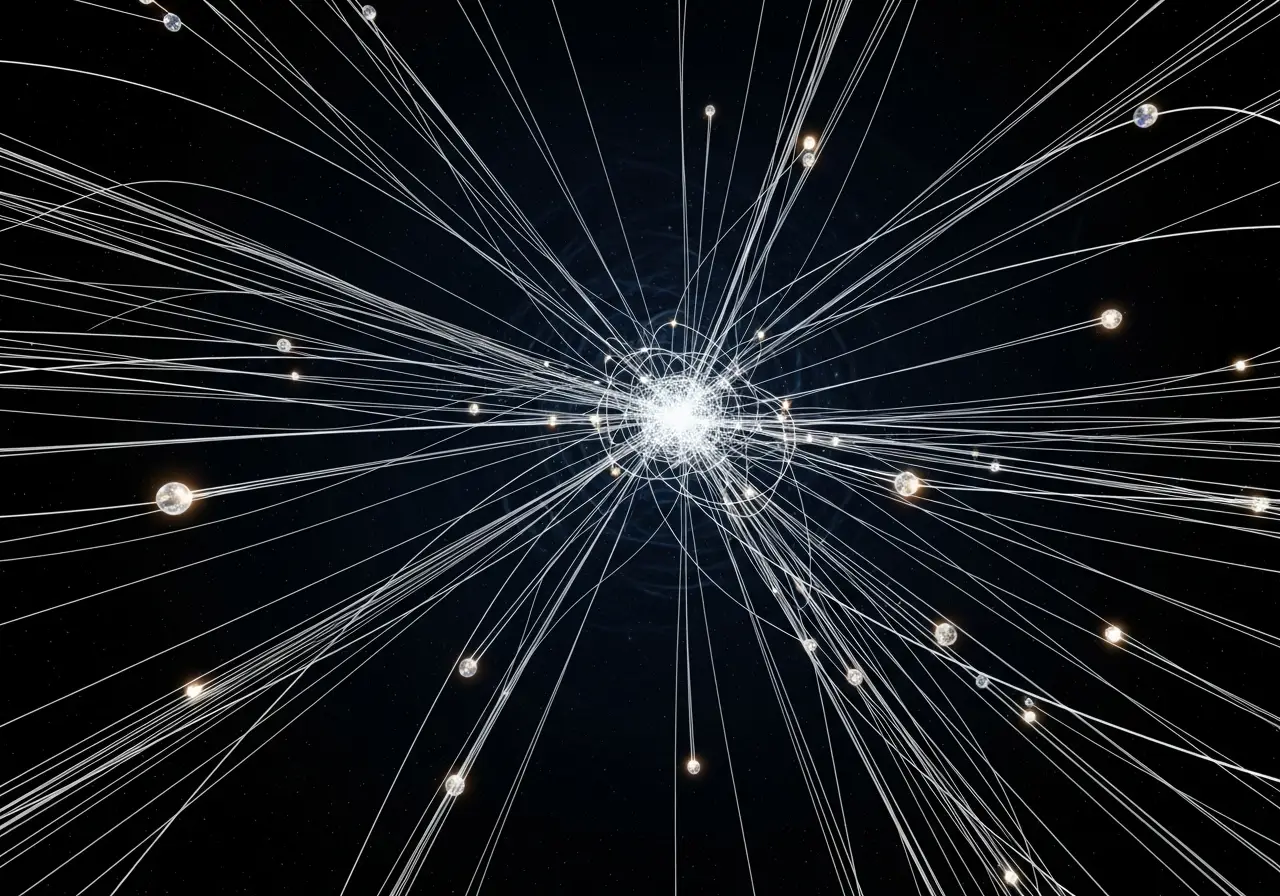

In a universe where every particle finds its path with precision, the Pilot Wave Theory introduces a captivating narrative that challenges the randomness often associated with the quantum world. This interpretation, also known as the De Broglie-Bohm Theory, provides an intricate vision of reality in which particles move along determined routes, guided by unseen pilot waves—a concept akin to a surfer navigating a wave with skill and purpose.
The theory reshapes our understanding of the quantum realm, moving us away from the idea of particles as erratic wanderers through probability. Instead, it paints them as graceful dancers, following preordained paths with coherence and intention. Imagine a grand cosmic ballet where every particle’s journey is meticulously plotted, each step synchronized in a vast, interconnected choreography.
Embedded within this theory are profound implications that challenge the foundations of quantum mechanics. It offers a compelling counter-narrative to the Copenhagen interpretation, suggesting that what appears chaotic at first glance often masks a deeper, elegant order. By examining these guided particle trajectories, we begin to question longstanding notions of quantum indeterminacy, entanglement, and even free will.
If we consider the role of pilot waves as motivators in the universe, the possibilities are vast. Harnessing these principles might revolutionize how we approach technology, scientific discovery, and perhaps even the nature of human consciousness. Could understanding these trajectories offer new insights into creating technologies that mirror the universe’s inherent elegance, or help us unlock the mysteries of the mind?
While pondering such grand concepts, it’s crucial to maintain a sense of balance and humor. In a universe that may be elegantly choreographed, everyday mishaps—like spilling coffee before a meeting—remind us that life’s unpredictability still finds its space. These moments, both graceful and chaotic, enrich our experience, much like the interplay between determinism and randomness enriches the cosmos.
Ultimately, the Pilot Wave Theory invites us to rethink our role in the universe. It suggests that, while we might operate within a grand structure of interconnected pathways, the essence of whimsy and spontaneity remains integral. As we delve into these quantum mysteries, we’re encouraged to embrace both the coherence and the delightful unpredictability of existence. The dance of life, with its ordered steps and unexpected stumbles, remains a testament to the beauty of our ever-evolving journey.