
It’s easy to get lost in the noise of quantum computing hype. But the real challenge is wresting useful computation out of the noisy NISQ devices we have *now*. If you’re serious about leveraging quantum advantage *today*, you need to be talking about topological quantum error correction—not as a distant dream, but as a concrete strategy to bridge the chasm between quantum hype and hardware reality.
Topological Quantum Error Correction: More Than Future-Proofing
The prevailing narrative often frames topological quantum error correction (TQEC) as a future-proofing necessity. However, focusing solely on its role in achieving full error correction misses a critical, immediate application: its power as a sophisticated quantum error mitigation strategy for today’s noisy intermediate-scale quantum (NISQ) devices. We’re not talking about a minor tweak; we’re talking about fundamentally reshaping how we approach programming these temperamental beasts.
Topological Corrections: Adapting for the Workshop
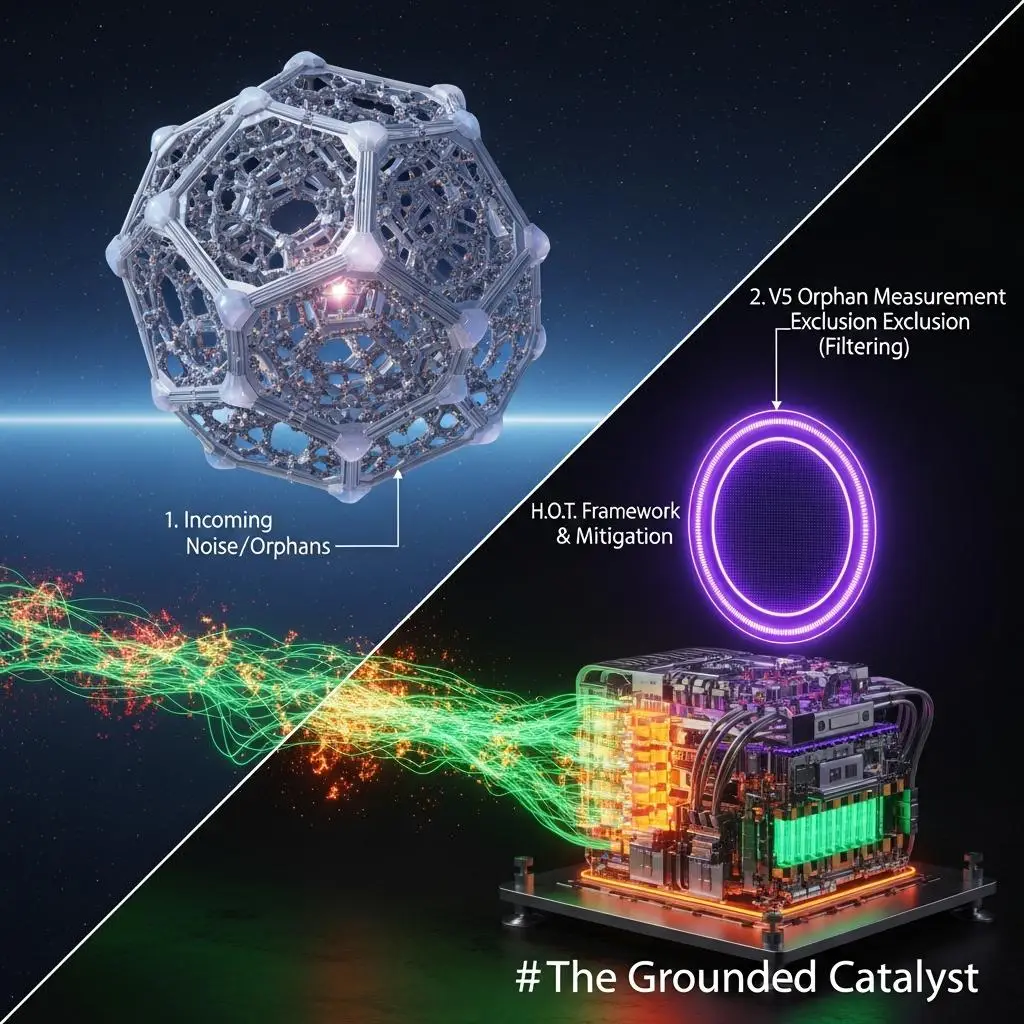
Think of it like this: instead of waiting for a perfectly insulated lab, we’re learning to perform sensitive experiments in a bustling, slightly chaotic workshop. The noise isn’t just accepted; it’s actively managed through clever design. The inherent redundancy and non-local encoding of quantum information within TQEC frameworks can be repurposed to significantly improve the fidelity of computations on current hardware, even without full logical qubits.
Topological Corrections: Group Operations and Error Mitigation
We apply this foundation to demonstrating non-trivial Elliptic Curve Discrete Logarithm Problem (ECDLP) instances. We’re implementing Shor-style period finding over elliptic curve groups. The critical innovation lies in mapping these group operations onto our recursively-geometric, error-mitigated gate patterns. We can reconstruct the hidden period from surviving, higher-fidelity data. We can resolve ECDLP instances on current devices that appear “beyond reach” using standard resource estimates and conventional noise models.
Topological Error Correction: Practical Innovations Today
This isn’t about waiting for logical qubits; it’s about extending the practical boundaries of what today’s hardware can achieve through sophisticated quantum programming.
For More Check Out