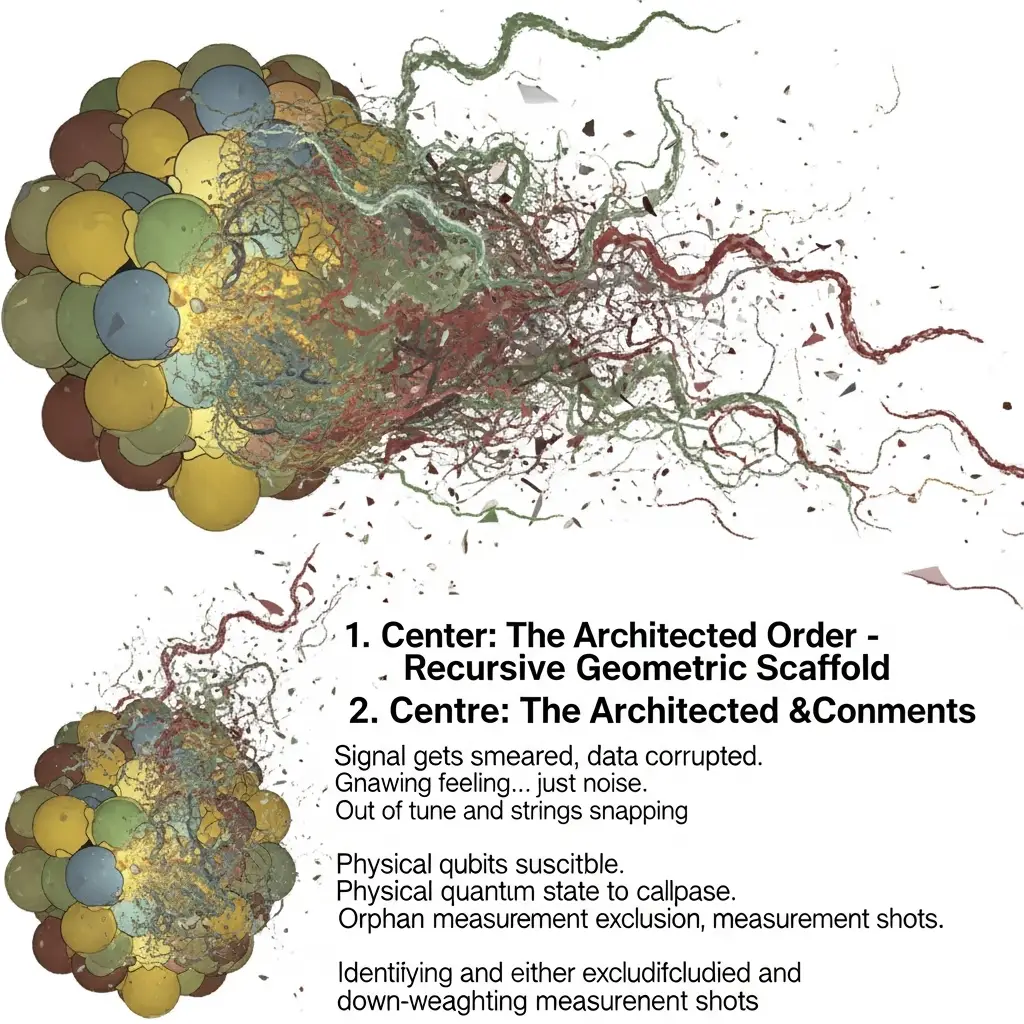

You’re staring at your NISQ processor, right? The one that’s supposed to be doing *something* useful by 2025, not just burning electricity. But then you hit the wall – not a roadmap wall, but a raw hardware wall. The moment you try to run anything beyond a trivial circuit, the signal gets smeared, the data corrupted.
Quantum Noise and Error Correction: The Gritty Reality
Forget the holographic atom animations and the Silicon Valley pixie dust. The real quantum revolution isn’t a distant glimmer on a whiteboard; it’s happening in the grit, grime, and frankly, the sheer stubbornness of getting today’s hardware to *work*. We’re talking about the Operational Technology, the under-the-hood magic that turns theoretical algorithms into actual, measurable results on devices that, let’s be honest, are more like temperamental toddlers than fully formed logical processors. This is for the engineers and physicists who understand that a qubit isn’t a Platonic ideal; it’s a physical entity susceptible to everything from thermal fluctuations to stray magnetic fields.
Navigating Quantum Noise with Purpose-Built Error Correction
Our approach at Firebringer Quantum is to bypass the “wait and see” mentality. We’re not building for tomorrow’s perfect quantum computer; we’re extracting utility from the imperfect machines of today. This means treating the NISQ era not as a preliminary stage, but as the primary battlefield. We’ve developed H.O.T. (Hardware Optimized Techniques) architecture that acts as a specialized operating system for this noisy hardware. It’s about engineering solutions at the gate level, understanding the specific quirks of each processor, and essentially coaxing it into performing tasks it was never theoretically designed for.
Quantum Noise Resilience Through Intelligent Error Correction
By wrapping these ECDLP algorithms in our V5 measurement discipline, we’re able to reject anomalous shots and reconstruct the hidden period from higher-fidelity surviving data. The outcome is that we can resolve ECDLP instances on current devices that appear “beyond reach” under standard resource estimates—estimates that assume flat circuits, no sophisticated measurement logic, and naive noise models. This shows that by focusing on geometry, recursion, and intelligent measurement, we can effectively extend the practical boundary of what today’s quantum hardware can achieve.
Engineered Capability in the Face of Quantum Noise and Error Correction
The transition isn’t a switch to be flipped in 2025; it’s a process of engineered capability, built by those who understand that the future of quantum computing lies in its present, messy, and wonderfully complex reality.
For More Check Out