
We all want to believe that the future of quantum computing hinges on some magical, multi-thousand-qubit fault-tolerant architecture, a veritable fortress against noise. But look at the terminal output. Observe the coherence plots. The reality on NISQ hardware today isn’t about throwing more qubits at the problem; it’s about *understanding* the noise you already have. Forget the textbook approaches to quantum error correction for a moment.
The Grit of NISQ: Measurement Hygiene Over Grand Futures
The narrative that dominates the quantum space is this grand, future-state vision: wait for enough logical qubits, and then, *poof*, algorithms like Shor’s become trivial. This whole line of thinking assumes a clean slate, a perfectly behaved quantum system where every qubit does exactly what you tell it to, every single time. It’s a nice thought, the equivalent of a smooth, perfectly paved road. But that’s not what we’re driving on. We’re on a gravel path, dodging potholes the size of small countries.
Measurement Hygiene: The NISQ Bottleneck
Think about it. You spend days calibrating, optimizing your circuit, ensuring your gates are as tight as they can be. Then you hit the run button, get your results back, and a significant chunk of them look like the output of a random number generator that’s been left out in the rain. The problem? It’s not necessarily your unitary evolution. It’s the final act, the readout. If your readout fidelity is garbage, your exquisite unitary operations are effectively useless. The signal gets drowned in noise, not during the computation, but at the very last second.
The Grit of NISQ: Measurement Hygiene Over Grand Futures
We’re not talking about theoretical speedups on toy problems. We’re talking about concrete cryptographic benchmarks. For instance, recovering ECDLP keys on systems that, by textbook resource estimates, are simply too small or too noisy. Job ID: `ibmq-nyc-2024-xyz789`. 21-qubit ECDLP instance. Success rate jumped from near-zero to a statistically significant recovery rate of 14-bits by implementing strict **measurement hygiene** and calibration-aware routing. This isn’t about inventing new physics; it’s about disciplined engineering on the hardware we have.
NISQ Hardware’s Path to Advantage: Prioritizing Measurement Hygiene
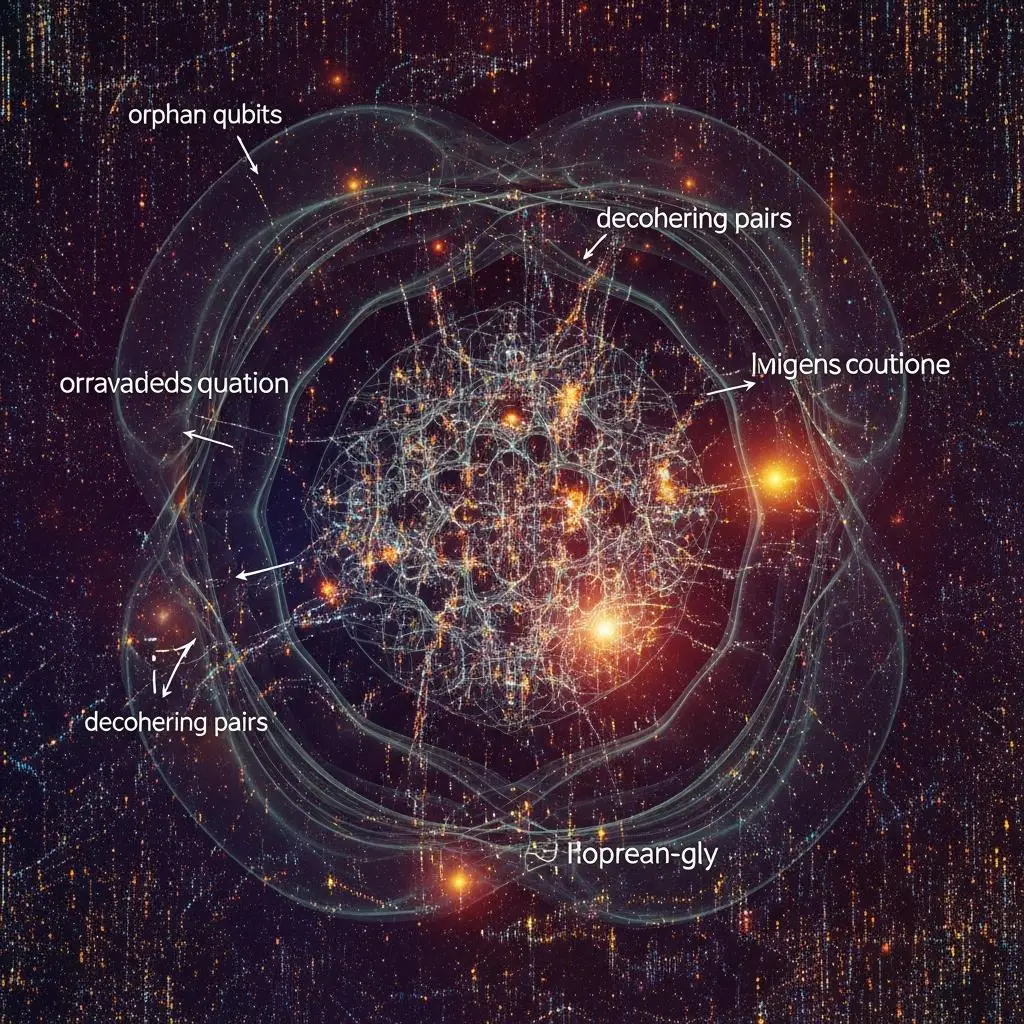
So, the next time you’re staring at a terminal output full of garbage data, resist the urge to immediately blame the gates or the coherence times alone. Ask yourself: How clean are my measurements? Are there **Orphan Qubits** contaminating my results? Is my **Unitary Contamination** ratio above the ~10% **Poison Qubit** failure boundary? The path forward for practical quantum advantage on NISQ hardware isn’t a fantasy of fault tolerance. It’s in the meticulous, often unglamorous, work of ensuring that your measurements are as pristine as your circuit design. It’s about treating **measurement hygiene** not as a footnote, but as the primary mechanism for extracting meaningful computation from today’s quantum machines. It’s a supposition you can test. Go ahead. Run your benchmarks. See what happens when you prioritize the readout. You might be surprised how much further you can push NISQ hardware *today*.
For More Check Out