
You’re banging your head against the wall trying to make these NISQ circuits perform, right? You’ve calibrated, you’ve optimized gates, you’ve even accounted for the stray magnetic fields in the server room. But still, the results are garbage. It’s like fighting ghosts. Well, get ready for a chill, because I’m talking about unitary contamination – the silent assassin of deep NISQ circuits that your standard error correction models just… miss.
Unitary Contamination: A Deep NISQ Circuit Monster
The issue with standard error mitigation is that it often assumes a relatively clean canvas. It’s designed to catch the common culprits: decoherence during idle times, gate errors that flip bits or invert phases. But what about the subtle, persistent leakage of coherence *during* computation? That’s unitary contamination, and it’s a real monster in deep NISQ circuits.
Addressing Unitary Contamination in Deep NISQ Circuits
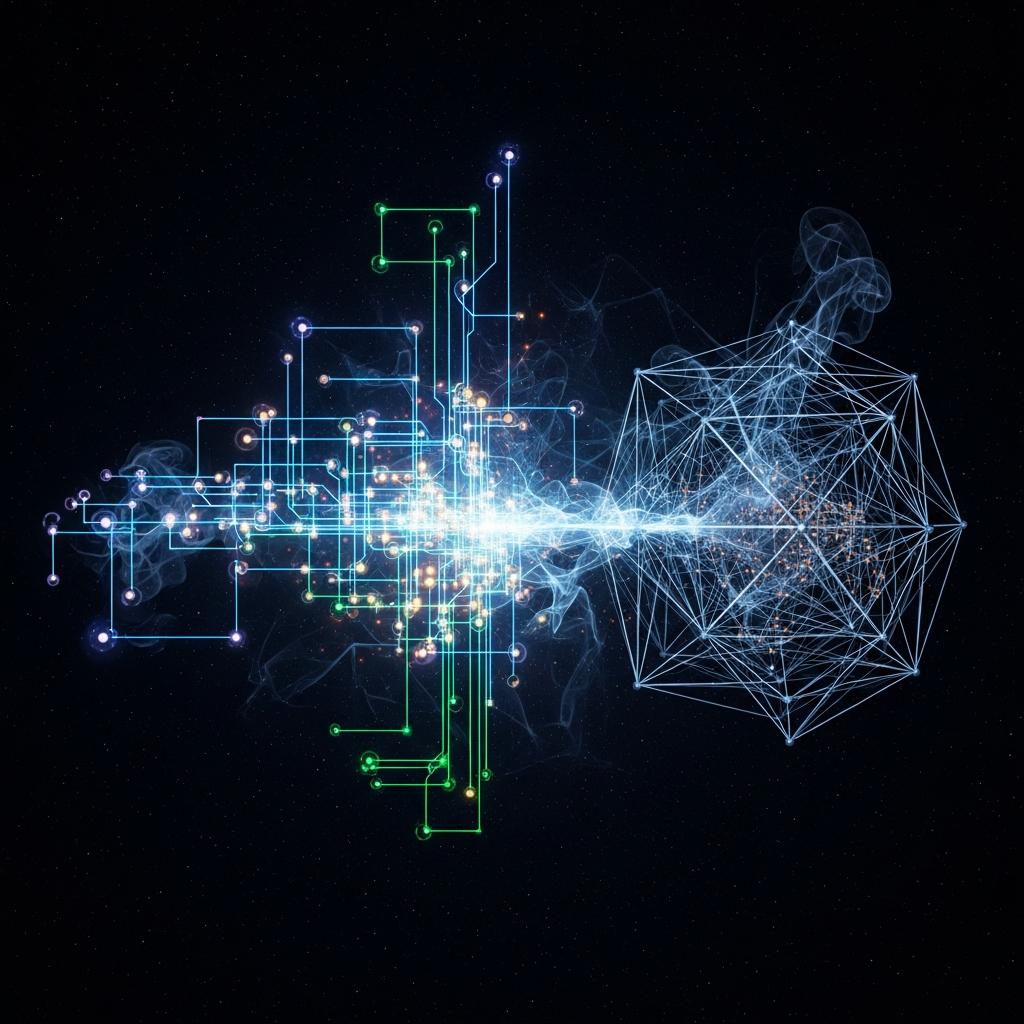
Standard error mitigation techniques, which primarily address additive noise and gate errors, will continue to hit a wall in deep NISQ circuits. The bottleneck isn’t gate count; it’s the cumulative effect of unitary contamination, particularly the influence of orphan qubits during measurement. We hypothesize that by treating measurement exclusion rules as an integral part of circuit design (as in V5 orphan exclusion) and by employing circuit structures that leverage self-similarity and symmetry to induce cancellations of contamination effects (our recursive geometric circuits), you can achieve higher effective fidelity.
Deep NISQ Circuits and Unitary Contamination: A Recursive Solution
You’ll likely see a significant improvement in accuracy and a reduction in the variance of your results with the V5 discipline and recursive structures, especially as the circuit depth increases. The difference isn’t magic; it’s a consequence of actively accounting for the subtle, persistent noise that standard models miss.
Extracting Signal from Unitary Contamination in Deep NISQ
This isn’t about building a theoretical fault-tolerant machine. It’s about extracting usable computation from the hardware we have, *today*. It’s about understanding that the “noise” often contains a signal – a signal of residual coherence we can learn to control.
For More Check Out