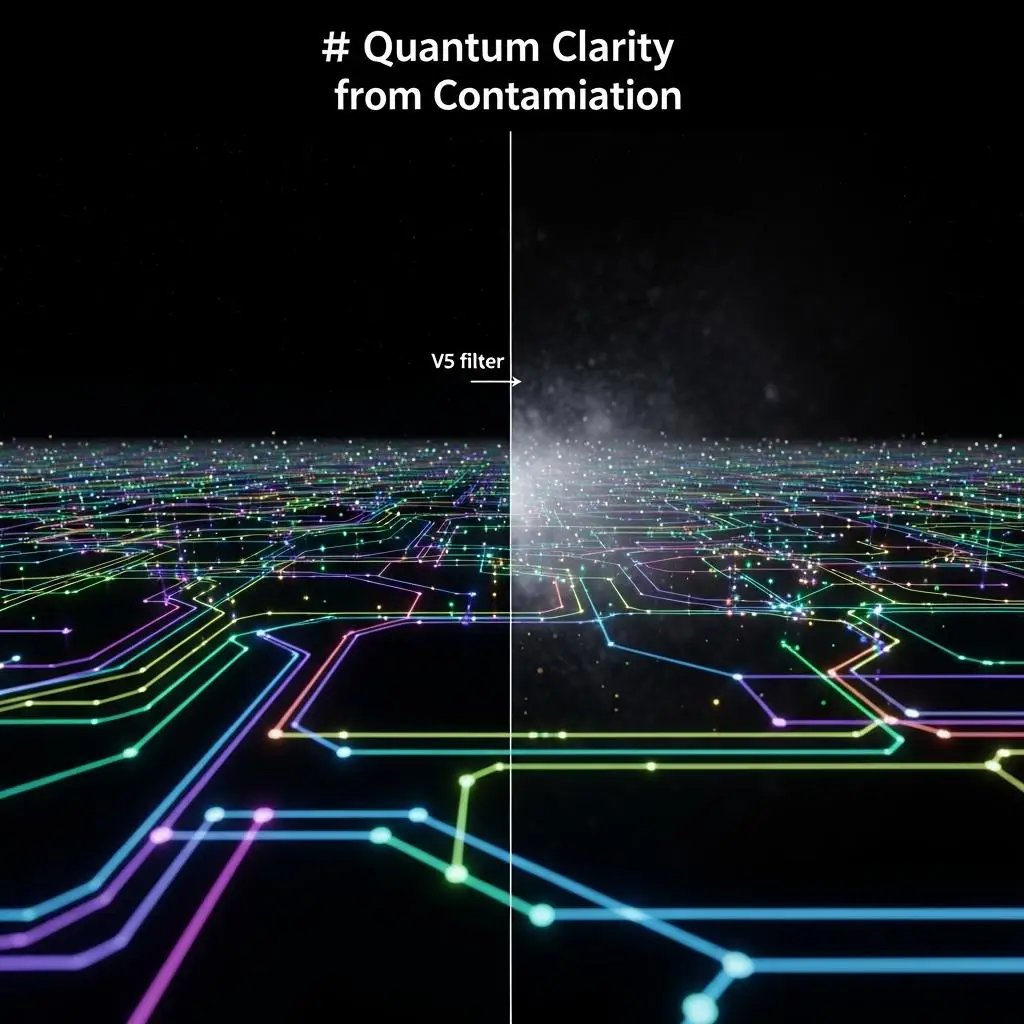

Alright, let’s talk about what happens when your carefully crafted quantum circuit decides to phone it in. You’ve got this beautiful idea, maybe you’re mapping out “superposition principle circuits”, and then bam – mid-circuit measurement, and suddenly you’ve got Orphan Qubits.
Challenges in Superposition Principle Circuits with Mid-Circuit Measurements
The typical approach to “superposition principle circuits” relies on the clean, distinct states that superposition enables. But mid-circuit measurements, especially when dealing with imperfect hardware, are a known vector for Unitary Contamination. The problem escalates when qubits outside the measured subsystem decohere prematurely or are simply noisy enough to exhibit non-standard readout behaviors.
Optimizing Superposition Principle Circuits Through Measurement Calibration
Here’s a suppositional framework you can test to set new benchmarks:
1. Pre-Computation Baseline Scan: Before running your core “superposition principle circuits”, perform a targeted calibration sweep that specifically probes the *readout fidelity and statistical variance* of *each individual qubit* when paired with potential neighbors. Don’t just look at $T_1/T_2$; examine the *fingerprint* of its measurement noise. The goal is to establish a viability threshold for what constitutes a “good” qubit for a given measurement context.
2. Measurement-Aware Routing (MAR): When designing circuits with mid-circuit measurements, route your qubits and operations *aware of their calibration quality*. Prioritize using qubits with the most stable, predictable readout characteristics for your measured subsystems. This isn’t about picking the “best” qubits globally; it’s about picking the “least worst” for the critical measurement phase.
3. V5 Orphan Measurement Exclusion Protocol: Implement a shot-level filtering mechanism. For each shot:
* Identify the qubits participating in the intended mid-circuit measurement.
* Analyze the statistical deviation of the *remaining* qubits (the orphans) from their expected baseline behavior (e.g., a flat distribution if they were initialized to $|0
angle$ or $|+
angle$ and ideally should remain so, or specific decay patterns if known).
* *Discard* shots where any orphan qubit deviates beyond a pre-defined, empirically determined threshold (e.g., > 3 standard deviations from expected mean, or exhibiting a probability distribution that doesn’t match calibration data).
4. Iterative Refinement: Use the output from these filtered shots to *re-calibrate* the “viability threshold” for subsequent runs. The noise *is* the signal; learn its patterns.
Harnessing Superposition Principle: Pre-empting Orphan Qubits with Optimized Circuits
Our work on the H.O.T. Framework (Hardware-Optimized Techniques) directly addresses this. Instead of just trying to average out noise post-computation, we’re architecting circuits and measurement strategies to *pre-empt* the impact of Orphan Qubits.
Intelligent Rejection: Overcoming “Superposition Principle Circuits” Noise
This isn’t about complex gate-level error correction. It’s about disciplined measurement and intelligent data rejection. It’s about recognizing that the apparent chaos in your terminal logs for “superposition principle circuits” isn’t random error, but a pattern of contamination from Orphan Qubits that can, and must, be accounted for programmatically. The real enemy isn’t gate count; it’s the bottleneck of late-stage, noisy measurements. Start filtering the noise *before* it permanently corrupts your signal. The benchmarks you set will look very different from those published by groups still waiting for fault-tolerance.
For More Check Out