
You’ve heard the buzzwords, seen the projections, and probably spent hours wrestling with phantom errors that just don’t add up. That nagging feeling that your carefully crafted quantum circuits are being sabotaged by something you can’t quite pin down? Yeah, that’s the mystery quantum noise elimination problem, and it’s been plaguing us all.
The Orphan Qubit Mystery: A Quantum Noise Elimination Quandary
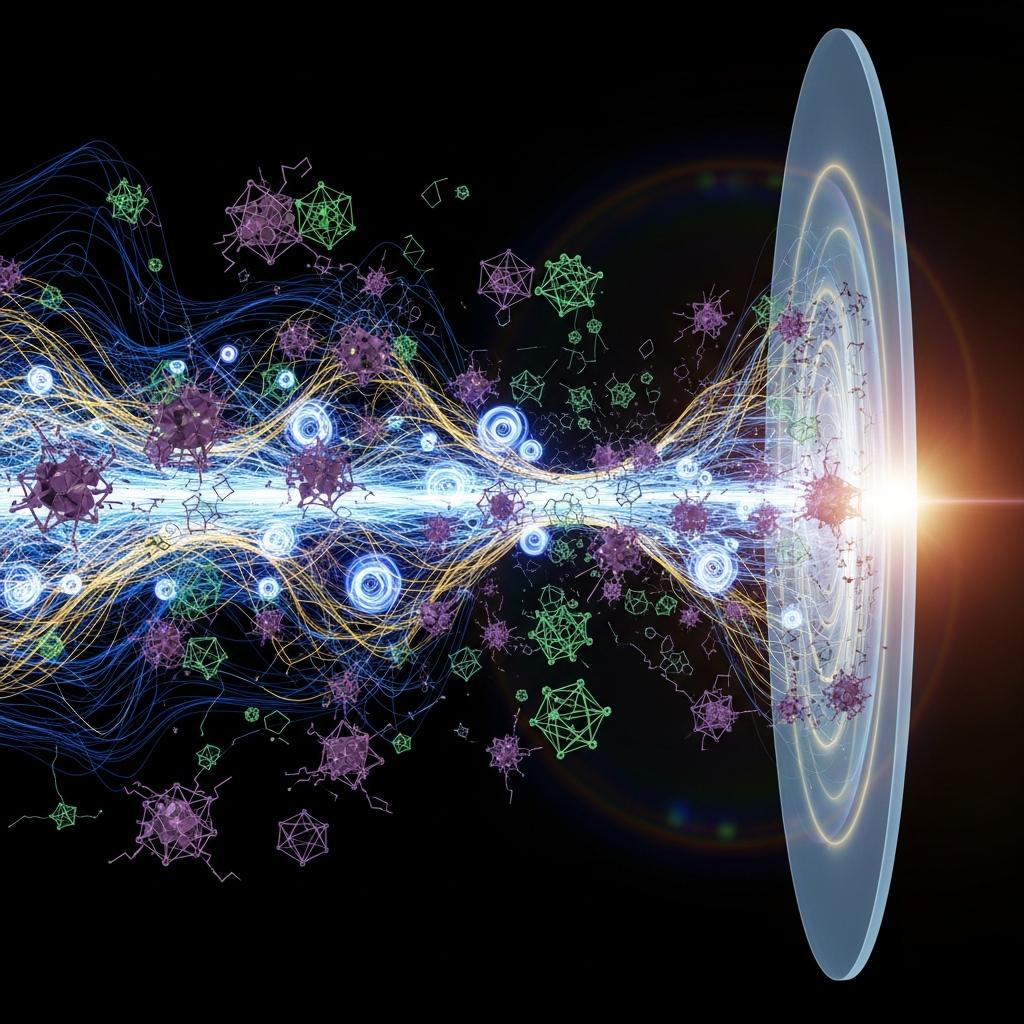
The core of the mystery quantum noise elimination problem, as we’ve seen it, isn’t necessarily gate infidelity on its own. It’s the *contamination* of your valid computations by the behavior of a small, but significant, fraction of your qubits. We’ve termed these problematic qubits ‘orphan qubits’. They’re the ones sitting outside the primary unitary operation, or worse, those exhibiting severe decoherence ($T_1/T_2$ ratios that make them functionally useless) but are still nominally part of the circuit execution.
The Mystery of Quantum Noise Elimination: A V5 Tactic
Our H.O.T. Framework, particularly the V5 measurement discipline, tackles this head-on. Instead of trying to meticulously correct for every single bit of unitary contamination from every potential source, we’ve implemented a straightforward principle: If a qubit’s measurement statistics deviate significantly from the expected stabilizer structure for a given circuit, we *exclude* it. Plain and simple.
Quantum Mystery: Noise Elimination via Orphan Ratio
Notice the “Orphan Exclusion Ratio.” That’s the signal. We’re seeing consistently that by filtering out shots where more than, say, 10% of the qubits exhibit this “poison qubit” behavior, we’re effectively filtering out the bulk of the noise that would otherwise corrupt the measurement. This isn’t about *fixing* the poison qubits; it’s about *isolating* your computation from their influence.
Unmasking Quantum Noise: The Mystery of the Poisoned Qubit
So, the next time you’re staring at a job log filled with inexplicable noise, before you dive into the weeds of elaborate error correction codes or blame the compiler, consider this: are your results being drowned out by a handful of poison qubits? And if so, can you simply choose not to listen to them? The evidence suggests you can, and the payoff is a significant leap forward in practical quantum computation, today.
For More Check Out