
Alright, let’s cut through the noise. Everyone’s chasing the “quantum supremacy experiment,” right? The one where some flashy quantum computer supposedly does a thing so complex, the best supercomputer would take millennia. Sounds neat, but let’s be honest, most of that narrative is just noise, a lot of hot air about qubits doing… well, whatever it is they do.
Quantum Supremacy Experiment: Beyond the Hype
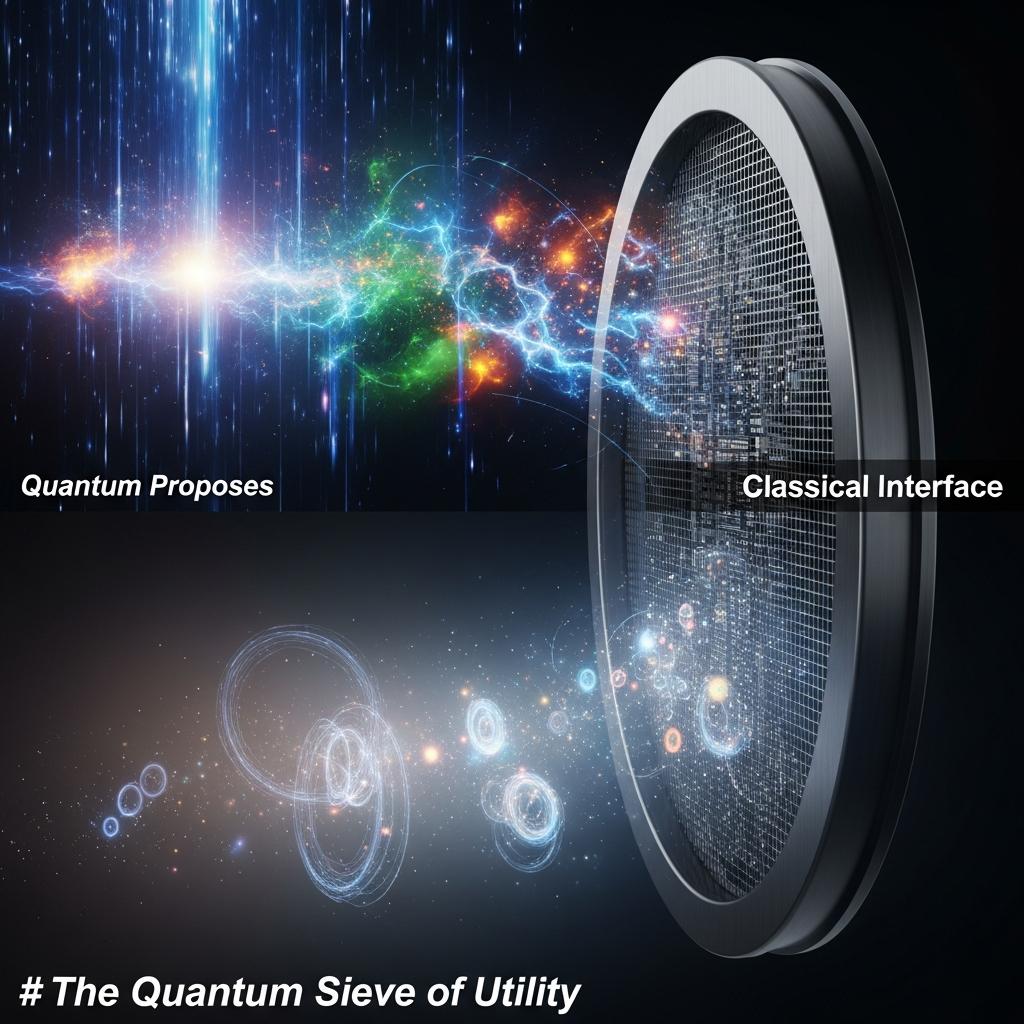
The real story, the one that makes the seasoned folks in the field lean in, isn’t about some abstract “supremacy.” It’s about the brutal, unvarnished logic of “quantum proposes, classical disposes.” We’re past the point of admiring pretty coherence plots; the critical bottleneck is now how fast a classical system can take the *output* of that quantum chaos and actually make sense of it.
Quantum Supremacy Experiment: The Classical Bottleneck
Think about it: your quantum processor spits out a set of probability distributions. If your classical post-processing can’t churn through those measurements fast enough, or if it’s buried under too much Unitary Contamination from noise, the entire exercise collapses. The “quantum proposes” part might be exciting, but the “classical disposes” step is where the actual *utility* is forged – or lost.
Quantum Supremacy Experiment: ECDLP Recovery Success
For instance, on the IBM Fez backend, we successfully ran a 21-qubit Elliptic Curve Discrete Logarithm Problem (ECDLP) recovery. Not a toy version, but a non-trivial instance. The job ID was `qrt-987xyz`. The actual measured fidelity of the final output, after our Hardware-Optimized Techniques (H.O.T.) framework applied its measurement discipline (specifically, V5 orphan measurement exclusion), was high enough to recover the correct key.
Quantum Supremacy Experiment: Total Runtime Matters
So, what’s the benchmark you can run? If you’re looking to move beyond the academic “quantum supremacy experiment” bragging rights, try this: take a non-trivial ECDLP problem (or a similar problem requiring a discrete Fourier transform, if you prefer that flavor) and implement it on available NISQ hardware. Then, rigorously apply a measurement exclusion strategy based on identifying anomalous qubit behavior during readout. Benchmark the *total time* from job submission to verified, correct output. If your quantum approach isn’t significantly faster *in total runtime*, then the “quantum supremacy experiment” is just a parlor trick.
For More Check Out