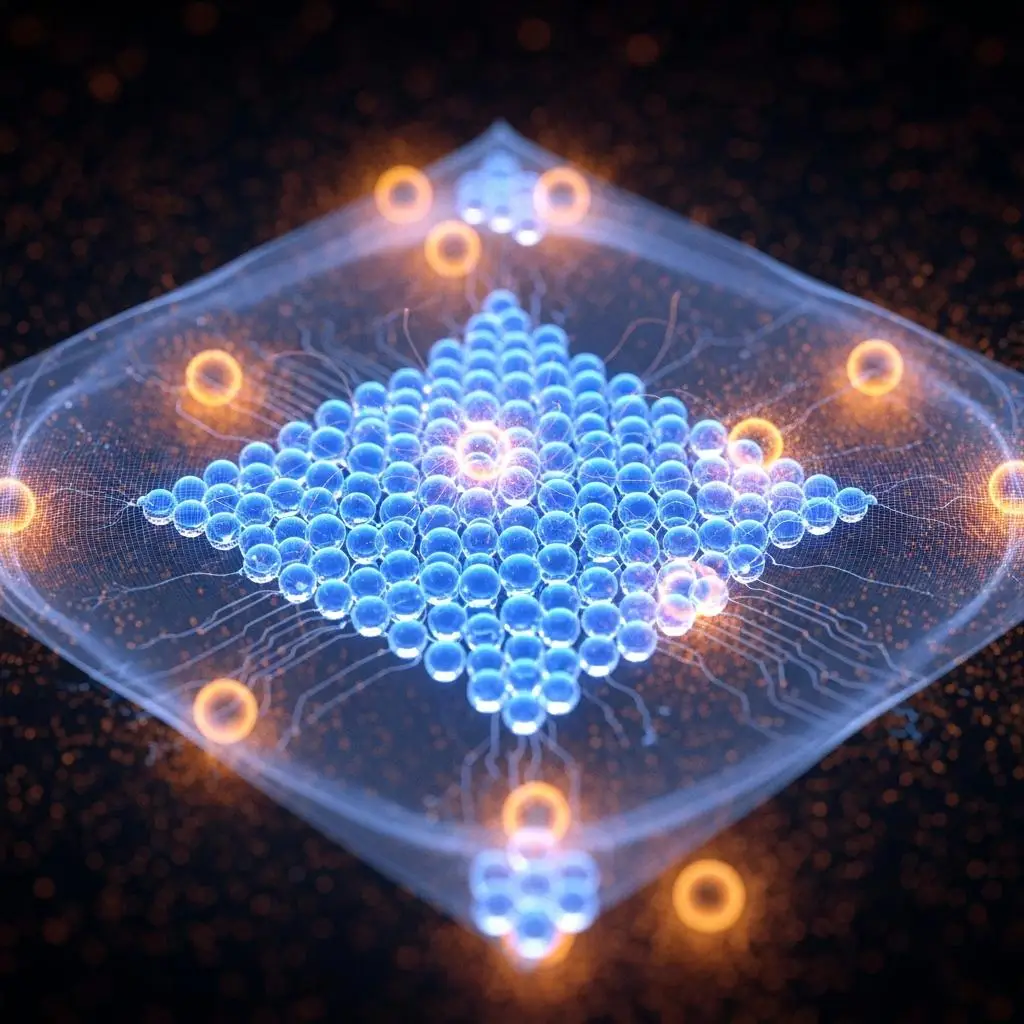

Alright, let’s get this down. Justin here, orange beard and all. Look, if you’re still mapping out your quantum strategy around fault-tolerant architectures and the mythical million-qubit machine, you’re probably staring down the wrong end of the telescope. We’re not talking about some far-off theoretical construct; we’re talking about leveraging the noise, *now*.
Topological Quantum Error Correction: Extracting Signal from NISQ Chaos
The real prize in this NISQ era isn’t building perfect qubits, it’s understanding how to extract signal from the chaos. Forget waiting for the perfect system; we’re seeing tangible business advantage by focusing on what’s actually possible today, even with the inherent imperfections. It’s about smart application, not just brute force scaling. Our approach, let’s call it the Hardware-Optimized Techniques (H.O.T.) Framework, isn’t about conjuring error-free states out of thin air. It’s about recognizing that noise isn’t just something to be fought; it’s a signal in itself.
Topological Qubits and Noise-Aware Circuit Design
Can you devise recursive geometric circuit patterns, tuned to a specific backend’s noise fingerprint, that embed computational primitives (like modular exponentiation or group operations) in a way that benefits from the *principles* of topological protection—distributed encoding and local error cancellation—even without true logical qubits? Can you then wrap these circuits in a measurement discipline that actively identifies and discards shots exhibiting *unitary contamination* from semi-collapsed qubits?
Topological Approaches to NISQ ECDLP Breakthroughs
We’re seeing results on 21-qubit ECDLP instances that would make the theorists blush, not because the hardware is suddenly flawless, but because our programming stack is designed to exploit its limitations. We’ve seen success on ECDLP instances with bit lengths of 14, achieving rank 535/1038 on specific hardware runs—a tangible demonstration that the boundary of what’s possible is much closer than the sliding presentations suggest.
Topological Strategies for NISQ Utility and ECDLP
If you can, you’re not just running quantum algorithms; you’re defining a new benchmark for NISQ utility. You’re demonstrating that the path to quantum advantage isn’t a distant highway of fault tolerance, but a series of challenging, yet solvable, detours through the noise-filled landscape of today. The real power isn’t in perfect qubits; it’s in programming the chaos. Run your benchmarks. Show us what your calibration-aware routing and noise-aware geometry can do. The terminal logs don’t lie, and frankly, neither do successful ECDLP recoveries. Let’s see what you can build.
For More Check Out