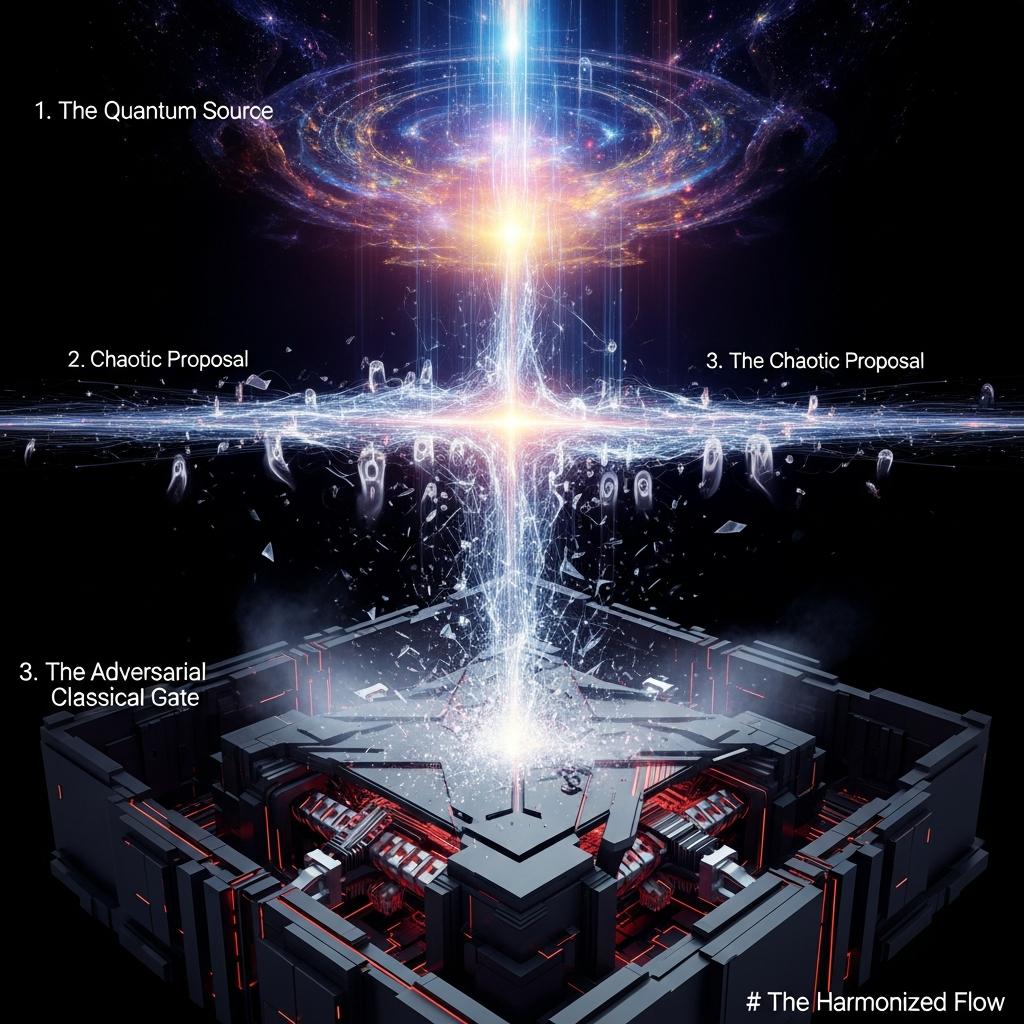

Everyone’s buzzing about quantum supremacy, but the real story isn’t about some abstract “first.” It’s about what happens *after* the qubits do their thing. The groundbreaking quantum supremacy experiment you might have heard about? For most practical applications, the real work, the actual *decision*, still happens in the classical realm.
Quantum Supremacy Experiment’s Readout Ambiguity
The issue isn’t necessarily that the quantum computer *failed* to execute the intended operations. It’s that the *readout* and subsequent classical interpretation often drowns the signal in noise—or worse, produces results that, while statistically *interesting*, don’t pass the rigorous classical sanity checks required for real-world problem-solving.
Quantum Experiment’s Expected vs. Actual Outputs
We’ve been operating under the assumption that if the quantum computer spits out a number, it *should* be the right one, or at least close enough for classical post-processing to salvage. But the reality on the hardware floor, say, debugging a 21-qubit ECDLP instance, tells a different story. The true challenge is building systems where the “classical dispose” stage is a mere formality, not a quantum execution-killer.
Quantum Supremacy Experiment’s Recursive Geometric Circuits
Consider the V5 orphan measurement exclusion. It’s not about fixing the hardware; it’s about building a smarter classical interpretation layer. The second layer involves using recursive geometric circuits. The third layer is applying this to concrete problems, like ECDLP. We’ve successfully recovered 21-qubit keys on IBM Fez, and yes, even a 14-bit ECDLP instance at rank 535/1038.
Rethinking the Quantum Supremacy Experiment’s Verification Challenge
So, what does this mean for the next quantum supremacy experiment? It means we need to stop treating the classical verification as an afterthought. The true benchmark isn’t just achieving a complex quantum computation, but achieving one where the output is immediately actionable. It’s about shifting the burden: making the quantum system’s output inherently trustworthy, thereby minimizing the classical decision logic’s adversarial role.
For More Check Out