
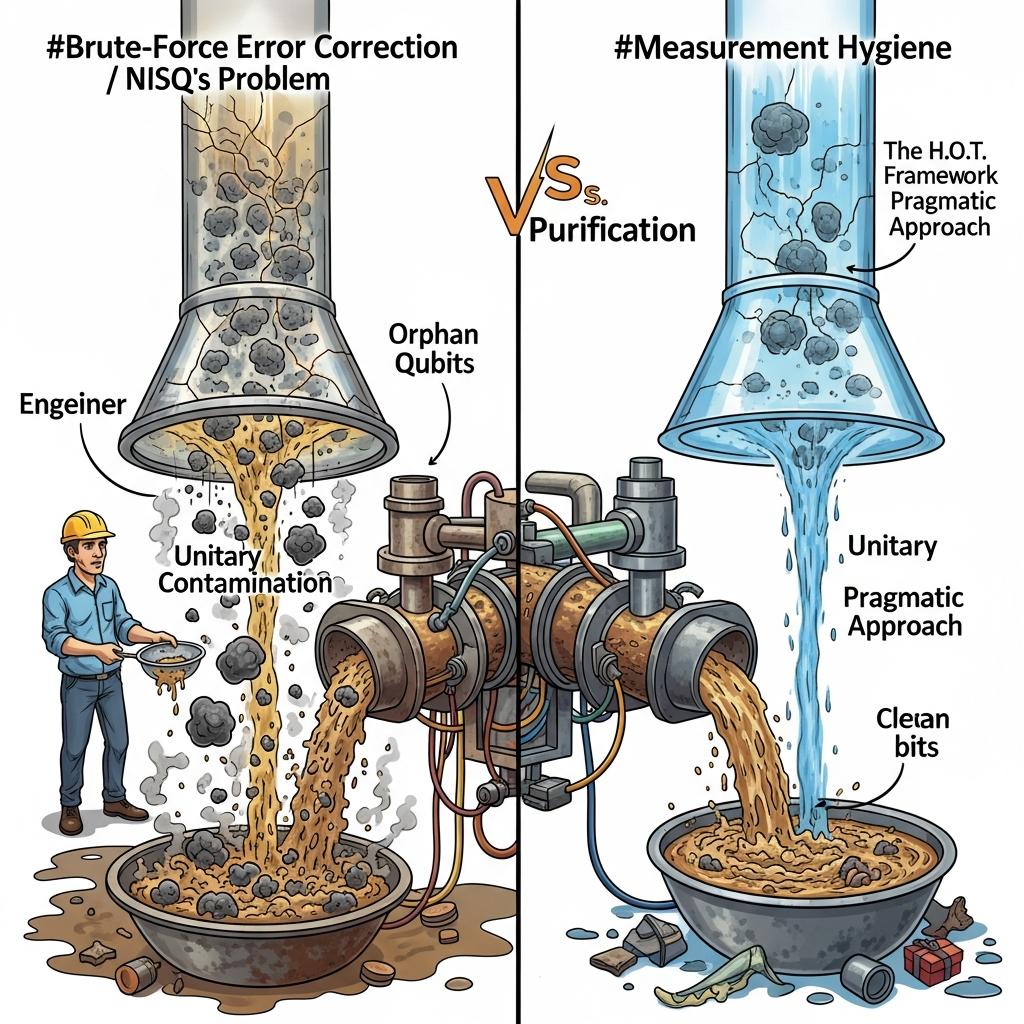

They’re selling you a bridge to a million-qubit future, but your immediate problem isn’t the number of qubits; it’s the junk you get back from the ones you *do* have. Forget the glossy slides promising fault-tolerance; the real battleground right now, on this brittle NISQ hardware, is what we’re calling measurement hygiene. You’ve got systems drowning in noise, and while some folks are still chasing theoretical error correction codes, we’re finding that meticulously cleaning up the readout—properly handling that Unitary Contamination—is the fastest, most direct path to actual, usable quantum advantage. Get this wrong, and your fancy algorithms are just spewing garbage, no matter how many cycles you throw at it.
Measurement Hygiene: A NISQ Hardware Bottleneck
The prevailing narrative: cram more qubits, apply more gates, and eventually, magic happens. It’s a seductive story, but it ignores a fundamental constraint of today’s hardware. The real enemy isn’t just decoherence *during* computation; it’s the garbage produced *at the end* by a cascade of imperfect measurements. We’re talking about the so-called “Orphan Qubits” – those that decohere early and bleed noise into the final readout, corrupting your signal. They’re not just dead weight; they actively poison the well of your results.
NISQ Measurement Hygiene: A Hardware Bottleneck
This is where the **H.O.T. Framework** comes in. We’ve been operating under the assumption that **Noise IS Signal**, but not in the way you might think. It’s not about some mystical interpretation of decoherence patterns. It’s about recognizing that not all noise is created equal. Some is inherent to the system’s baseline **Fingerprint**, and some is the direct consequence of corrupted states at readout. Our approach systematically separates the two.
NISQ Hardware: Prioritizing Measurement Hygiene
Our contention is that aggressive **measurement hygiene** applied *before* applying complex error-correction codes yields better practical results today. Why? Because it directly addresses the most immediate source of data corruption. By identifying and excluding shots exhibiting **Unitary Contamination** from Orphan Qubits, we effectively boost the SPAM fidelity without touching the hardware or attempting to stitch together fragile logical qubits. Think of it this way: you’re trying to build a solid structure on a shaky foundation. Would you spend all your resources reinforcing the foundation’s edges, or would you focus on ensuring the concrete you pour *at that moment* is as pure and well-mixed as possible?
NISQ Hardware: Rethinking Measurement Hygiene
The implication for anyone trying to push the boundaries of NISQ programming is clear: stop treating measurement as the final, often flawed, step. Treat it as an active, integral component of the quantum algorithm. Understand your backend’s **Fingerprint**, identify your **Poison Qubits** not as errors to be corrected, but as contaminants to be quarantined. The next time you look at a benchmark or a proposed algorithm, ask yourself: “How clean is the output?” Because without meticulous **measurement hygiene** on **NISQ hardware**, the most impressive circuit design is just an expensive way to generate noise. And that’s not a path to advantage; it’s a dead end.
For More Check Out