
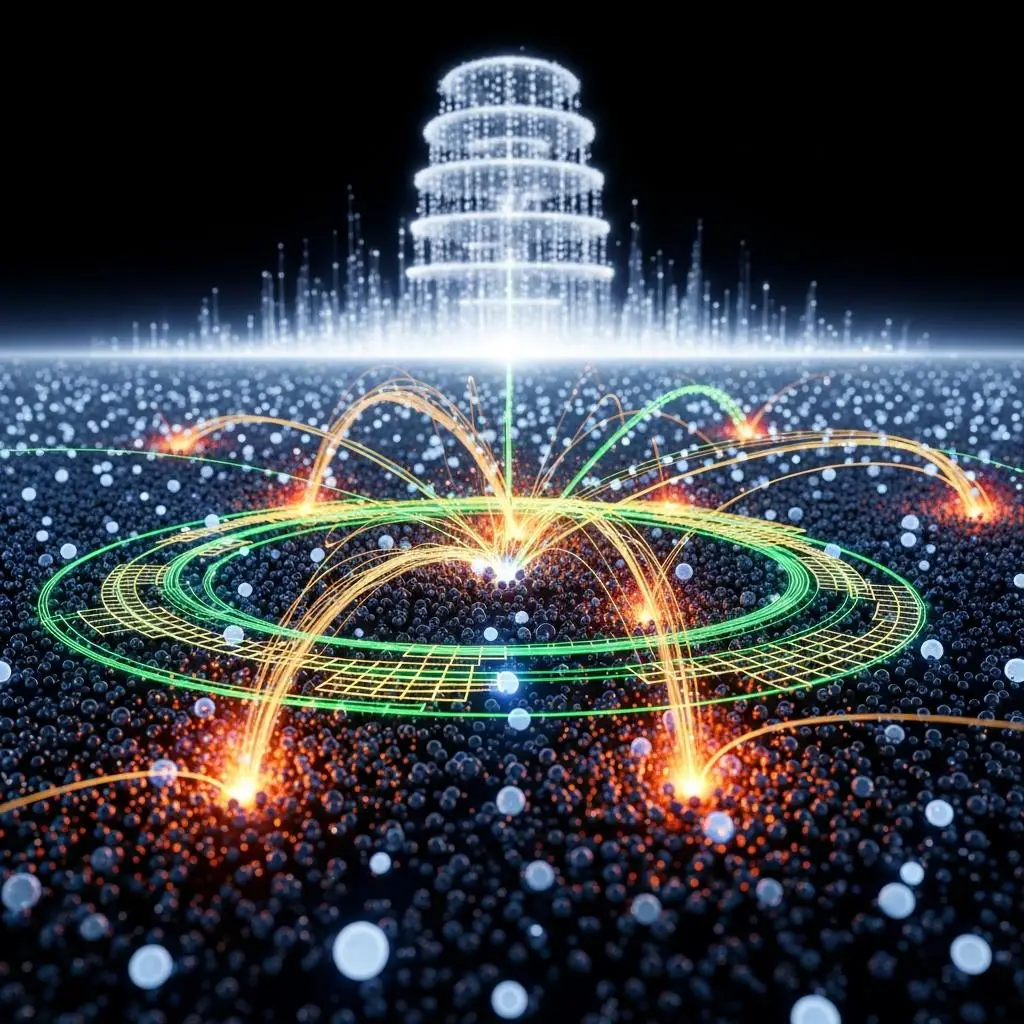

Fault-tolerant quantum computers with millions of qubits are great for presentations, but they’re mostly noise right now. Businesses need near-term advantages, not a decade-long wait. The focus should be on what can be achieved today with existing hardware, and not the distant future.
Topological Quantum Error Correction in the NISQ Era: Harnessing Noise with H.O.T.
The real opportunity lies in the NISQ era, where quantum error mitigation strategies can turn limitations into advantages. This involves exploiting the known imperfections of current hardware to achieve results that exceed theoretical expectations. A framework, Hardware-Optimized Techniques (H.O.T.), is introduced, built on the principle of using, not fighting, the noise.
Topological Approaches to Error-Free Quantum Computing: Leveraging Noise
The noise present isn’t simply an issue; it holds valuable information. By understanding the specific characteristics of a quantum computer’s backend, identifying faulty qubits (e.g., those with a ~10% or higher contamination ratio), and systematically excluding them during measurement, significant gains are possible. The V5 orphan measurement exclusion method is presented as an example of designing circuits and readouts with this strategy in mind.
Topological Quantum Error Correction: Routing Noise with Geometric Structures
The circuits that benefit from this discipline involve recursive geometric structures. This approach reduces errors and improves performance. Real cryptographic challenges, such as a 21-qubit ECDLP key recovery (Job ID `ibm-fez-2024-11b7a`) and a 14-bit ECDLP (rank 535/1038) have been successfully run on current hardware. Measurement latency is identified as the biggest challenge, not gate count. Through smart routing and multi-pass post-processing, usable signals can be extracted from what others discard.
Topological Approaches to Harnessing Imperfect Qubit Noise
The path to near-term quantum advantage is built on a deep, empirical understanding of hardware. It involves calibration-aware routing, noise-as-signal methodologies, and circuits designed to inherently cancel errors through their structure. Quantum programmers should stop waiting for the million-qubit dream and instead focus on mastering the art of programming the imperfect qubits available now. Implement V5 orphan exclusion and design a recursive circuit motif to understand what insights your ‘noise’ can provide.
For More Check Out