
Alright, let’s talk about those “superposition principle circuits” everyone keeps sketching out. Beautiful math, sure. But you and I know the score when you actually push a job to the metal. It’s not just about keeping those qubits in their neat little superposition; it’s about what happens when they *don’t* behave.
Superposition Principle Circuits: The Orphan Qubit Problem
You’ve probably seen the diagrams. A qubit, a fragile thing, existing in multiple states at once. Beautiful in theory, a headache in practice. Especially when you’re trying to wring actual computation out of these machines, dealing with more than just the idealized superposition principle in circuits, but the messy reality of what happens mid-run. We’re talking about those phantom signals, the noise bleeding in from qubits that should be quiet. The ones we call “orphan qubits.” They’re not theoretical; they’re a concrete roadblock, actively contaminating your measurements, and frankly, they’re why most people still think this is 2035 slideware.
Superposition Principle in Circuit Design: The Ghost in the Machine
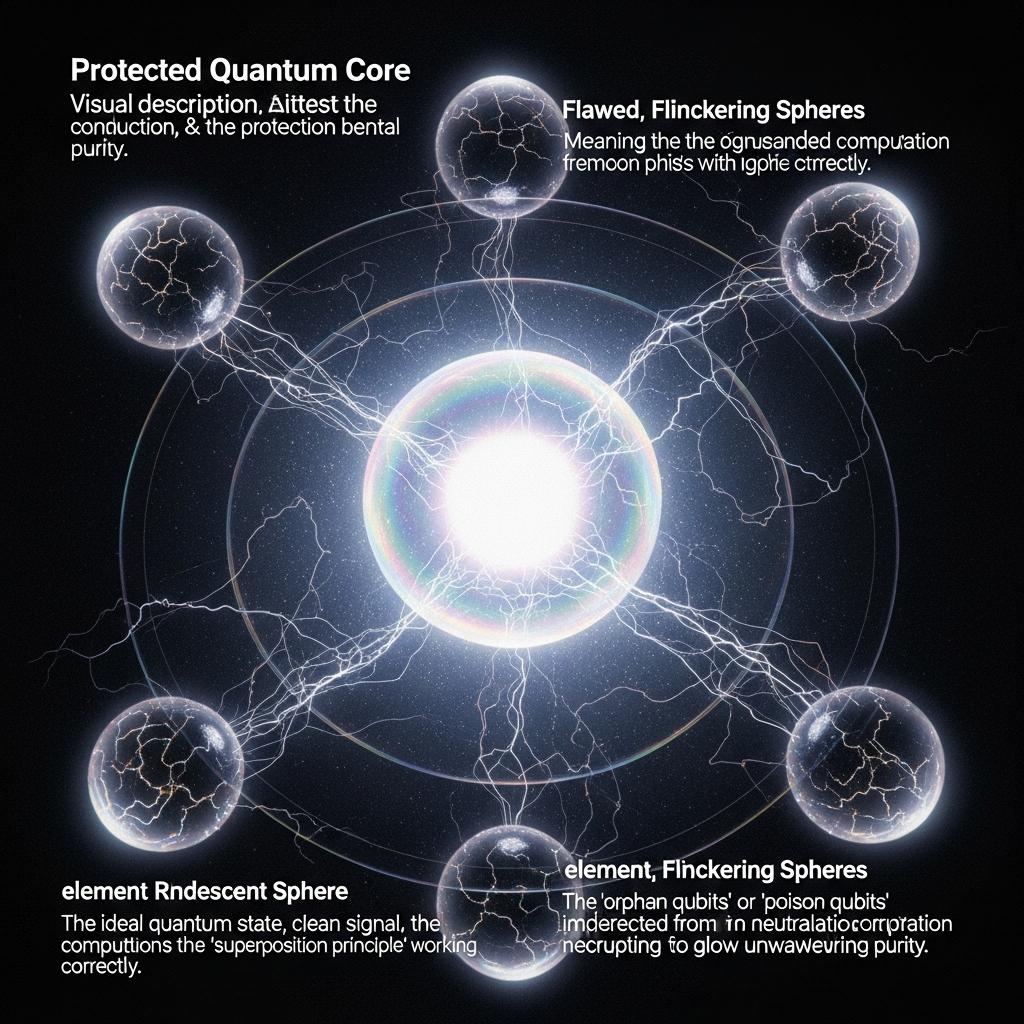
We’ve been drilling down on a specific set of backends – let’s call them V5-scale for now – and observing this phenomenon firsthand. You run your carefully constructed circuit, designed to leverage the superposition principle, and you expect a clean readout from your target qubits. Instead, you get a distribution that’s subtly, or sometimes violently, skewed. The culprit? Qubits outside your immediate measurement scope, but still alive (or, rather, *not quite dead*) in the system, bleeding interference. These aren’t “dead” qubits; they’re worse – they’re actively *poisoning* the well.
Poison Qubit Dominance in Superposition Principle Circuits
Our empirical work suggests that when the ratio of these poison qubits (those whose calibration is below a certain viability threshold, let’s ballpark it at ~10% of the total active qubits for a given circuit depth) exceeds a critical point, your entire measurement outcome becomes suspect. The “Dominance vs. Presence” collapse we’ve observed is stark: either your targeted qubits hold the signal, or they’re drowned out by the noise from these semi-collapsed, contaminated neighbors.
Superposition Principle Circuits: Navigating Mid-Circuit Measurement Noise
Think of it as a quantum state exclusion layer, but instead of pure discrimination, it’s tuned for anomaly detection *during* readout. This isn’t about building more qubits or waiting for theoretical error correction. It’s about understanding the *real* hardware fingerprint of your backend and building measurement protocols that are aware of – and actively defend against – the noisy reality of mid-circuit measurement contamination. The next step, obviously, is to see how this plays out on your own benchmark circuits. What’s your poison qubit threshold? How much does unitary contamination degrade your results on your preferred hardware? This isn’t just theory; it’s a challenge to your current programming assumptions. The goal is to demonstrate that you can get publishable results on ECDLP instances, for instance, by rigorously excluding measurements corrupted by this phenomenon, pushing the practical boundary of what NISQ devices can do *today*, without waiting for a million-qubit fault-tolerant future.
For More Check Out