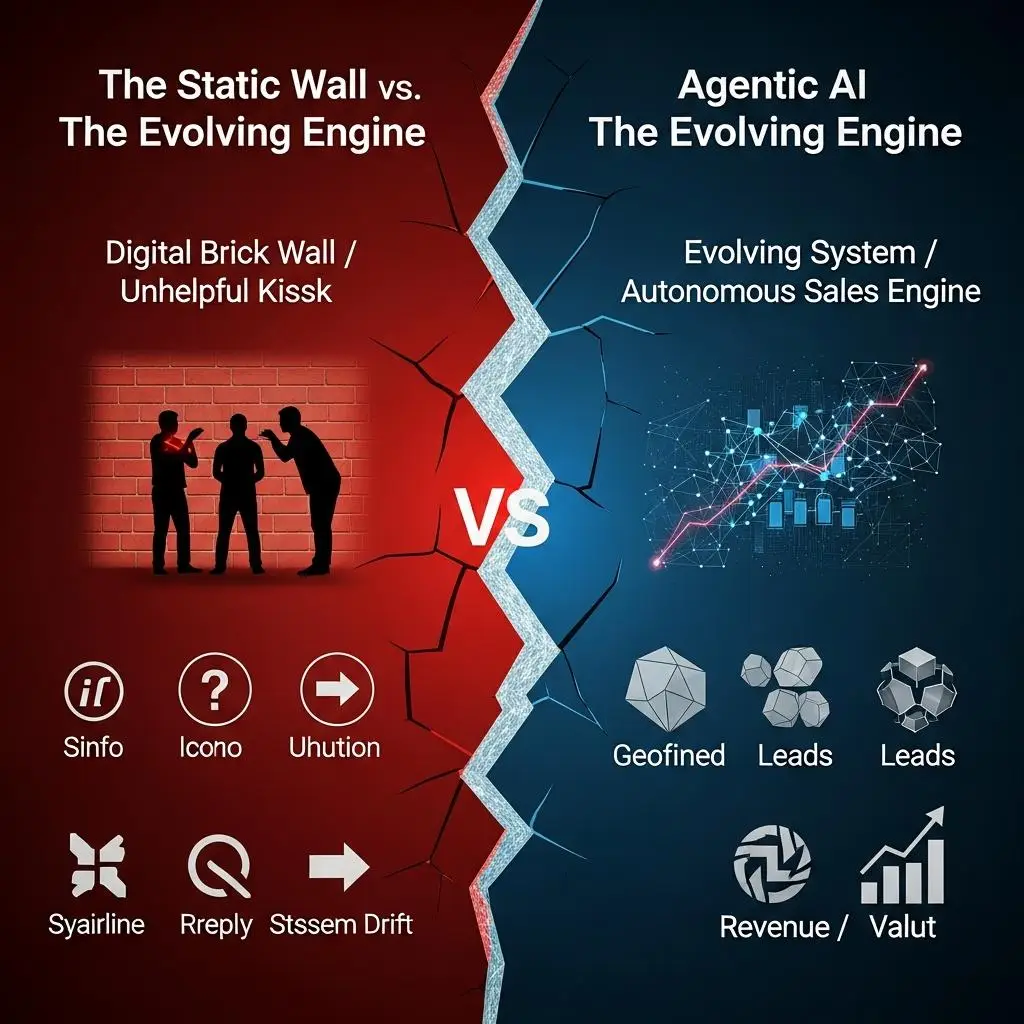

You’ve likely had conversations with chatbots that feel like talking to a particularly unhelpful kiosk attendant – polite, utterly predictable, and completely incapable of understanding what you *actually* need. The difference between agentic AI vs. traditional chatbots isn’t just academic; it’s the chasm separating a digital brick wall from an autonomous sales engine that operates with relentless precision. This is about architecting systems that actively pursue your business objectives.
Agentic AI vs. Traditional Chatbots: A Fundamental Difference
Traditional chatbots are excellent at retrieving pre-defined information based on specific keywords, but they are reactive tools, bound by the parameters of their training data and programmed conversational flows. They don’t *understand* your business goals; they *simulate* understanding based on pattern matching. Agentic AI, on the other hand, operates on a fundamentally different principle: intent, designed to pursue a goal and proactively identify potential leads.
Governing Agentic AI: Beyond the Chatbot Facade
The secret sauce here lies in understanding the underlying architecture: defining the objectives, establishing clear operational parameters, and implementing robust feedback loops. It’s not about finding a magical “agentic chatbot” off the shelf. We’re not just talking about a tool; we’re talking about designing a system. This requires a mindset shift: from *using* AI to *governing* AI within a revenue-generating framework. Think of what a Sales Engine can be for you.
Agentic AI: Elevating Sales Beyond Traditional Chatbot Limits
Agentic AI is engineered to maximize revenue throughput by consistently moving potential clients through your sales funnel. It can automatically segment leads, personalize outreach, and identify optimal follow-up times, all contributing to a higher conversion rate. It can adapt to variations, learn from its interactions, and generally operate with a higher degree of resilience. This is the foundation for an autonomous sales engine.
Agentic AI vs. Chatbot: Defining the Core Distinction
To begin building your autonomous sales engine, start by meticulously documenting your current sales process. Identify every step, from initial lead generation to final payment. Next, clearly define the primary objective. Finally, consider the “measurement discipline” aspect. It’s through this disciplined approach that you transform a chatbot into a truly autonomous revenue-generating asset.
For More Check Out