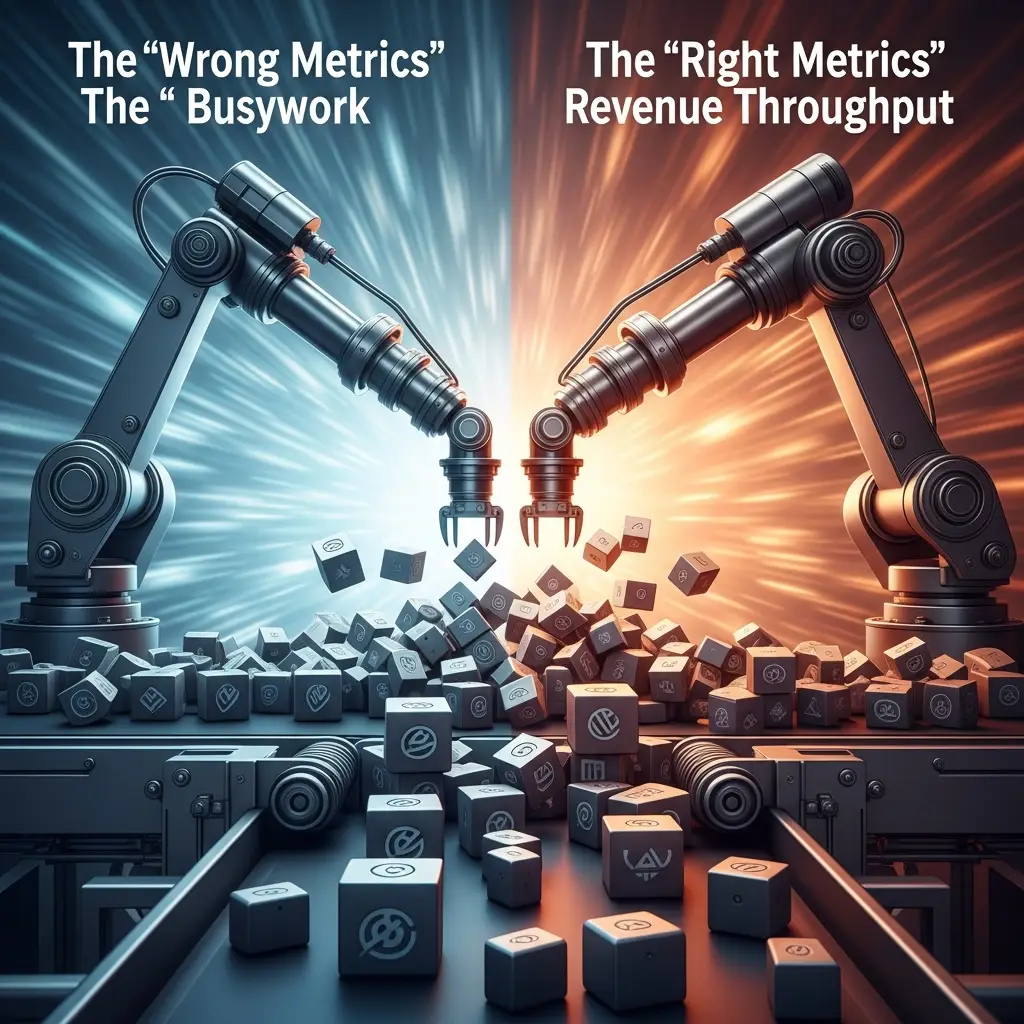

Break the piece, Forget the endless charts showing how much *faster* your team churns out tasks with AI. Most businesses are tracking the wrong AI productivity metrics, mistaking busywork for business impact. We’re talking about AI productivity metrics that track revenue impact, not just efficiency gains, and if you’re not looking at this, you’re essentially flying blind while your competitors build actual revenue engines. Imagine looking at a blueprint for a skyscraper and only measuring the speed of the nail gun – it misses the entire point, leaving you with a lot of hammers and no towering structure to show for it.
AI Productivity Metrics: Measuring Revenue Impact, Not Just Efficiency
This isn’t about getting a few more emails out the door. It’s about understanding how the AI tools you’re using, or considering, actually contribute to your bottom line. For us, the only metric that truly matters is **revenue throughput**: the actual amount of money flowing into your business, facilitated by your processes, including AI. It’s the difference between a hobby that eats time and a real, income-generating enterprise. If your AI isn’t directly or indirectly pushing more money into your bank account, it’s just an expensive distraction.
AI Productivity Metrics: Linking Output to Revenue, Not Just Speed
Think about it like this: you wouldn’t measure the “efficiency” of a baker by how fast they can crack an egg if the resulting cake is inedible. The goal is a sellable product that customers pay for. Similarly, if your AI is generating content that doesn’t convert, or automating tasks that don’t lead to sales, its “speed” is irrelevant. We need to shift our focus from the *process* of using AI to the *outcome* it generates. Are those AI-assisted proposals closing more deals? Is the AI-generated marketing copy bringing in more qualified leads? These are the tough, but crucial, questions.
AI Productivity Metrics: Quantifying Revenue Gains Beyond Mere Efficiency
So, how do we actually start measuring revenue throughput when it comes to AI? It begins by dissecting your existing client acquisition and delivery pipeline. Map out every single step, from initial lead generation to final invoice payment. Then, critically assess where AI can *meaningfully* impact these stages, not just speed them up. For instance, if you use AI to draft initial outreach emails, the relevant metric isn’t how many emails you send, but how many of those AI-assisted emails lead to discovery calls, and subsequently, to paid projects.
AI Productivity Metrics: Shifting Focus from Efficiency to Revenue Impact
Ultimately, this shift in perspective—from efficiency to revenue throughput—is not just about optimizing your current operations. It’s about building a resilient, revenue-generating machine that doesn’t depend on you being chained to your desk. It requires a disciplined approach, treating AI not as a magic wand, but as a powerful, albeit occasionally temperamental, tool that needs to be integrated into a system designed for growth.
For More Check Out