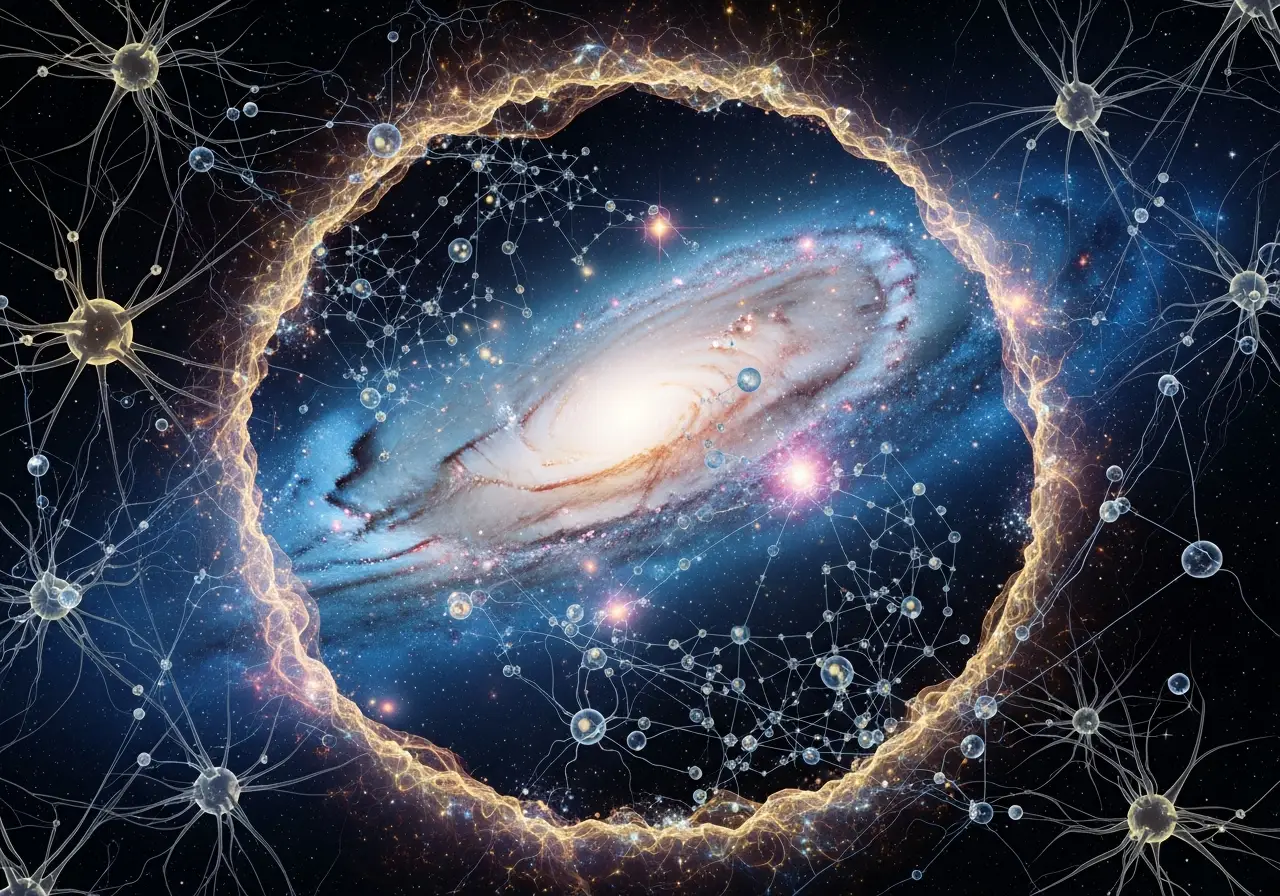

Imagine you’re standing on the brink of a vast expanse, an ocean of cosmic wonder where waves of limitless potential ripple beneath your feet. It’s enticing—this mysterious realm called quantum mechanics, where the dance of reality often feels like it teeters on the brink of chaos and order. Recent discoveries are nudging us toward considering an objective view of the universe—one that isn’t solely shaped by our observations.
Quantum mechanics has long intrigued both scientists and philosophers with its core paradox: the simple act of observing seems to impact the behavior of tiny particles. This insight has resulted in varying interpretations, often suggesting that our consciousness might be pivotal in shaping reality. But maybe it’s time to explore the notion of a universe with its own independent framework—a cosmos that follows its intrinsic tendencies, regardless of us watching or not.
One compelling narrative within this dialogue is the many-worlds interpretation. This theory suggests that each choice made manifests a new reality, like branches from an ever-growing tree, each branch existing independently of the others. It’s a bit like having a boundless collection of stories where each decision spins a fresh tale, uninfluenced by our presence.
There’s a delicious twist here, akin to the surprise of an unexpected flavor in a trusted dish. Recognizing quantum mechanics as objective doesn’t diminish our part; rather, it weaves our consciousness into the fabric of reality. Our thoughts and emotions ripple out, interacting with the grander field of existence, much like influencing outgoing tides.
Yet, this shift raises challenges. Our everyday experiences—concrete and tactile—seem irreconcilable with the abstract dance of quantum particles. Bridging this divide between quantum mechanics and classical physics might feel like melding stark contrasts, suggesting that more is happening beneath the surface than meets the eye.
The concept of quantum decoherence offers insight into how multiple potentials condense into singular, observable realities. When quantum states interact, they abandon their potential multiplicity for concrete outcomes. This speaks to an existence that marches forward on its own terms, independent of our witnessing.
Acknowledging a more objective reality invites us to ponder our connection to the cosmos in a fresh light. It offers the possibility of a universe governed by consistent truths, reassuring and grounded, and perhaps, with a hidden harmony amid the apparent tumult.
The shift toward recognizing an objective reality is stirring within the scientific sphere. As we refine understandings and embrace broader theories, a vital conversation begins—one that illuminates paths previously shrouded in ambiguity.
By accepting an objective framework, we recognize our consciousness plays its part—with every thought and intent weaving into the universe, contributing to the overarching symphony.
In embracing these insights, we embark on a transformative journey. The path forward is one of courage, exploration, and shared intent—marking an era where science aligns more closely with human experience. Together, we advance into the vast unknown, understanding that as we ponder the cosmos, we also define our place within it.