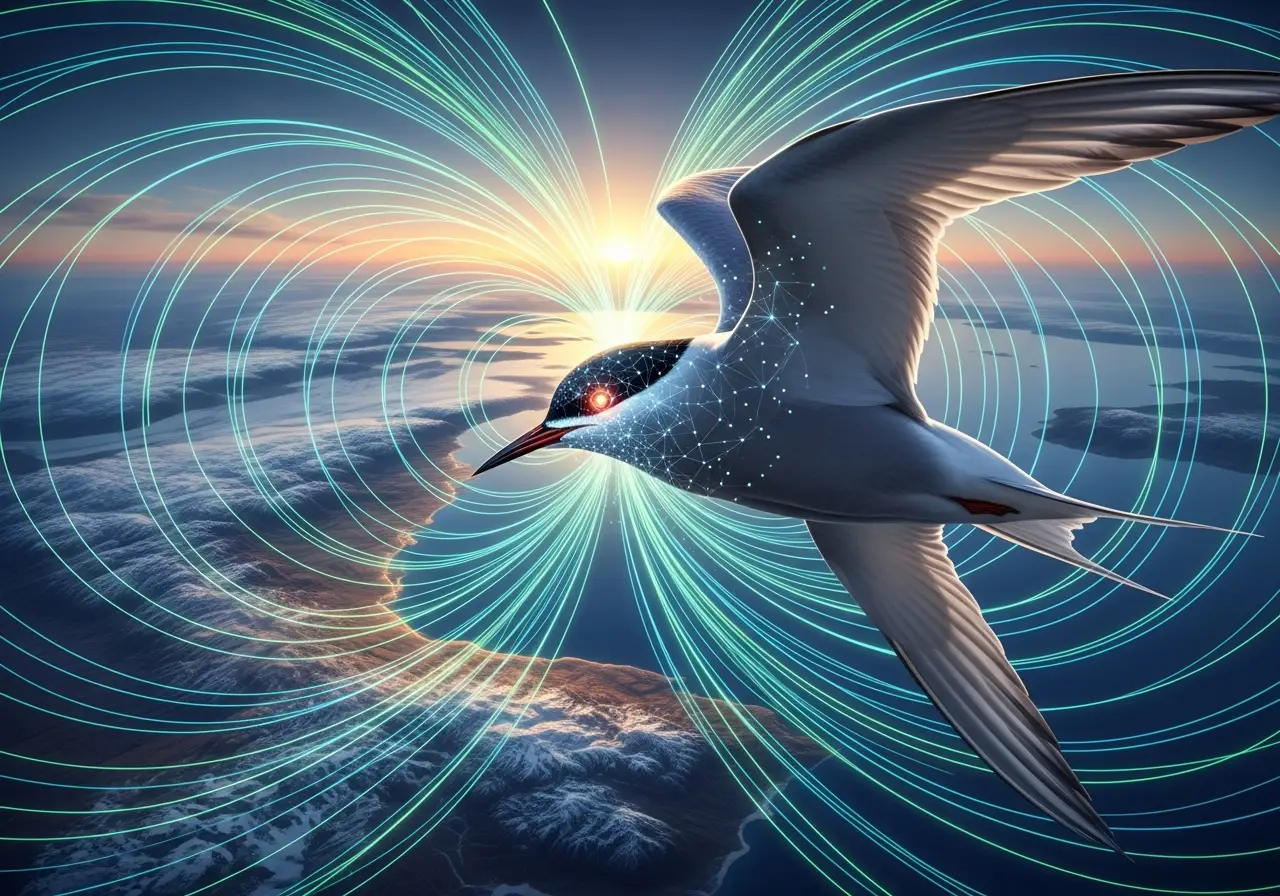

Imagine a bird gliding effortlessly across continents, guided not by our conventional tools but by an instinct deeply connected to Earth’s magnetic tapestry. This isn’t the realm of imagination—it’s a testament to nature’s complexity, demonstrated through the phenomenon of avian magnetoreception.
Birds possess a remarkable ability to detect magnetic fields, thanks in part to a molecule called cryptochrome in their retinas. Unlike anything you’d find in a typical science class, this molecule interacts with magnetic fields through quantum principles like entanglement and superposition. In simpler terms, when light energizes these molecules, electrons shift states, allowing birds to perceive navigation cues.
The magic happens through these electrons forming pairs that react to Earth’s magnetic field, sending neural signals to the brain—essentially coding a magnetic map inside their heads. This process, grounded in quantum coherence, enables birds to maintain orientation across vast distances. Think of it as having an inbuilt navigation system that’s more sophisticated than any high-end GPS.
Different species apply these tools in unique ways. The European Robin, for instance, combines magnetic navigation with visual landmarks, crafting detailed maps for migration. This multifaceted approach underscores how birds adapt their sensory abilities to their environment and experiences.
Beyond its mesmerizing nature, understanding avian magnetoreception holds broader ecological implications. As we observe shifting climates and increasing urbanization, insights into bird navigation could inform strategies for resilience, both in wildlife and potentially for human technology. Imagine developing innovations that harness these quantum principles for exploration without the need for traditional GPS systems.
In essence, bird navigation through magnetoreception offers a glimpse into quantum mechanics at play in everyday nature. It’s not just about understanding how birds find their way—it’s a celebration of the interconnectedness and intelligence of life, inviting us to explore the boundaries of science and technology inspired by nature’s ingenuity.