
Imagine a tiny world where diamonds do more than shine—they become keys to the mysteries of the universe. Within these sparkling gems, there are unique imperfections called Nitrogen-Vacancy (NV) centers. These tiny quirks, nestled within the diamond’s perfect structure, are far from ordinary. They’re bustling with potential, poised to shape technology in remarkable ways—from powering quantum computing to acting as highly sensitive sensors. Let’s explore this fascinating realm of diamond-based quantum systems, where the natural brilliance of diamonds intersects with groundbreaking science, unveiling a path that could reshape our technological landscape.
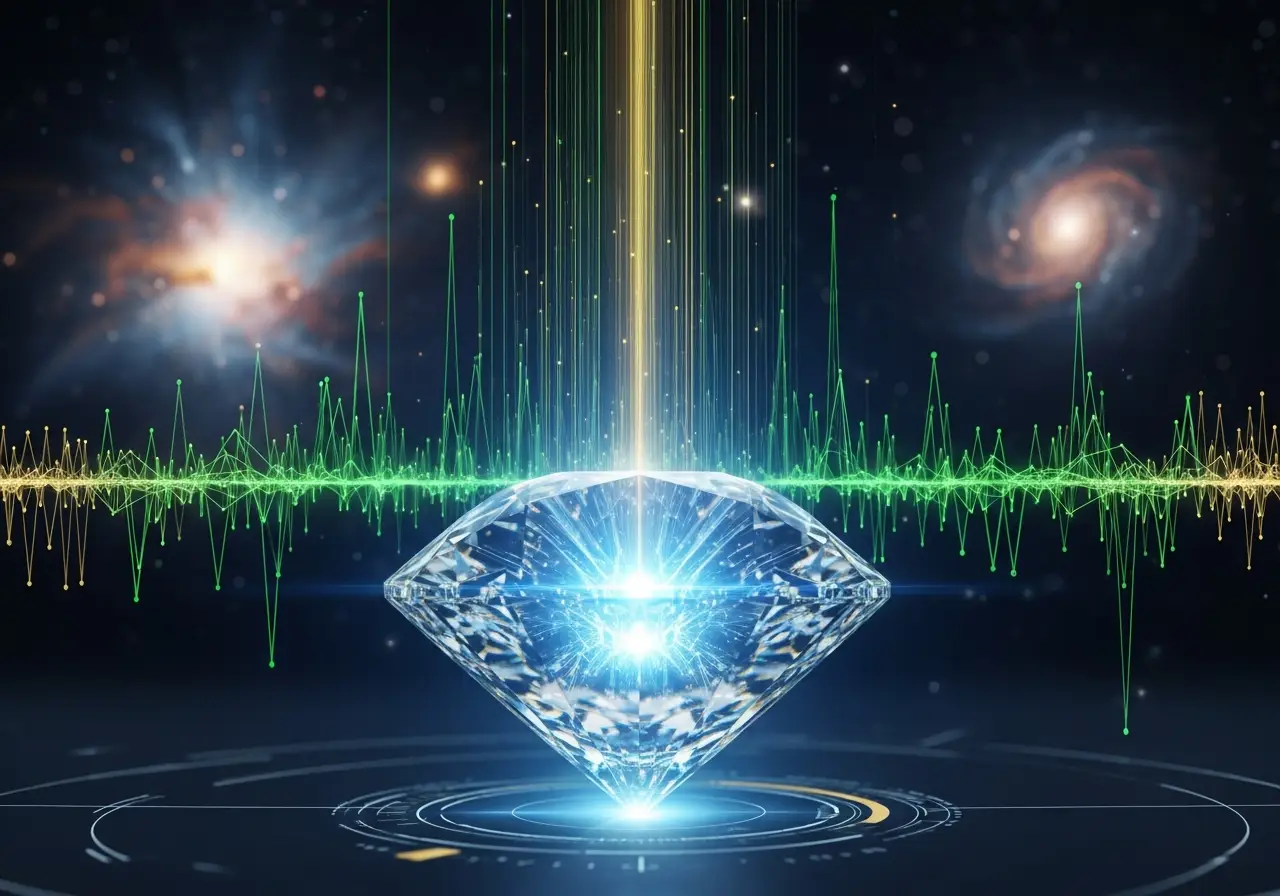
At the core of each NV center is a nitrogen atom standing in for a carbon atom in the diamond, creating an empty space next to it. While “vacancy” might suggest absence, in quantum terms, it’s a dance of energy and information—imagine it as a radiant spot that sends out streams of quantum light, capable of carrying information in extraordinary ways. These centers light up when exposed to illumination, releasing photons that reveal their quantum states. This enables them to act as exciting conduits for information, foreshadowing a future where communication across vast spaces becomes a tangible reality.
A standout feature of NV centers is their ability to maintain quantum coherence at room temperature, defying the typical need for ultra-cold environments that quantum phenomena usually demand. This makes them incredibly promising for practical uses, behaving as qubits for quantum computing and serving as finely-tuned sensors that can measure magnetic fields, temperature fluctuations, and electric fields with unprecedented precision. Envision a device that can analyze individual cells or track invisibly small particles—this isn’t science fiction, but a near-future possibility.
As researchers harness the power of NV centers, they are crafting systems where these diamond-based wonders could sustain networks of quantum computers, effortlessly sharing information irrespective of distance. This isn’t a mere theoretical possibility—studies have illustrated that arranging NV centers in certain configurations can exponentially expand their data-handling and transmission capacities, tracing complex patterns in real-time.
There’s a wide-ranging real-world impact too. Various industries, from healthcare to tech, are keenly observing as NV centers edge closer to practical applications. In medicine, they promise real-time biological analysis, allowing for disease detection at a cellular level. In technology, these quirk-filled diamonds are preparing to step into roles once held by classic diamonds—propelling us into a quantum-enabled future. NV centers are deciphering complex patterns, making them accessible and understandable.
Beyond their scientific allure, diamonds tell a deeper story. Formed under intense conditions far below the Earth’s surface, these gems evolve over millions of years, only to become tools unlocking new horizons. It’s poetic how these natural wonders transition from geological marvels to instruments of our technological future.
The road ahead is being paved with each new discovery, bringing us closer to merging the classical and quantum worlds. Whether it’s by providing instant computing power or extending our sensory capabilities beyond the physical, NV centers are redefining the limits of technology. They remind us that out of imperfections can emerge our most valuable assets—a lesson profound within the realm of quantum physics.
So next time you see that sparkle from a diamond, think beyond its beauty and imagine the universe of possibilities shimmering inside. As NV centers shape the future, they offer more than just scientific advances—they invite you on a journey to explore and discover. Keep curious and remember that in the dance of these diamond defects lies a future rich with potential and promise.