
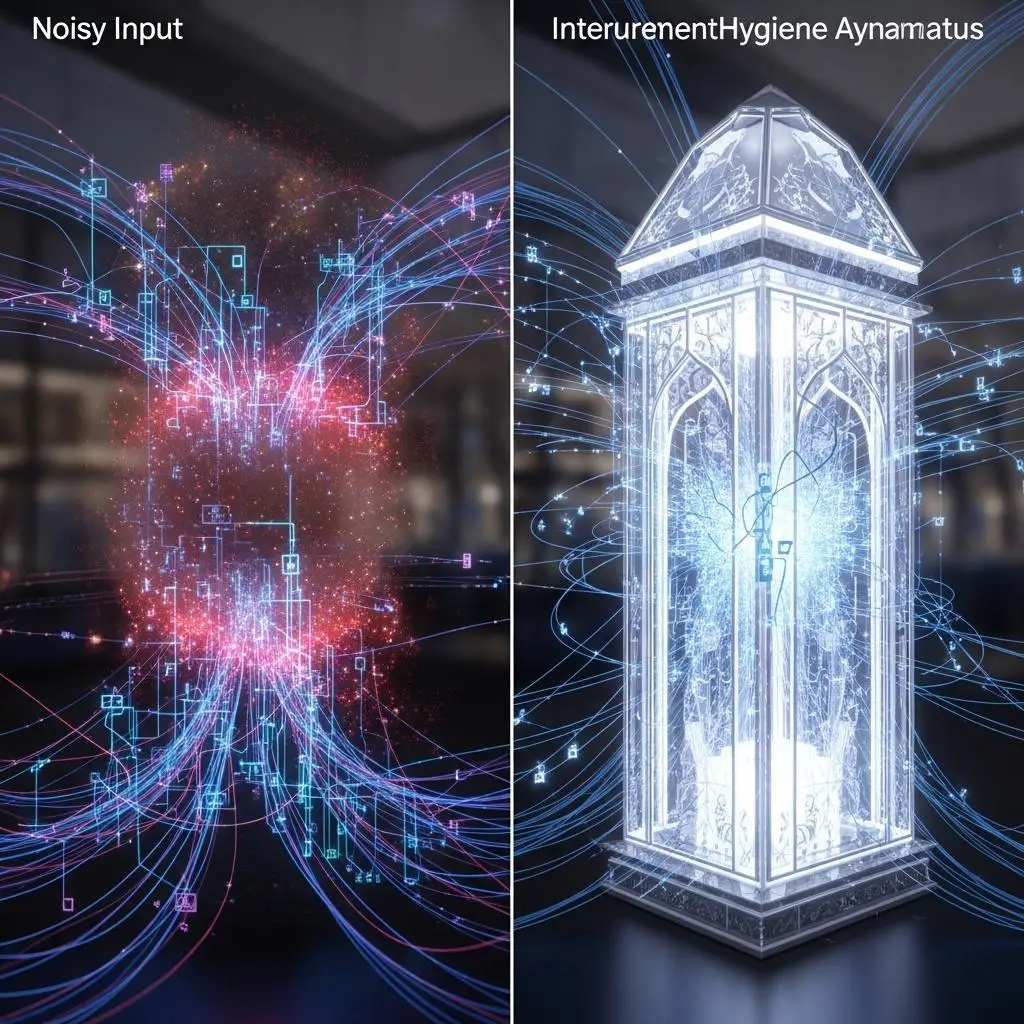

Alright, let’s talk about what’s actually happening on the metal, not just in the slide decks. Forget chasing fault tolerance on your whiteboard. The real action, the stuff that actually *moves the needle* on current NISQ hardware, isn’t about building bigger, more theoretical error-corrected codes that are years from silicon. It’s about obsessing over the plumbing.
Measurement Hygiene on NISQ Hardware
We’re talking about **measurement hygiene**, the gritty, often-overlooked details that turn noisy readout into usable signal. While everyone else dreams of millions of qubits, we’re extracting meaningful results *today* by understanding that the bottleneck isn’t gate count, it’s the signal contamination leaking out of your measurement apparatus. Here’s the deal: you’re not going to crack nontrivial ECDLP instances by brute-forcing error correction. The math just doesn’t hold up when you factor in the reality of *your* specific backend’s fingerprint. Instead, consider this a pragmatic framework for extracting value *now*: embrace **measurement hygiene** on NISQ hardware.
Measurement’s Grim Reality on NISQ Hardware
Think about it. You’ve got this beautiful, intricate circuit laid out. You’ve spent days (or weeks) optimizing gate placements, calibrating your coherence times, maybe even playing with recursive geometric circuits to eke out some coherent cancellations. And then you hit the measurement stage. This is where the rubber meets the road, and frankly, it’s where most of your hard-won quantum state goes to die. The problem isn’t just simple bit flips or gate errors. It’s the insidious **unitary contamination** from those neighbor qubits that are *almost* collapsed, the “poison qubits” whose $T_1/T_2$ are just… bad.
Enhancing NISQ Hardware Through Measurement Hygiene
So, what’s the alternative to throwing more hardware (which you don’t have) at the problem? It’s what we’re calling **measurement hygiene**. This isn’t about generic data cleaning; it’s about embedding intelligence *into the measurement process itself*. Consider the V5 orphan measurement exclusion. This isn’t an afterthought; it’s a first-class circuit construct. We identify shots where a small subset of qubits is throwing statistical curveballs – deviations that don’t align with the expected stabilizer structure. We then actively exclude or down-weight those problematic shots *before* they poison your inference.
NISQ Hardware: The Power of Measurement Hygiene
Try this: implement an ECDLP instance using a noise-robust, Regev-inspired construction. Map the elliptic curve operations onto your recursively-geometric circuits, but then, crucially, wrap the *entire* algorithm in a V5-style measurement discipline. You’ll start seeing ECDLP instances resolved on hardware that benchmarks suggest is years away from handling them. The takeaway? Stop treating your measurement apparatus as a black box that spits out numbers. Treat it as an integral, and often compromised, part of your quantum algorithm. Until we have large-scale, fault-tolerant machines, understanding and actively managing your measurement outcomes—your **measurement hygiene**—is the most direct path to achieving meaningful results on NISQ hardware. It’s the difference between chasing a theoretical ghost and actually running code that yields a correct answer. Go benchmark it.
For More Check Out