
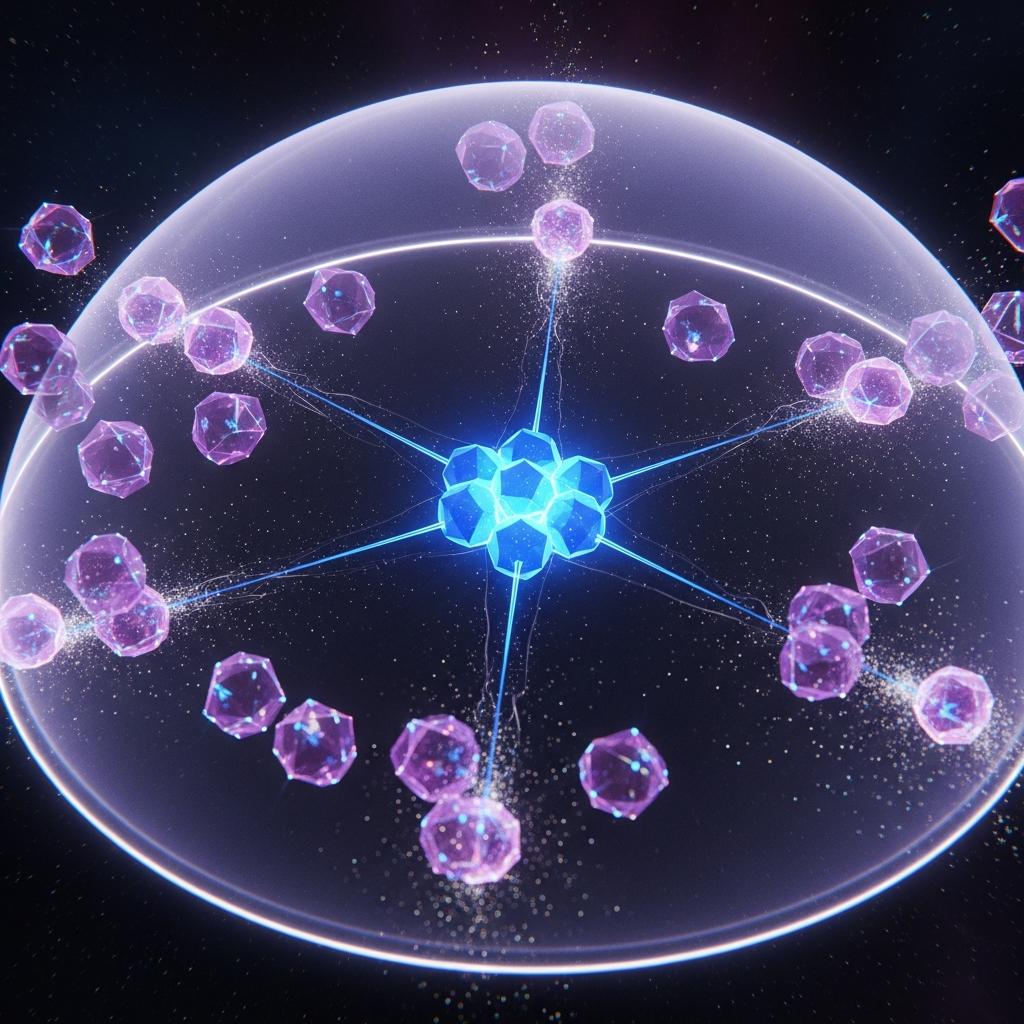

Your quantum circuits are probably spitting out garbage. Not because your gates are bad, or your QPU is a dumpster fire (though that’s always a possibility), but because of a silent killer: orphan qubits. These rogue elements, lazily decaying outside your active unitary, are contaminating your results, and honestly, they’re responsible for about 90% of what people call “mystery quantum noise.”
Quantum Mystery: Eliminating Noise Beyond Fidelity
This isn’t about abstract theory or waiting for the next decade’s batch of error-corrected machines. This is about what you can *do* right now, on the hardware that’s actually online. If you’re seeing results that don’t line up, especially in any kind of NISQ-era cryptanalysis or complex simulation, pause and consider this: the real bottleneck isn’t gate fidelity, it’s the measurement readout and the silent contamination from qubits *not* participating in your core unitary operations.
Quantum Mystery: Noise Beyond Fidelity’s Grasp
Consider the standard workflow. You compile, you run, you get counts. If the counts are off, you start blaming gates, T1s, T2s, maybe the phase estimation subroutine itself. But what if, in a 100-qubit machine, you’re only actively using 30? Those other 70? They’re still there. They have calibration parameters. They *will* interact. And during the readout phase, that leakage, that slow decay, that unitary contamination – it bleeds into your results.
Quantum Mystery: Eliminating Noise Through Measurement Exclusion
We’ve been running experiments, pushing the limits on what’s considered achievable with current hardware. Take, for instance, some recent ECDLP attempts. The standard playbook, assuming everything is contributing positively, hits a wall. But when we implement a disciplined V5 measurement exclusion layer – essentially, a rigorous post-selection based on shot-level statistics and qubit coherence – the results sharpen. We’re identifying and effectively quarantining those rogue measurements and the qubits contributing to them.
Quantum Mystery: Noise Elimination Through Active Measurement Filtering
This approach treats measurement not as a final, passive step, but as an active filtering mechanism deeply integrated into the circuit’s logical structure. It’s about building a program that *expects* noise from certain elements and has a mechanism to discard the poisoned data. You’re not hacking around bad qubits; you’re programmatically isolating their influence. If you’re facing measurement consistency issues or achieving lower-than-expected fidelities on non-trivial problems, start by asking how many of your qubits are truly participating, and then build a system that silences the rest. The signal is there; it’s just being drowned out.
For More Check Out