
Break the piece, They’re telling you 2035. We’re seeing 2025. Most of the quantum world is still staring at noise, trying to wrestle with quantum noise and error correction as if it’s some cosmic unsolvable riddle. But what if I told you the critical transition from fragile physical qubits to robust logical qubits isn’t some distant dream, but a roadmap you can trace on the terminal right now? It’s like standing on the edge of a precipice, hearing whispers of future breakthroughs, while the real work, the kind that makes actual hardware sing, is happening in the gritty, noisy present.
Practical Quantum Noise Mitigation and Error Correction
The academic world, bless its heart, often gets caught up in the theoretical elegance of fault-tolerant quantum computing. They’re busy sketching out massive logical qubit architectures, imagining these pristine, error-free machines that are decades away. It’s a noble pursuit, sure, but it’s also like admiring the blueprints for a skyscraper while ignoring the urgent need for a functional, albeit smaller, bridge *today*. We’re not waiting for the skyscraper; we’re building the bridge, and it’s already carrying traffic.
Embracing Quantum Noise and Error Correction as Design Constraints
My approach is built on a fundamental supposition: the current NISQ (Noisy Intermediate-Scale Quantum) hardware, with all its imperfections, is not an insurmountable barrier but a challenging, albeit hostile, substrate to *work with*. Instead of dreaming of flawless qubits, we’re actively engineering around the imperfections, treating “quantum noise and error correction” not as an abstract academic problem, but as a design constraint. It’s like a master lockpicker who doesn’t just wish for a perfect lock but figures out how to pick the one they’re holding, flaws and all.
Mitigating Quantum Noise Through Error Correction
So, what does this mean for the nitty-gritty, the stuff that actually scares off investors who are sold on 2035 roadmaps? It means demonstrating non-trivial Elliptic Curve Discrete Logarithm Problem (ECDLP) instances with Shor- and Regev-style constructions on hardware that’s supposed to be too limited. We’re talking about mapping group operations directly onto these recursively-geometric, error-mitigated gate patterns. Each elliptic curve add or double operation is not only algorithmically sound but physically implemented in a way that actively cancels a significant chunk of coherent errors.
Recursive Geometric Circuitry: Navigating Quantum Noise and Error Mitigation
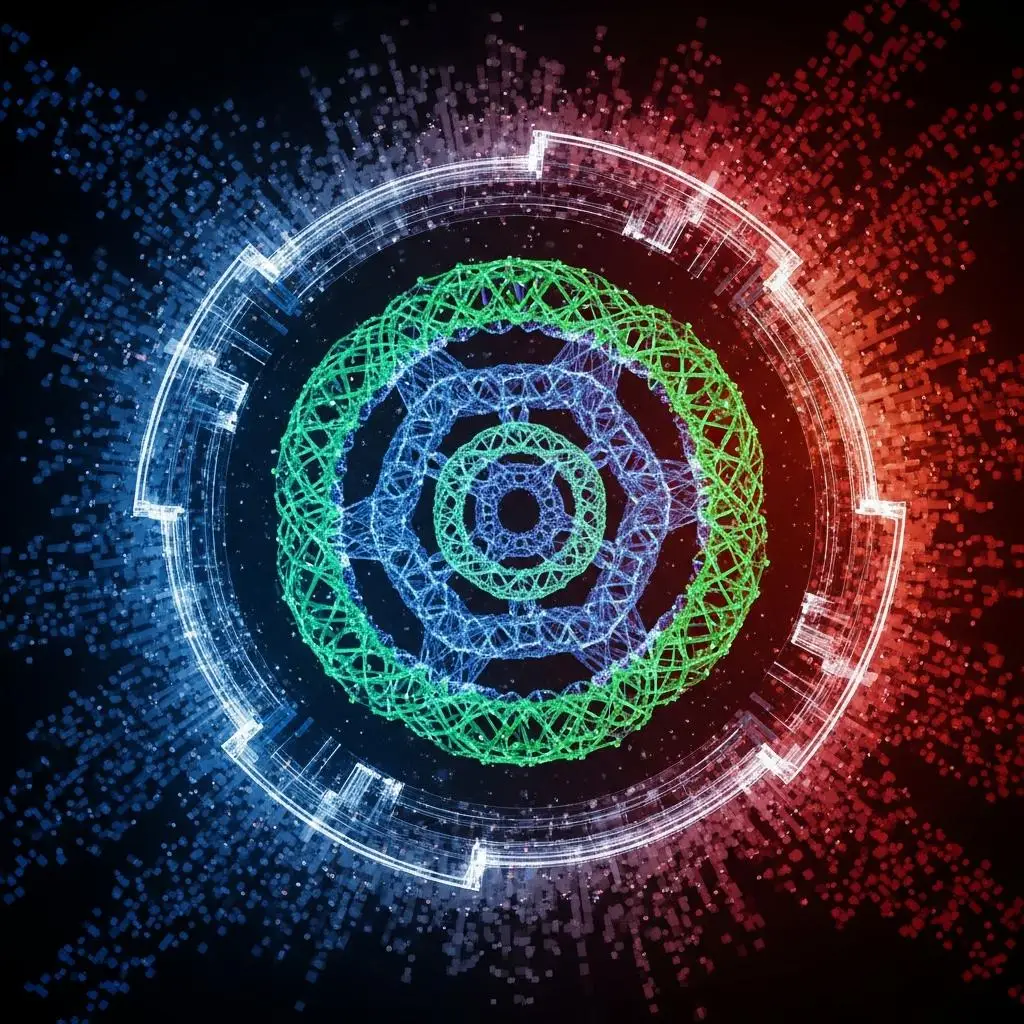
Beyond measurement, we’re leveraging recursive geometric circuitry as a form of gate-level error mitigation. Forget flat, linear circuits. We’re embedding computations within self-similar, nested patterns of entangling operations. This isn’t just about looking fancy; it’s about harnessing symmetry and geometric phase. Ideal unitary operations are designed to depend on global parameters, allowing many local errors – over/under-rotations, even some decoherence effects – to partially cancel each other out. It’s like creating a self-healing weave, where individual threads might fray, but the overall pattern remains robust.
For More Check Out