
You’ve seen the glossy brochures, the slick presentations promising a quantum future years, maybe decades, away. But the real work? The stuff that happens when the lights are low, and the only audience is a humming server rack? That’s where the actual quantum present is being forged. Most are waiting for the perfect, fault-tolerant machine—a ghost on the horizon. We’re talking about extracting utility *now*, from the noisy, unruly hardware that’s actually here.
Stabilizer Implementation: A Hostile Substrate Approach
This isn’t about abstract theory; it’s about hacking reality. We’re building a quantum stack that treats today’s noisy physical qubits not as a fragile toy, but as a hostile substrate. The goal? To achieve nontrivial computations, like solving elliptic curve discrete logarithm problems (ECDLP), on hardware that’s supposed to be too limited. Think of it as arm-wrestling a greased pig. You can’t just follow the textbook moves; you need a fundamentally different approach, one that acknowledges the pig’s inherent slipperiness.
Stabilizer Quantum Error Correction: A Pragmatic Defense Against Unitary Contamination
The common refrain is that NISQ devices are too flawed for serious computations. They’re riddled with “unitary contamination”—a fancy term for the mess that academic code, designed for perfect theoretical machines, makes when it hits real, cranky hardware. This contamination, manifesting as “orphan measurements” and anomalous readout events, is the ghost in the circuit that rugs hopeful investors and frustrates developers. The V5 measurement discipline is our first line of defense, a brutally pragmatic filter.
Recursive Geometric Circuitry: Stabilizer Symmetry in Action
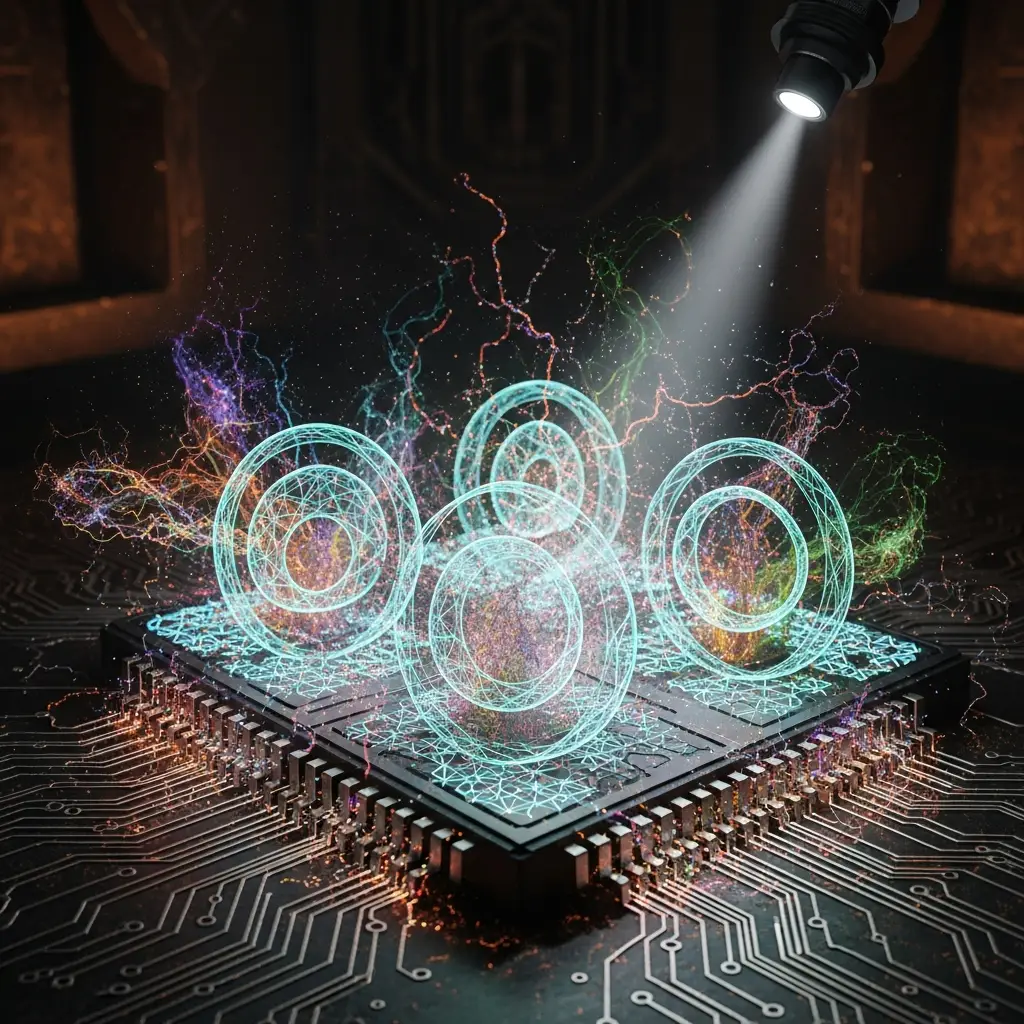
But filtering alone isn’t enough. The real magic, the quantum equivalent of duct tape and WD-40, lies in our “recursive geometric circuitry.” Forget flat, one-shot gate layouts. We embed computations within self-similar patterns of entangling operations. Imagine a fractal pattern, where each level mirrors the one before, but on a smaller scale. By arranging two-qubit gates in motifs like rings or tilings, we leverage symmetry.
Stabilizer Quantum Error Correction: Geometric Recursion in Practice
The ultimate test of this framework? Tackling the Elliptic Curve Discrete Logarithm Problem (ECDLP). This isn’t some academic curiosity; it’s a cornerstone of modern cryptography, and demonstrating Shor/Regev-style constructions on current hardware would be a seismic event. Our stack, however, demonstrates that careful quantum programming—leveraging geometry, recursion, and intelligent measurement logic—can dramatically extend the practical boundary of what today’s machines can achieve. This isn’t about waiting for fault tolerance; it’s about building utility *now*, by treating the limitations of NISQ devices not as insurmountable walls, but as design constraints to be architected around.
For More Check Out