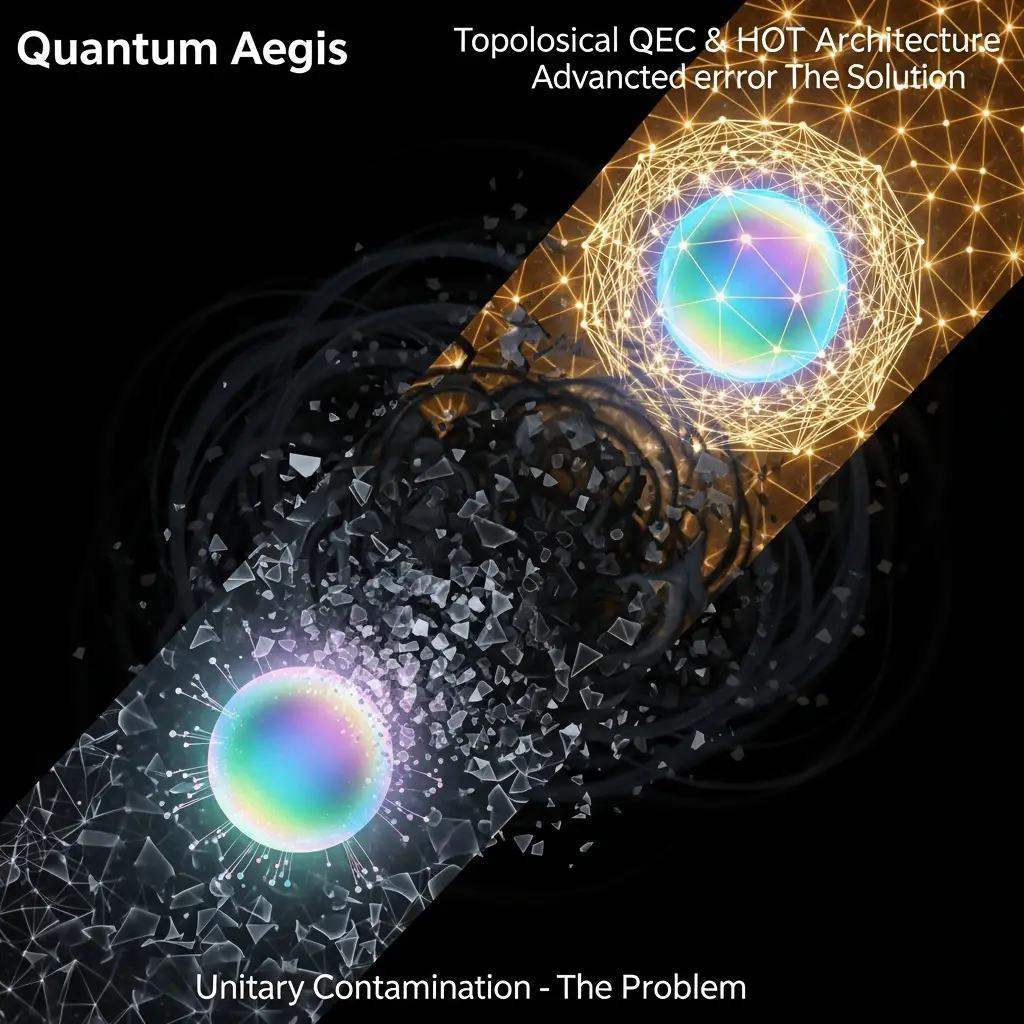

You’ve seen the press releases, the slick animations promising a quantum future just over the horizon. But run even a slightly deeper circuit on a current NISQ device, and the signals vanish, swallowed by something insidious: Unitary Contamination. It’s the ghost in the machine, making your carefully crafted quantum logic dissolve into noise before you can even take a measurement.
Topological Quantum Error Correction: Addressing Unitary Contamination in NISQ Devices
The promise of quantum computation hinges on manipulating delicate quantum states with incredible precision. Yet, the reality of Noisy Intermediate-Scale Quantum (NISQ) devices is far less glamorous. Unitary Contamination isn’t just a bug; it’s a fundamental challenge. Think of it like trying to whisper a secret across a crowded, boisterous stadium. Your message, however clear in intent, gets distorted by a cacophony of competing sounds – stray vibrations, other conversations, even the air conditioning hum.
Unitary Contamination: A Topological Defense
We’re not talking about fixing a few bad measurements here and there. Unitary Contamination poisons the well at a much deeper level. It’s the subtle phase shifts, the unintended excitations, and the cross-talk that accumulate with every operation. By the time you attempt to read out your result, what you’re measuring is less the intended computational state and more a probabilistic soup of what *might* have happened. This phenomenon is why complex algorithms, like those required for Shor’s algorithm or breaking elliptic curve cryptography, often appear hopelessly out of reach on current hardware.
Topological Quantum Error Correction: Hardware Innovations
The implementation of topological codes, however, is where the “hardware-optimized techniques” come into play, and frankly, where the real innovation is happening. It’s not about passively waiting for the perfect topological qubits to appear. It’s about engineering current, imperfect hardware to mimic the behavior of these robust codes. This involves sophisticated circuit design, precisely orchestrated sequences of operations, and a deep understanding of how to map the abstract topological concepts onto the physical constraints of existing quantum processors. This is the “H.O.T. Architecture” in practice.
Topological Methods for Realizing Quantum Supremacy
This isn’t about theoretical marvels that might see the light of day in a decade. This is about making today’s hardware do more, right now. The robust mathematical framework of topological quantum error correction, when translated into hardware-optimized techniques like disciplined measurement exclusion and recursive geometric circuitry, provides a concrete strategy for suppressing Unitary Contamination. It’s a call to arms for those who are building the quantum present, not just waiting for a hypothetical future.
For More Check Out