
You’ve probably seen the glossy brochures, the infinite qubit promises shimmering like heat haze. Most of that is just vaporware, a mirage for investors with too much cash and too little understanding. But what if I told you there’s a way to leverage quantum’s raw, unrefined power *now*, to gain a tangible business edge, not in some distant, imagined future, but on your P&L statements by the end of next quarter?
Topological Quantum Error Correction in the Trenches
Forget the hype cycle for a moment. The real quantum revolution isn’t waiting for the theoretical perfection of logical qubits; it’s happening in the trenches, on the actual hardware that’s humming in labs right now. We’re building a quantum programming stack that treats today’s noisy physical qubits not as a roadblock, but as a hostile substrate to be outmaneuvered. The goal? To coax meaningful computations out of these imperfect machines, pushing them into regimes that, until now, were thought to require full-blown fault tolerance.
Topological Error Correction: Navigating Orphaned Data
At the heart of this approach is a disciplined measurement strategy, specifically designed to circumvent the most egregious sources of error: the “orphaned” measurements. Think of it like this: imagine a complex orchestra performance. An “orphan” is like a single instrument playing completely out of tune, or a musician hitting a note that’s just… wrong. These aren’t just minor glitches; they’re statistical anomalies that can completely muck up the signal, creating phantom interference patterns and leading you down a computational rabbit hole.
Geometric Motifs for Topological Quantum Error Correction
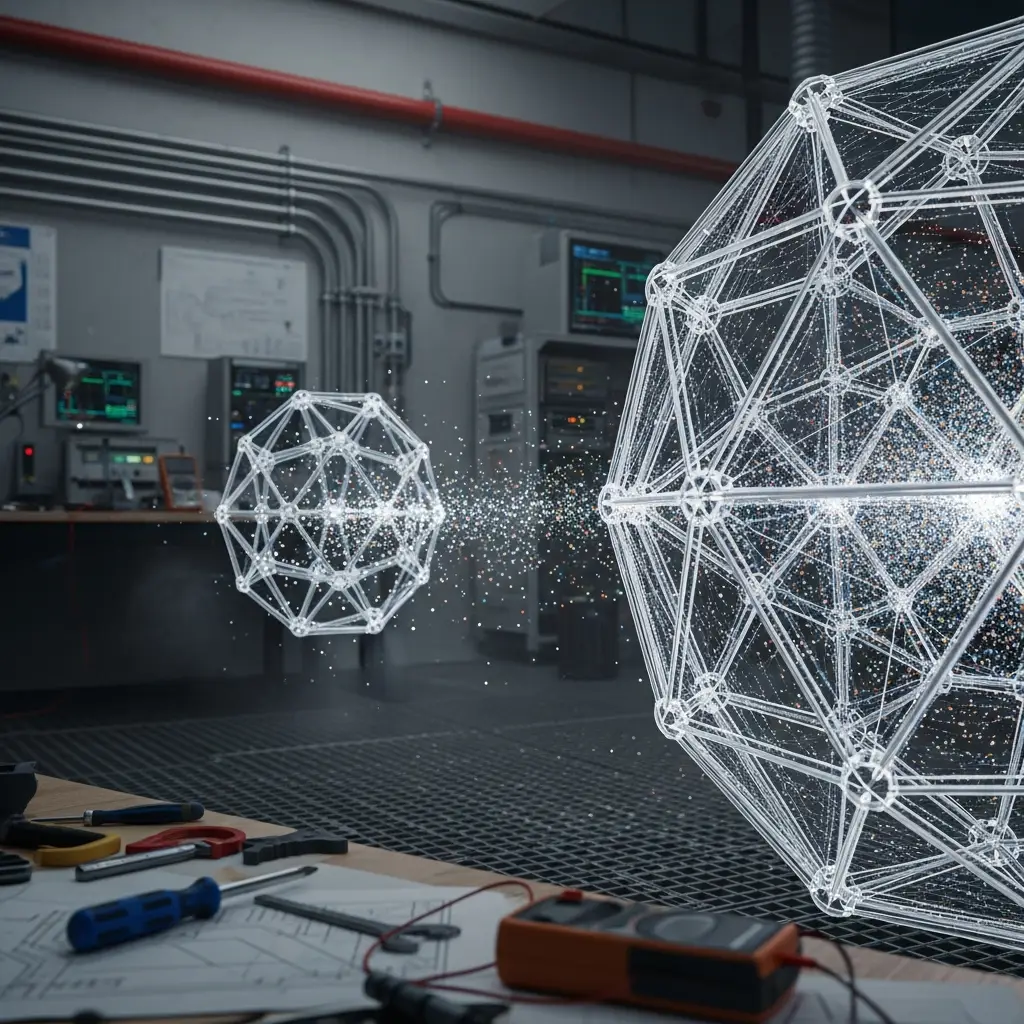
Crucially, these recursive geometric motifs are designed for reuse across a spectrum of algorithms. Whether we’re tackling period finding, phase estimation, or complex group operations on elliptic curves, the improvements made to the underlying geometry propagate through the entire stack. This means that advancements in our understanding of how to structure computations for noise resilience don’t just benefit one algorithm; they yield dividends across all applications built upon this foundation. It’s a compounding effect, where every optimization of the circuit shape is an advancement in error mitigation.
Topological Quantum Error Correction via Geometric Permutations
The true test of this approach lies in demonstrating its utility on concrete, computationally hard problems. We’re not settling for toy examples; we’re targeting the Elliptic Curve Discrete Logarithm Problem (ECDLP). This is a benchmark that requires significant quantum resources, and solving it on current NISQ hardware, conventionally, is considered beyond reach. Our strategy involves implementing Shor-style period-finding algorithms, but with Regev-inspired constructions that are inherently more noise-robust. We’re mapping elliptic curve operations onto our error-mitigated, recursively geometric gate patterns, so that each group operation is algorithmically sound and physically realized in a way that actively cancels a substantial fraction of coherent errors.
For More Check Out