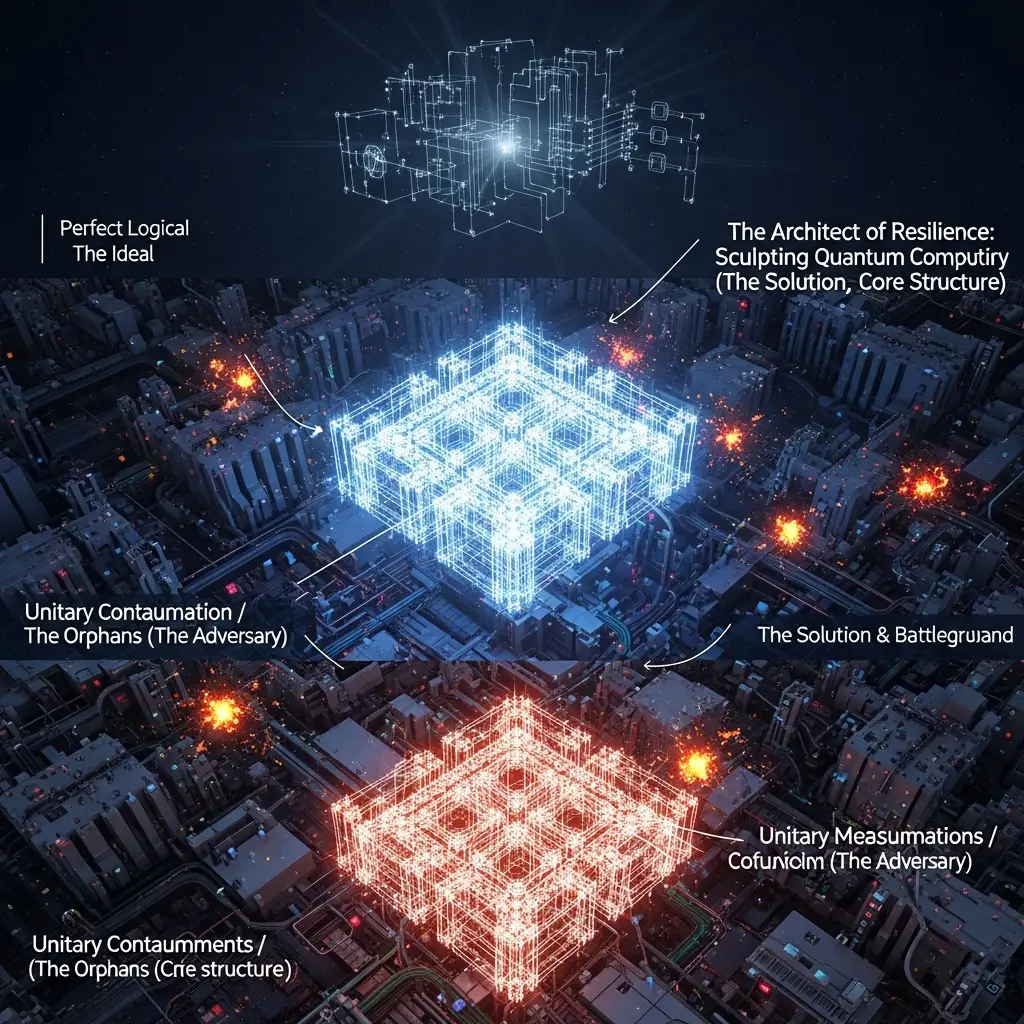

You’ve seen the grand visions, the glittering promises of quantum supremacy arriving on a wave of near-perfect qubits. But pull back the curtain, and you’ll find the real battleground isn’t in the algorithms themselves, but in the raw, untamed hardware. We’re talking about deep NISQ circuits, where every gate operation becomes a gamble, and “unitary contamination” isn’t some academic thought experiment; it’s the silent killer of progress.
Topological Quantum Error Correction: Fighting the Present with Present-Day Quantum Devices
Most of what you read about quantum computing feels like looking at a blueprint for a skyscraper that won’t be built for another decade. It’s all about the end-state, the flawless, logical qubits that are supposed to magically appear and solve everything. But I’m here to tell you that the real progress, the stuff that makes a difference *now*, is being built in the dirt, in the messy, analog reality of today’s noisy intermediate-scale quantum (NISQ) devices. We’re not waiting for the future; we’re wrestling with the present, and it’s a far more interesting fight than most acknowledge.
Harnessing Topological Quantum Error Correction for Today’s Quantum Reality
Our core mission is to bridge the chasm between the hype and the hardware reality. For too long, the quantum community has been content to marvel at theoretical constructs, waiting for the perfect machines that will eventually arrive. We, on the other hand, are focused on extracting utility *today*. This means developing “Hardware Optimized Techniques” (H.O.T.) that bypass the usual vendor bottlenecks and academic delays. Think of it as the underground manual for getting real work done on real quantum computers, not just fancy simulators. The primary enemy we’re battling is what we call “unitary contamination.”
Topological Error Correction: Navigating Circuitry
By combining this disciplined measurement strategy with recursive geometric circuitry, we’ve been able to push the boundaries of what’s considered feasible on current NISQ hardware. We’re demonstrating nontrivial instances of the Elliptic Curve Discrete Logarithm Problem (ECDLP) using Shor/Regev-style constructions on machines that are normally assumed to be far too limited for such tasks. This is a concrete, falsifiable benchmark of “useful” quantum computation, moving beyond toy algorithms. Our programming strategy maps group operations onto these robust, error-mitigated gate patterns.
Topological Quantum Error Correction: A Geometry-Infused Approach
The result is a demonstration that careful quantum programming—embracing geometry, recursion, and measurement logic—can extend the practical boundary of what today’s hardware can achieve, without waiting for the advent of full fault-tolerant logical qubits, and particularly in ways that directly address the challenge of *topological quantum error correction* by building in resilience from the ground up.
For More Check Out