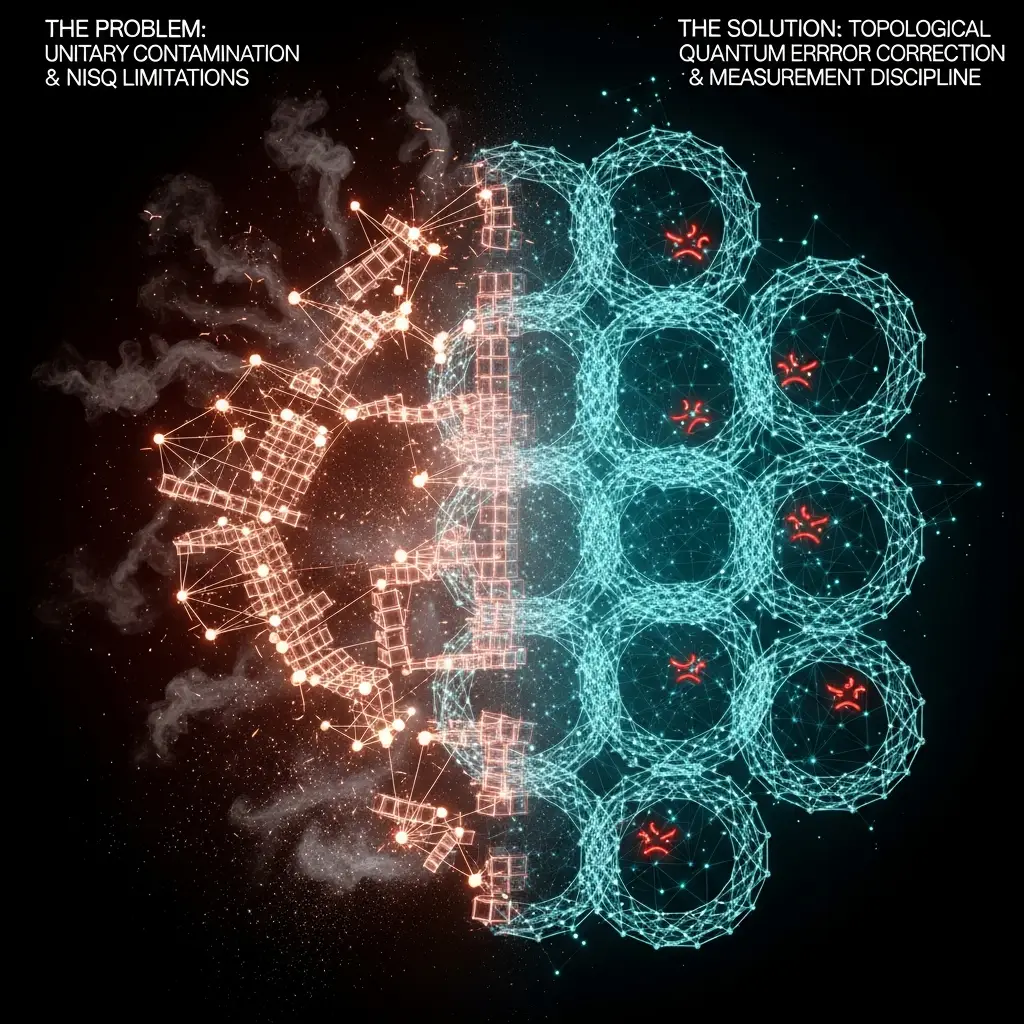


Alright, let’s talk about why your quantum jobs are going sideways. You’ve spent weeks calibrating your backend, meticulously designing circuits, and wrestling them into submission with H.O.T. Framework techniques, only to see your job fail at the last second. We’ve all been there. The common narrative blames decoherence, gate infidelity, or some other well-trodden error path. But what if the real enemy isn’t what you think?
Unitary Contamination in Deep NISQ Circuits
While your intended operations are unfolding, there’s this… bleed-through. It’s not just a bit of extra noise during a gate; it’s the semi-collapsed state of *other* qubits, the ones that should be inert or decohered in a way that doesn’t affect your calculation, actively *interfering* with your unitary evolution. We call this **unitary contamination**. Think of it this way: you’re trying to execute a perfect dance routine. But in the background, dancers who are *supposed* to be off-stage or have already finished their steps are still shuffling around, bumping into your lead performers, subtly altering their trajectories.
Mitigating Unitary Contamination in Deep NISQ Circuits
Deploying H.O.T. Framework techniques that explicitly model and down-weight contributions from identified “poison qubits” (those showing significant deviation from expected coherence behavior during calibration runs) at the V5 measurement exclusion stage, *before* algorithmic inference, can improve the success rate of deep NISQ ECDLP instances by mitigating the effects of unitary contamination. Test this by comparing job success rates on identical circuits and backends, with and without a V5 exclusion layer specifically tuned for detecting coherent state leakage from non-participating qubits.
Unitary Contamination Lurking in Deep NISQ Circuits
Your measured fidelity might look decent for individual gates, your $T_1$ and $T_2$ times might pass muster, but when you chain operations, the cumulative effect of these “poison qubits” —qubits with $T_1/T_2$ below the viability threshold, that is—starts to rug the circuit. They inject systematic errors that gate-level error mitigation often smooths over because it’s looking at the *intended* evolution, not the unintended but coherent interference. Standard error correction protocols, which often assume a certain degree of independent noise or focus on logical qubit fidelity derived from averaging over many shots, can miss this entirely.
Deep NISQ Circuits: Unmasking Unitary Contamination
So, next time a job tanks, don’t just blame the usual suspects. Dig into your readout. Look for statistical anomalies that suggest more than just shot noise. Are certain qubits consistently showing up with unexpected correlations? Are your measurement outcomes showing patterns that deviate from what a flat, noise-free circuit would produce, even after accounting for known gate errors? This is your signal of unitary contamination. It’s the hidden coherence killer in deep NISQ circuits, and mastering its detection and mitigation is where we start to extract real value from these machines, today.
For More Check Out