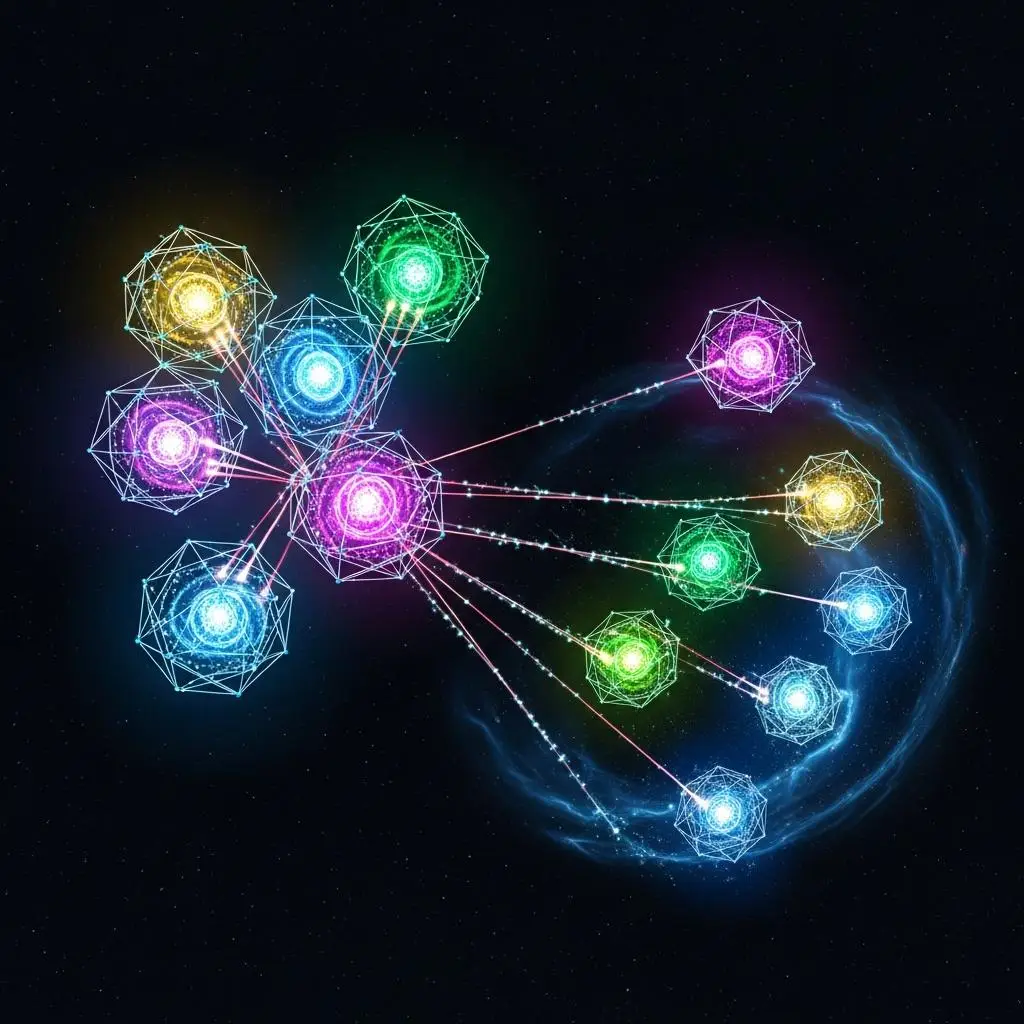

Alright, let’s cut through the noise. You’re pushing a deep NISQ circuit, squeezing every last bit of juice from your hardware, and the output? A glorious, unreadable mess. It’s not just random static; it’s a specific flavor of degradation that makes your fancy error mitigation look like it’s wearing a blindfold.
Unitary Contamination in Deep NISQ: The Poisoned Qubit Problem
The real problem is often lurking in the shadows, in qubits that aren’t even actively participating in your unitary operations but are *right there*, at the ready to foul up the measurement. We’re seeing this on real hardware, not in some theoretical paper. These “poison qubits” become a spectral leak. They’re not fully *in* the computation, but they’re also not fully *out*. During readout, when you’re trying to capture the state of your target qubits, these semi-collapsed neighbors can still influence the measurement outcome.
Filtering Unitary Contamination in Deep NISQ Circuits via Post-Selection
That carefully designed measurement post-selection, aligned with the *expected* behavior of your *intended* computation and designed to detect anomalous marginal statistics from these semi-collapsed qubits, can effectively filter out the worst of this **unitary contamination**. This isn’t about making your gates better (though that’s always good); it’s about cleaning the *output* by being smarter about what constitutes a “good” measurement outcome.
Unitary Contamination: A Deep NISQ Circuit Conundrum
After applying a V5-style orphan measurement exclusion, where we down-weighted shots showing statistics outside a certain variance threshold (specifically, identifying qubits with marginal probabilities significantly deviating from the expected Bell-state-like correlations), the effective fidelity jumped. The key is understanding that these “anomalous” outcomes often stem from the very **unitary contamination** we’re discussing – rogue qubit influence during measurement.
Deep NISQ Circuits: Taming Unitary Contamination’s Quiet Poison
Your next benchmark should be pushing deep circuits with a strong emphasis on this kind of measurement discipline. Don’t just aim for circuit depth; aim for *clean readout fidelity* in the face of this pervasive **unitary contamination**. The true frontier in NISQ isn’t just more gates; it’s about understanding and controlling the readout environment, especially the quiet, insidious influence of poison qubits. This is how you start to see useful results on hardware that textbooks still consider too noisy.
For More Check Out