
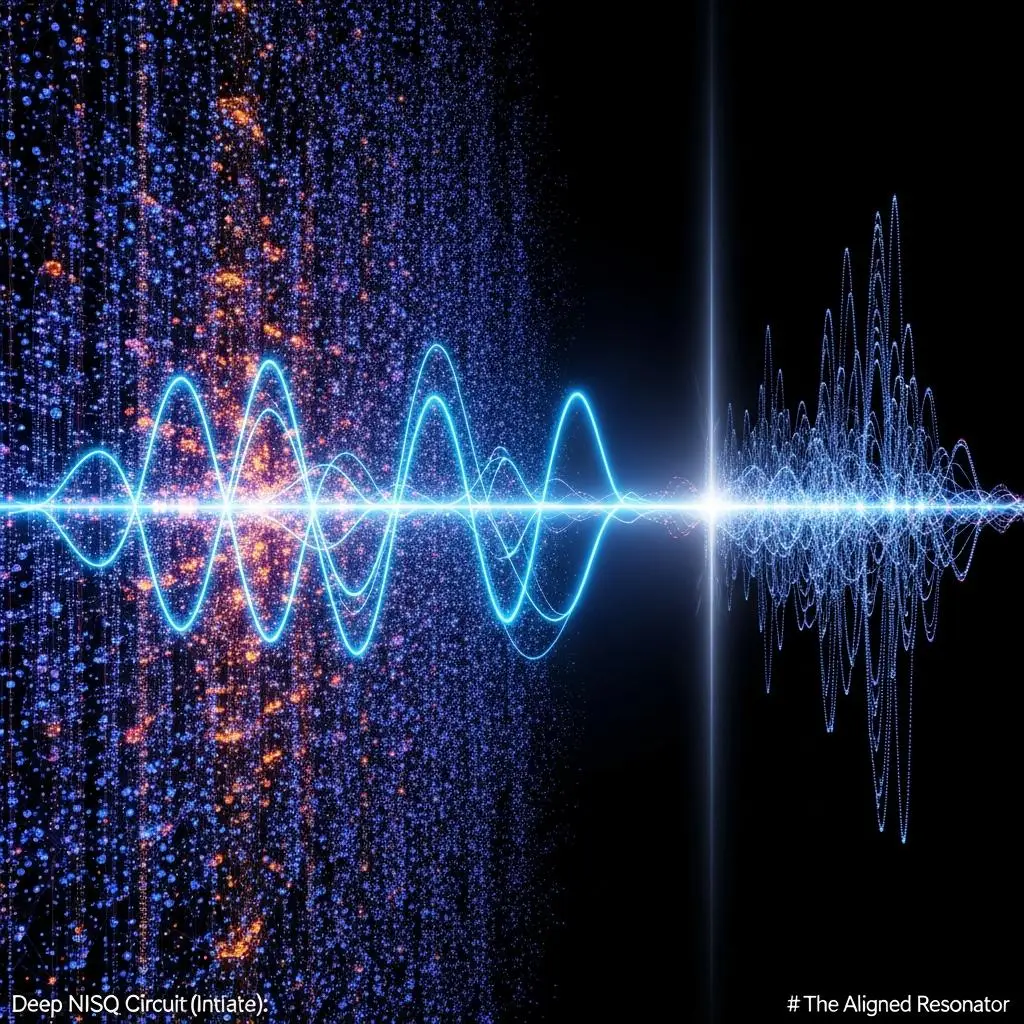

Alright, let’s talk about what’s *really* going on when your deep NISQ circuits go sideways. You’re pushing it, right? Running that circuit you spent weeks optimizing, the fidelity numbers are… fine. Maybe even better than expected for the specific backend fingerprint you’ve got. But the output? It’s not just noise. It’s just plain *wrong*. Like the universe decided to have a laugh at your carefully crafted unitary.
Deep Unitary Contamination in NISQ Circuits
What you’re probably staring at isn’t just your garden-variety gate errors. This is something else, something deeper. This is **unitary contamination**.
Now, I know what you’re thinking: “Error correction should handle this.” And for the theoretical wonderland where qubits behave, maybe it does. But in the trenches of the NISQ era, that’s a different story. Unitary contamination is the hidden coherence killer, and it’s lurking in the shadows, making your meticulously designed computation look like some random terminal output from 2035 slideware. Standard error mitigation? It’s flying blind on this one.
Orphan Qubits: Unitary Contamination in Deep NISQ Circuits
Think about it. You’ve got your ‘main’ circuit, the one you’re actually trying to execute. But around the edges, you’ve got what we’re calling “orphan qubits.” These aren’t necessarily *broken* qubits in the traditional sense, not entirely dead yet. They’re just… off. Their coherence times might be borderline, their calibration drift is a constant headache, or they’re just not quite participating in the unitary evolution as intended. When these orphans, even just a small percentage of them, are part of your readout process, they *contaminate* the measurement.
Understanding Hardware for NISQ Resilience
So, what do you do? You can’t just wish it away. You can’t wait for fault tolerance. The answer, as usual, lies in understanding the *hardware* you’re actually running on, not the idealized model in the textbook.
This is where the **H.O.T. Framework** comes in. We’re talking about a three-layer approach:
Pushing Past Unitary Contamination in Deep NISQ Circuits
The key takeaway? Unitary contamination is real, it’s insidious, and it’s a major roadblock for deep NISQ circuits. It’s a blind spot for traditional error mitigation. But by combining a deep understanding of hardware fingerprints with calibration-aware circuit design and disciplined measurement, we can start to push past these perceived limits. The results we’re seeing suggest that the true bottleneck isn’t gate count; it’s measurement latency and the management of these subtle, contaminating effects. The question isn’t *if* we can do useful quantum computation on NISQ hardware, but *how* we’re going to intelligently manage the noise that’s already there. The textbooks haven’t caught up to the terminal logs yet.
For More Check Out