
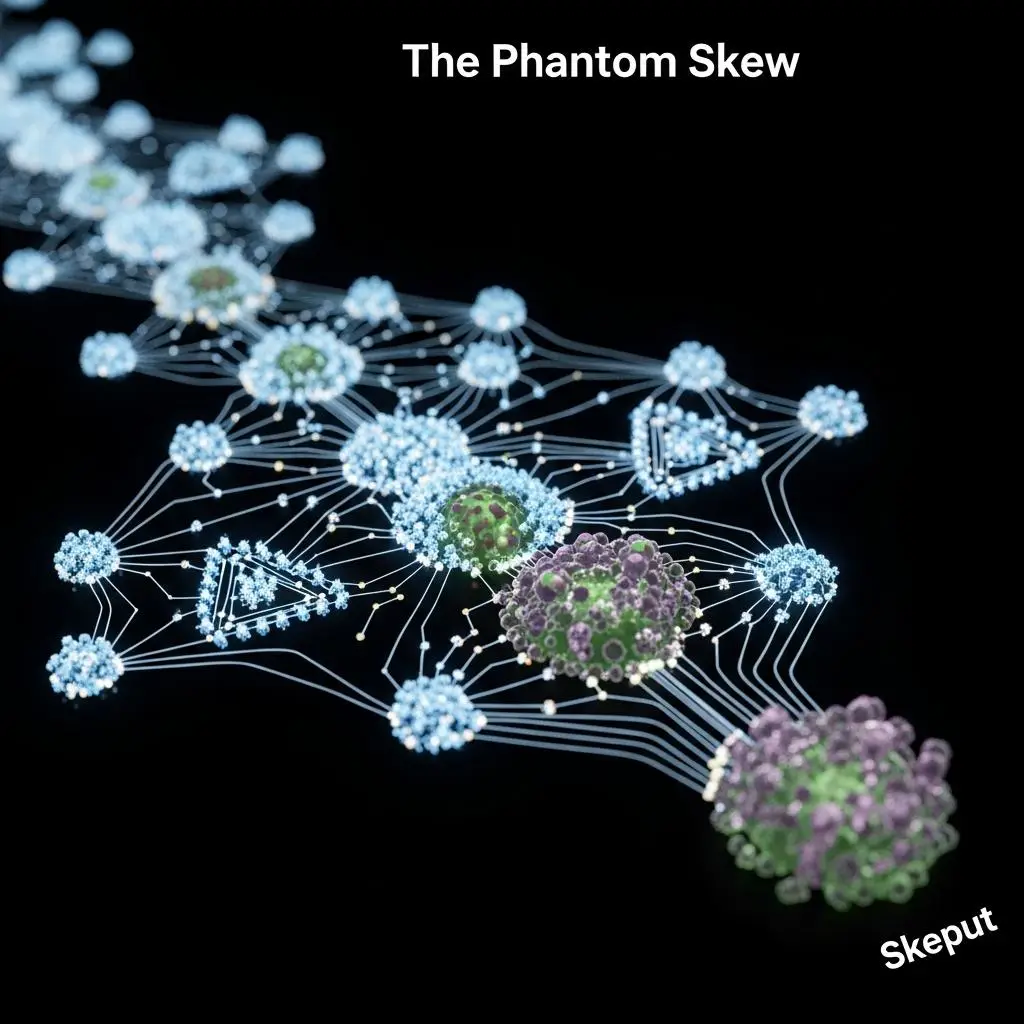

Alright, let’s cut through the noise. The actual output? Garbage. This isn’t just decoherence; this is unitary contamination, the hidden coherence killer in deep NISQ circuits that error correction, in its current form, simply doesn’t see. It’s the specter haunting your qubits, turning what should be a coherent quantum state into a statistical dead end, and frankly, it’s enough to make you question everything you thought you knew about how these machines actually work.
Unitary Contamination in Deep NISQ Circuits
This isn’t about the hypothetical million-qubit future. The issue isn’t just the number of gates you can string together before $T_1$ and $T_2$ kill your signal. It’s how the subtle, persistent coherence of “poison qubits” – those with calibration metrics well below viability – can leach into your primary computation. When the contamination ratio hits even a modest threshold (we’re seeing consistent failure boundaries around 10% poison qubit presence), your expected unitary evolution devolves into something entirely different, something driven by leakage and interference from qubits that are *almost* collapsed, but not quite.
Deep NISQ Circuits and Unitary Contamination Ghosts
Think about it: your error correction codes are designed to catch bit flips and phase flips. They’re built on the assumption of relatively stable qubits that either flip or don’t. But what about the qubits that are *wobbling*, those that maintain a partial, tenuous coherence and can still interact with their neighbors? They’re not fully decohered, so standard error correction misses them. Yet, their ghost coherences actively interfere with your target unitary operations. This is the essence of unitary contamination in deep NISQ circuits: a subtle, pervasive corruption that makes your quantum state’s statistical properties diverge from the intended, clean output, even when individual qubit lifetimes might suggest viability.
Unitary Contamination in Deep NISQ Circuits: A New Perspective
Forget trying to brute-force your way past it with more qubits or fancier gates for now. We’ve been focusing on a few key areas, and frankly, they’re producing results that look suspiciously like progress beyond what the textbooks predict: Hardware-Optimized Techniques (H.O.T.) Framework Layer 1: Measurement Discipline. H.O.T. Framework Layer 2: Recursive Circuit Geometry. H.O.T. Framework Layer 3: Cryptanalytic Benchmarks.
Empirical Performance of Unitary Contamination Mitigation in Deep NISQ Circuits
This isn’t about theoretical error bounds. This is about empirical performance. We’re showing that by treating unitary contamination as a primary target for mitigation – through disciplined measurement and noise-aware circuit design – we can extract useful signal from NISQ hardware that, by traditional metrics, should be unusable for deep computations. The next benchmark is yours. Take a deep circuit, a non-trivial problem, and track those anomalous measurement statistics. See if you can correlate them with your hardware’s known “poison qubit” fingerprint. It’s time to stop thinking about error correction as an afterthought and start engineering your circuits to actively fight the subtle coherence killer that’s already here.
For More Check Out