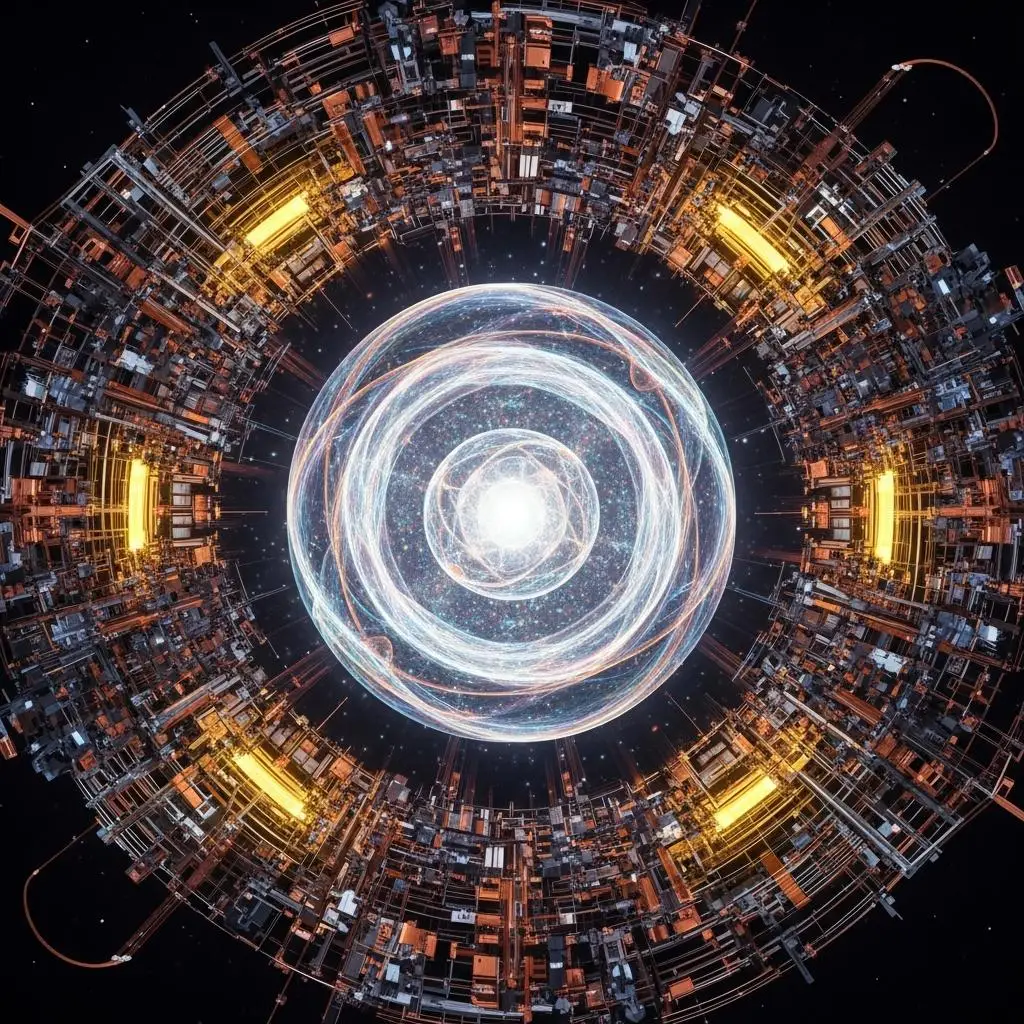

You’ve probably seen the flashy infographics, the swirling galaxies, and the promises of quantum computers solving humanity’s grandest challenges. But what if I told you that the real bottleneck isn’t some far-off theoretical hurdle, but a very present, very physical constraint within the quantum circuits themselves? We’re talking about managing the notorious 9-bit threshold in these intricate 3D circuit rings. Forget the pop-science depictions; this is where the rubber meets the road, where the elegance of superposition, the bedrock of quantum computation, crumbles under the weight of real-world noise and latency.
Wrestling the Superposition Principle from Noisy Circuits
The academic world, bless its theoretical heart, often paints quantum computing in broad strokes of logical qubits and fault-tolerant futures. We’re told to wait for the arrival of robust error correction, for the day when abstract algorithms can finally be unleashed upon silicon. But what if that’s a colossal misdirection? What if the true frontier isn’t building bigger, cleaner quantum computers, but learning to coax genuine utility out of the noisy, temperamental hardware we *have* right now? This is the “Quantum Present” we’re building at Firebringer Quantum – a domain where the *superposition principle* isn’t just an academic concept, but a delicate quantum state we wrestle into submission within the confines of real, messy circuits.
The Superposition Principle Under Siege in 3D Architectures
Consider the infamous 9-bit threshold. It’s not an arbitrary number pulled from thin air; it’s a critical inflection point where the inherent fragility of multi-qubit superposition states, particularly within the three-dimensional circuit geometries that promise greater connectivity, begins to actively work against us. Imagine trying to keep a dozen perfectly synchronized dancers on stage, each performing an intricate pirouette, while random gusts of wind keep nudging them off balance. The more dancers, the more susceptible the whole ensemble is to being thrown into disarray. The *superposition principle* demands exquisite coherence, and in these dense 3D architectures, that coherence is under siege.
Geometric Circuitry and the Superposition Principle
Furthermore, we’ve developed “recursive geometric circuitry” as a form of built-in error mitigation. Instead of relying solely on external error correction codes, which demand a prohibitive overhead on current NISQ devices, we embed computational resilience directly into the circuit’s topology. These aren’t flat, linear sequences of gates. We’re talking about self-similar patterns, like fractal tilings or intricate rings, where entangling operations are arranged in a way that promotes cancellations of coherent errors. The geometric phase and specific path designs of operations ensure that ideal unitary operations are less susceptible to local perturbations.
The Superposition Principle as a Foundation for Quantum Advantage
This entire framework culminates in demonstrating non-trivial computational feats, like solving instances of the Elliptic Curve Discrete Logarithm Problem (ECDLP). ECDLP is a cornerstone of modern cryptography, and breaking it is a benchmark of “useful” quantum computation. We achieve this by implementing Shor-style period-finding algorithms, adapted with noise-robust constructions, and mapping these group operations directly onto our recursively geometric, error-mitigated gate patterns. Each elliptic curve operation is designed to be algorithmically correct while physically realized in a manner that inherently suppresses a significant fraction of coherent errors. The result is that we can resolve ECDLP instances on hardware that, by conventional resource estimates (assuming flat circuits, no measurement discipline, and standard noise models), would be considered “beyond reach.” This is the Firebringer Quantum UVP in action: “The Practitioner’s Foresight: Bridging the Chasm Between Quantum Hype and Hardware Reality.” We’re not waiting for the hypothetical fault-tolerant future; we’re forging a quantum present by fundamentally rethinking how we program and operate on existing hardware. The *superposition principle* remains our guiding light, but our methods are grounded in the tangible, the testable, and the undeniably real constraints of the machines we have today.
For More Check Out