

You’ve seen the shimmering promise of superposition, the mind-bending dance of particles existing in multiple states at once. It’s the bedrock of quantum computing, right? But dig a little deeper, past the pop-science gloss, and you’ll find the messy, raw truth: your carefully constructed quantum state can shatter mid-computation, leaving you with an orphaned qubit and a computation that’s effectively… null.
Superposition Theorem: Engineering with Today’s Noisy Quantum Hardware
This isn’t about waiting for the next generation of error-corrected quantum computers to magically solve all our problems. That’s like waiting for a fully self-driving car to deliver your groceries when you’re starving *now*. We’re talking about building a better car, right now, with the parts we have. My approach, and what I’ve been hammering on, is about treating today’s noisy quantum hardware not as a delicate flower needing constant protection, but as a piece of industrial equipment that’s frankly a bit… grimy.
Beyond Amplification: Decoding Signals with Superposition
Think of it like this: you’re trying to get a message across a crowded, noisy room. Standard practice is to just shout louder, hoping your signal cuts through. What we’re doing is more like learning to read lips, or developing a coded language that’s robust against interference. The V5 measurement discipline, this isn’t some abstract data-cleaning hack applied after the fact. It’s baked into the program itself.
Recursive Geometry and the Superposition Theorem’s Reach
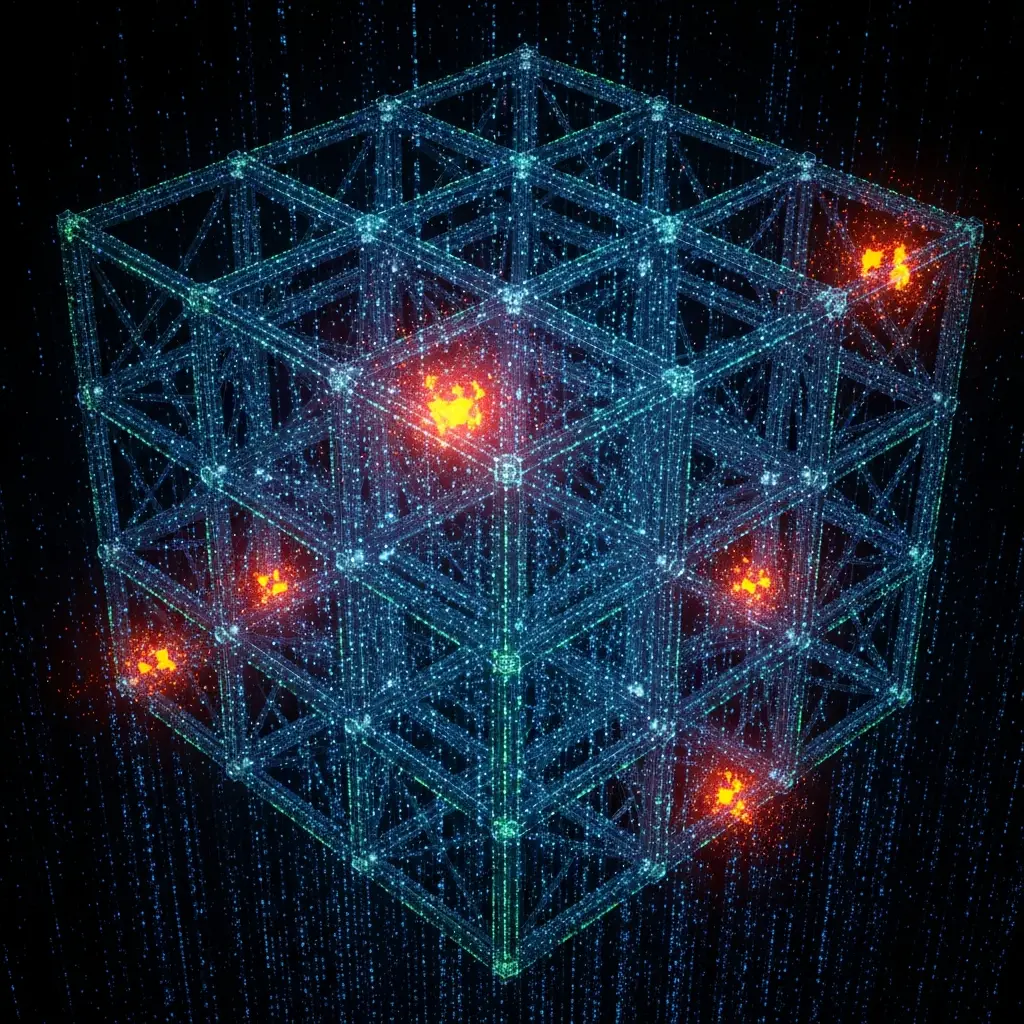
But it doesn’t stop there. The real magic, the thing that pushes the boundaries of the superposition theorem’s applicability on current hardware, comes from intertwining this measurement discipline with recursive geometric circuitry. Forget the flat, linear layouts of gates that dominate most NISQ programming. We’re talking about embedding computations within self-similar patterns of entangling operations, think fractal-like tilings or intricate rings. These aren’t just pretty patterns; they’re deliberate engineering choices.
Superposition Theorem’s Practical Extension on NISQ Hardware
The result is a practical demonstration that the superposition theorem isn’t just a theoretical construct confined to idealized environments. By employing a sophisticated quantum programming approach—one that marries precise measurement logic, recursive circuit geometry, and cryptanalytic benchmarks as rigorous stress tests—we can effectively extend the practical operational boundary of today’s NISQ hardware. We’re solving non-trivial ECDLP instances on devices that, under conventional assumptions of flat circuits and no measurement filtering, would appear far beyond reach. This is how we move from the theoretical promise to tangible, usable quantum computation, today.
For More Check Out