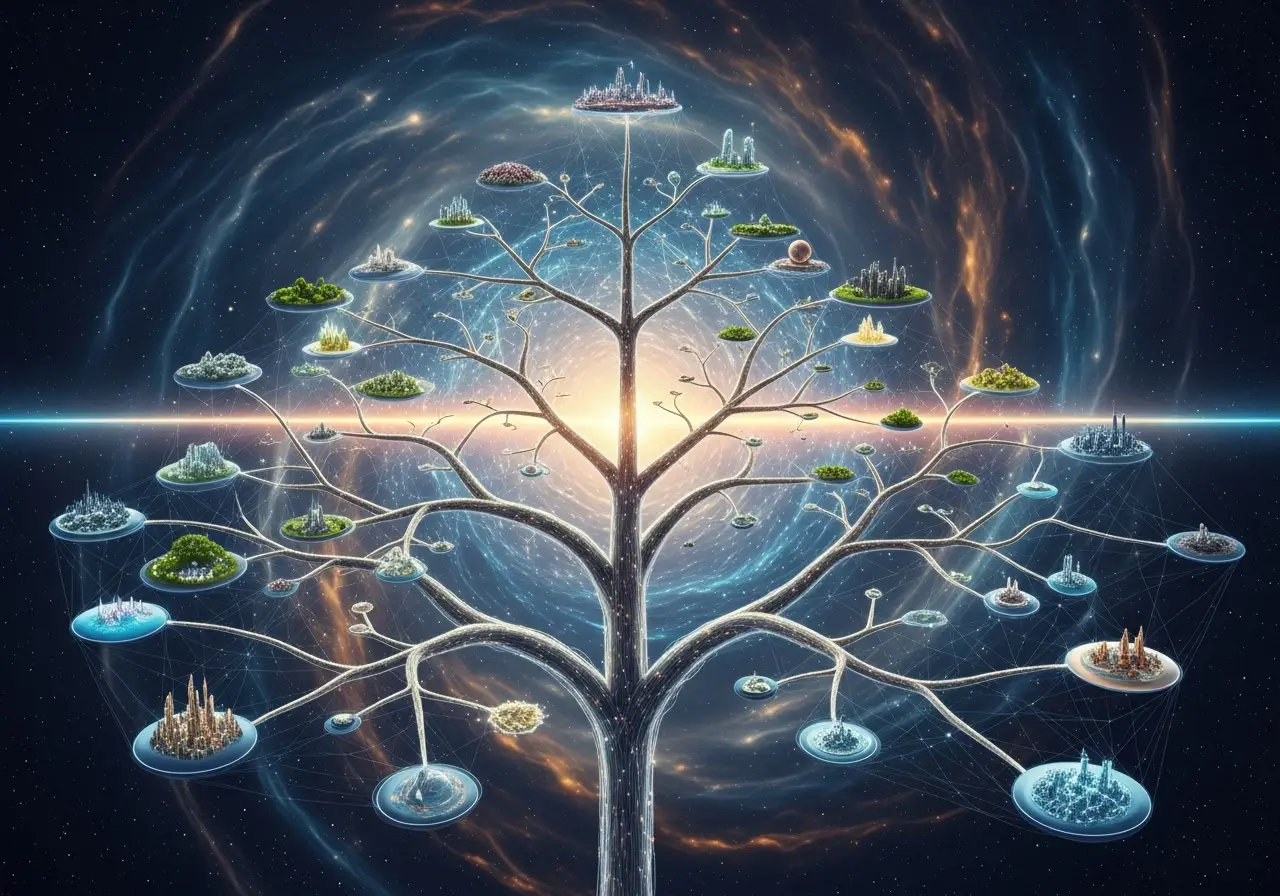

Imagine you’re at a point where every decision you make could create a whole new world. This is the crux of Everett’s Many-Worlds Interpretation, a theory that suggests parallel realities exist alongside our own. Each choice, no matter how small, potentially forms a separate universe filled with its own unique outcomes.
Introduced by Hugh Everett III in 1957, this theory contrasts with the traditional view where observing a quantum particle determines its state. Instead, Many-Worlds suggests all possible outcomes of a quantum event occur, each in its own universe. Picture this as an extensive library where every possible life path you could take is written in its own book. One book is about the life where you took a job overseas; another, where you stayed home and pursued a different dream. All these realities coexist within a vast multiverse.
Many-Worlds provides a solution to the quantum measurement problem without requiring wave function collapse. Each observed outcome branches into a separate reality, forming a tapestry of potential life paths. Every decision—be it hitting snooze on your alarm or choosing a breakfast cereal—could result in a new universe, leading to experiences independent from one another.
Though it may sound like science fiction, Many-Worlds touches on profound concepts related to our understanding of consciousness and intention. Quantum physics shows that simply observing can influence a system’s state. Within the Many-Worlds framework, observation isn’t about collapsing possibilities but rather engaging in the unfolding of a reality. This suggests our thoughts and intentions might hold power over the worlds we create, highlighting the importance of choices we make, even those that seem insignificant.
The theory also dives into quantum entanglement, where two particles can be connected despite vast distances. This could mean our parallel lives are intertwined in ways we don’t fully understand. Moments of synchronicity could be glimpses into these connected dimensions.
Critics might see this as far-fetched, questioning the necessity of infinite branching realities. However, the theory has roots in quantum mechanics. The idea of superposition—where particles exist in all possible states until observed—aligns with Many-Worlds, bringing credibility from the smallest particles to our everyday lives.
Consider a thought experiment: envision a version of yourself who boldly chased their dreams, contrasted with a version that played it safe. In the Many-Worlds Interpretation, both are equally real and meaningful, motivating us to reflect on our choices without dwelling on regrets.
In practical terms, realizing that each choice influences multiple realities prompts us to act thoughtfully. Acknowledging this complexity, we see the weight of our actions, thoughts, and emotions. By focusing on positive intentions and pursuing meaningful goals, we contribute to a richer narrative, affecting our world and beyond.
Everett’s Many-Worlds Interpretation invites us to be more than mere spectators of our lives—encouraging us to shape our realities with intention and awareness. This understanding of the universe reveals a complex web of existence where coexistence is the norm. Embracing this, we see how interconnected our lives truly are, part of an endless tapestry woven from countless realities. As we navigate this journey, each decision is a step into an unexplored world of possibilities.