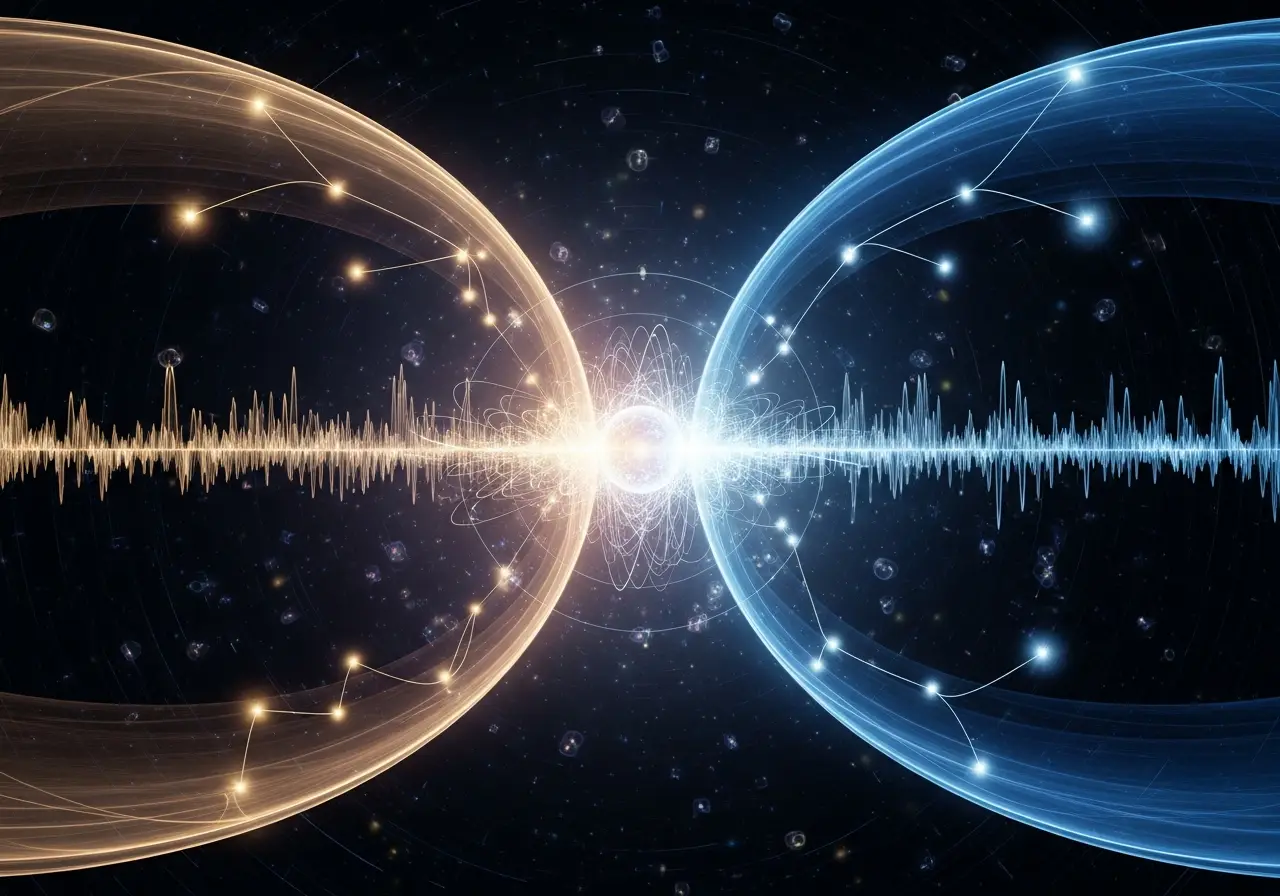

Imagine a reality where decisions ripple both forward and backward in time. Delayed Choice Experiments uncover a universe where observation can influence not only the future but also rewrite the past. Here, quantum particles move to a retrocausal rhythm, challenging everything we know about time and decision-making.
These experiments, like the famous double-slit setup, toy with the notion that our choices can alter particles’ past behavior. It’s a head-scratching universe where cause and effect seem to waltz out of step, suggesting our intentions might shape events already etched into history.
At the core of this peculiar world is retrocausality—the concept that what we do now might echo back to affect what already happened. This idea opens up a tantalizing loop of possibilities, suggesting time isn’t a one-way street. Instead, it invites us to be co-creators of our reality, crafting narratives that transcend conventional timelines.
Why ponder these quantum conundrums? They push us to rethink everything from free will to the very structure of reality. Could it be that we’re not just passive observers but active architects of time itself? By accepting this, perhaps we find a bit of comfort, knowing that regret might be less about changing the past and more about altering our present perspective.
So, how do these quantum revelations shape our understanding? They invite us to view time not as a rigid structure but as something more malleable, influenced by our consciousness and choices. Next time you’re faced with a decision, consider that it might not only chart your future—it could also subtly paint over your past. Embrace this intriguing concept, and begin to see the past as a canvas, ready for the strokes of your evolving awareness.