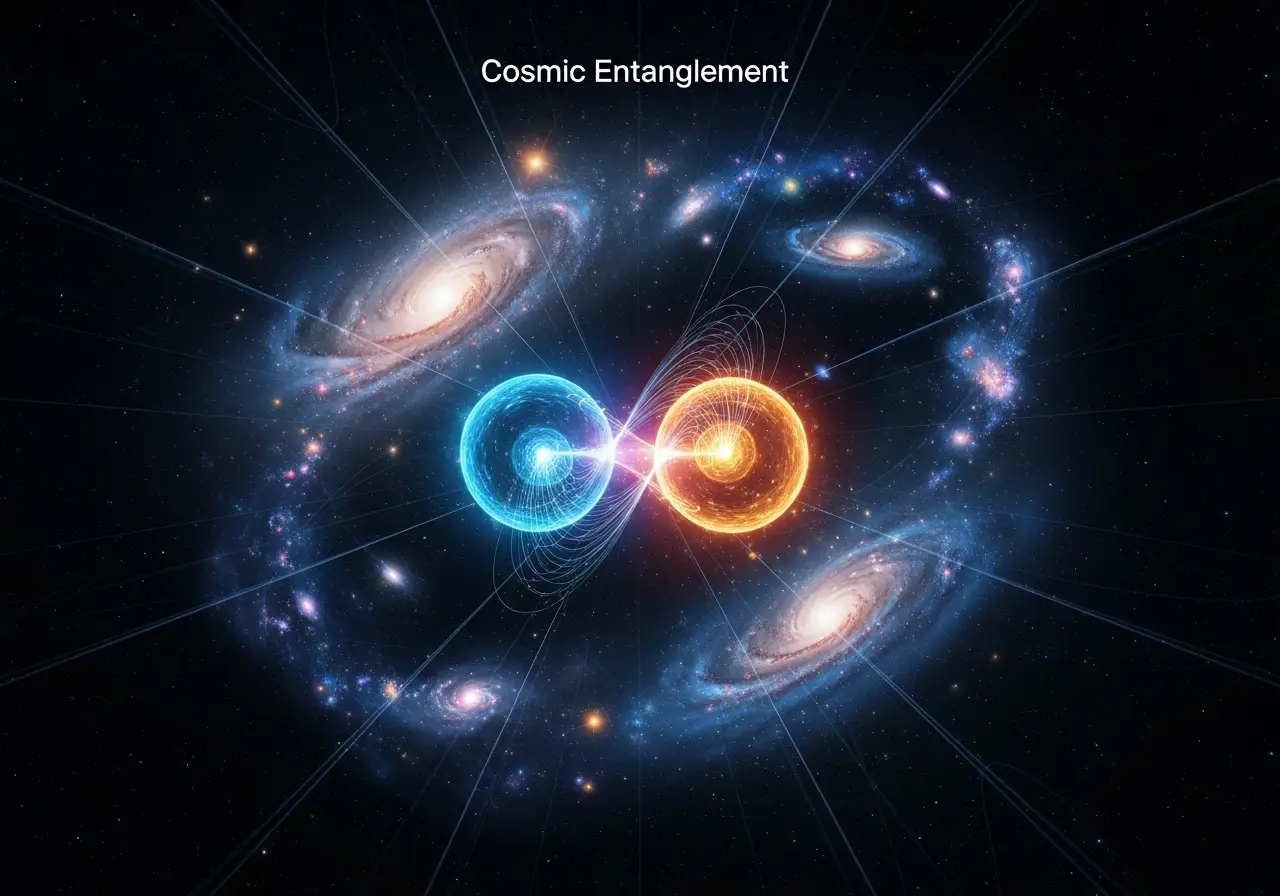

Bell’s Theorem offers a peek into a world where particles defy traditional notions of distance and separation, shattering our classical understanding of reality. Imagine observing two particles—Alice and Bob—experiencing an instant connection despite being galaxies apart. When Alice’s state changes, Bob’s follows suit, suggesting a bond deeper than any physical distance could allow.
Bell’s discoveries challenge the idea of local hidden variables. Imagine if all the underlying secrets of the universe were tucked into neat boxes. Experiments based on his theorem reveal that these boxes don’t contain what we expect. Instead of fitting into classical realism, the outcomes show a universe more nuanced and interconnected than previously thought.
The impact of these revelations stretches beyond physics, hinting at a universe where our sense of separation might be an illusion. Consider the implications for human experience: perhaps our thoughts and emotions resonate on a cosmic scale, urging us to rethink our interconnectedness. All of this is underpinned by experimental evidence that defies intuition, from unusual particle behaviors to potential advances like quantum computing and secure communication.
Everyday life may seem unchanged, yet these findings whisper of a reality where our connections run deeper than coffee chats or daily routines. The promise of quantum entanglement isn’t just scientific; it’s a call to explore the fundamental ties we share with the universe—and each other. Bell’s theorem pushes us to reflect on these cosmic bonds and their mysterious, transformative potential.