
Our universe is a mystery—a delicate weave of consciousness and the unseen hands of gravity. Dive into Orch-OR Theory, a venture into the cosmic dance of Orchestrated Objective Reduction. Think of quantum particles as dancers in a grand show, guided not merely by observation, but by gravity’s invisible influence. Strip away layers of this theory, and you’ll find a narrative that questions our understanding of awareness and reality—hinting at a symphony that unites our consciousness with the universe’s core.
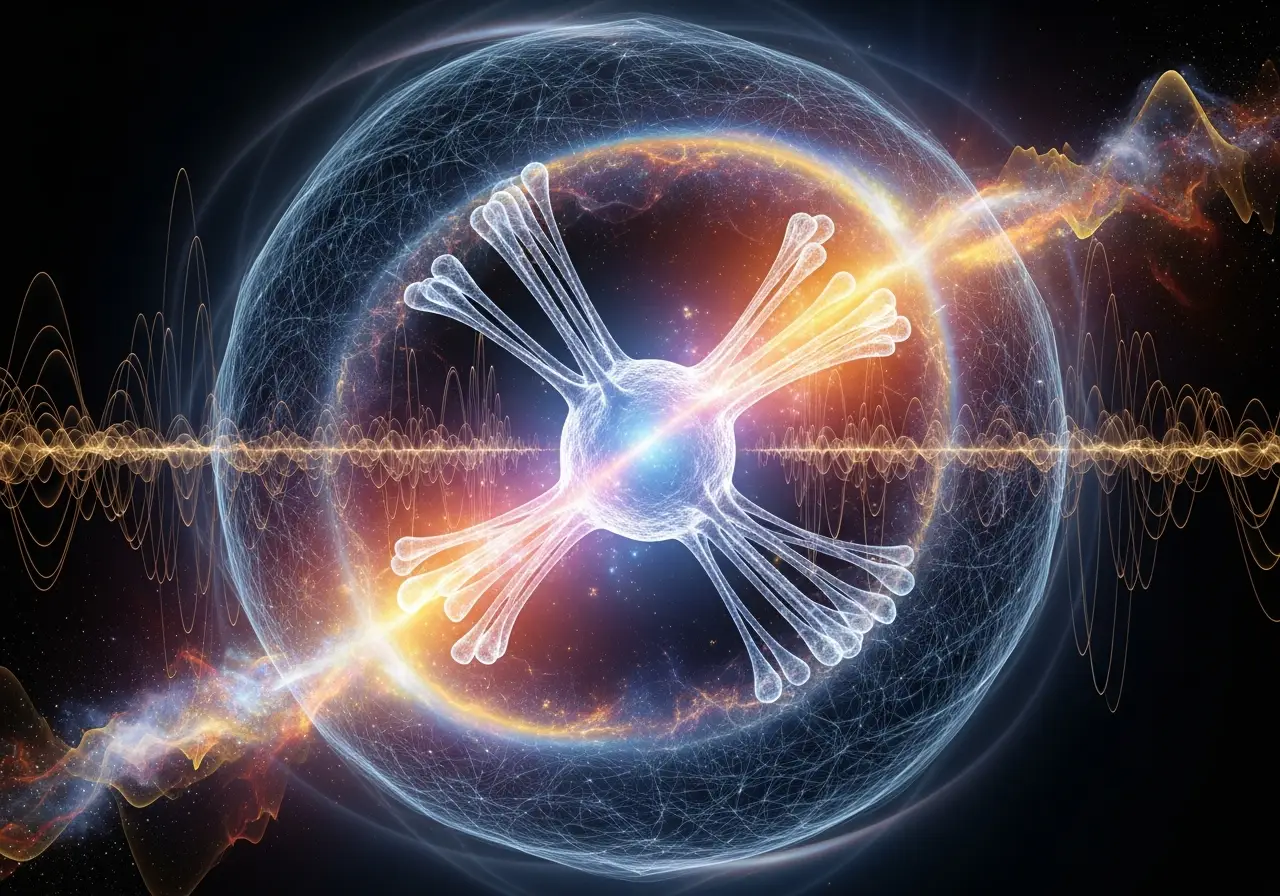
At Orch-OR’s heart is the idea that quantum mechanics might be intertwined with the physical structure of our neurons, particularly microtubules. These tube-like structures may be bustling hubs where particles interact in a whirlpool of possibilities. Their leap into definitive states could be swayed not only by our observation but by gravitational shifts. It’s a thrilling theory suggesting gravity’s unseen hand shapes the reality we perceive.
This theory challenges conventional views. What if the universe isn’t solely crafted by our consciousness but operates on principles much like falling dominoes—responsive to gravity’s subtle cues? Orch-OR suggests that consciousness might simply witness a ballet long choreographed by the fundamental forces of physics.
Microtubules play a crucial role here, possibly acting as intermediaries in this gravity-influenced dance. They may not just conduct thoughts; they might enable the transition of quantum probabilities into reality, steered by gravity’s touch.
While it’s an enticing thought, Orch-OR has its skeptics. Many argue gravity alone doesn’t capture the full scope of human consciousness or experiences. They believe saying consciousness is merely a byproduct of gravity is like claiming a masterpiece is just random colors. Nevertheless, Orch-OR argues for an interconnected tapestry where particles and consciousness both feel the quantum and gravitational sway.
What stands out about Orch-OR is its shift away from a purely mechanical universe view. Here, gravity doesn’t just sit back; it actively shapes reality, supporting the quantum dance of life. It echoes ancient ideas suggesting connections within a greater whole—a cosmic puzzle where each piece springs to life through the gravitational ties knitting them together.
Orch-OR beckons us to shift how we perceive reality. Could thinking be both a child of consciousness and a note in the universe’s cosmic symphony? Picture our perceptions, emotions, and beliefs not as reactions to chaos but as parts of a quantum masterpiece—moved and molded by gravity’s rhythm.
This theory isn’t just a scientific venture; it’s a lens to gauge reality’s multifaceted grandeur. Each thought and meditation could be a key to quantum change—grounding us as active artists in the universe’s grand concerto, unified by gravity’s grace. Orch-OR challenges us to embrace a universe woven with consciousness, urging us to rethink our roles as both observers and creators in the cosmic narrative.