
Welcome to the intriguing realm of Quantum Debugging! Here, we dive into a universe where precision meets probability, and our traditional understanding is constantly challenged by the quirks of qubits. Imagine yourself as a quantum detective, unraveling the mysteries hidden within the quantum code and transforming errors into opportunities for learning and innovation. Every misstep in this realm echoes like a cosmic glitch, urging us to look closer, understand better, and innovate further.
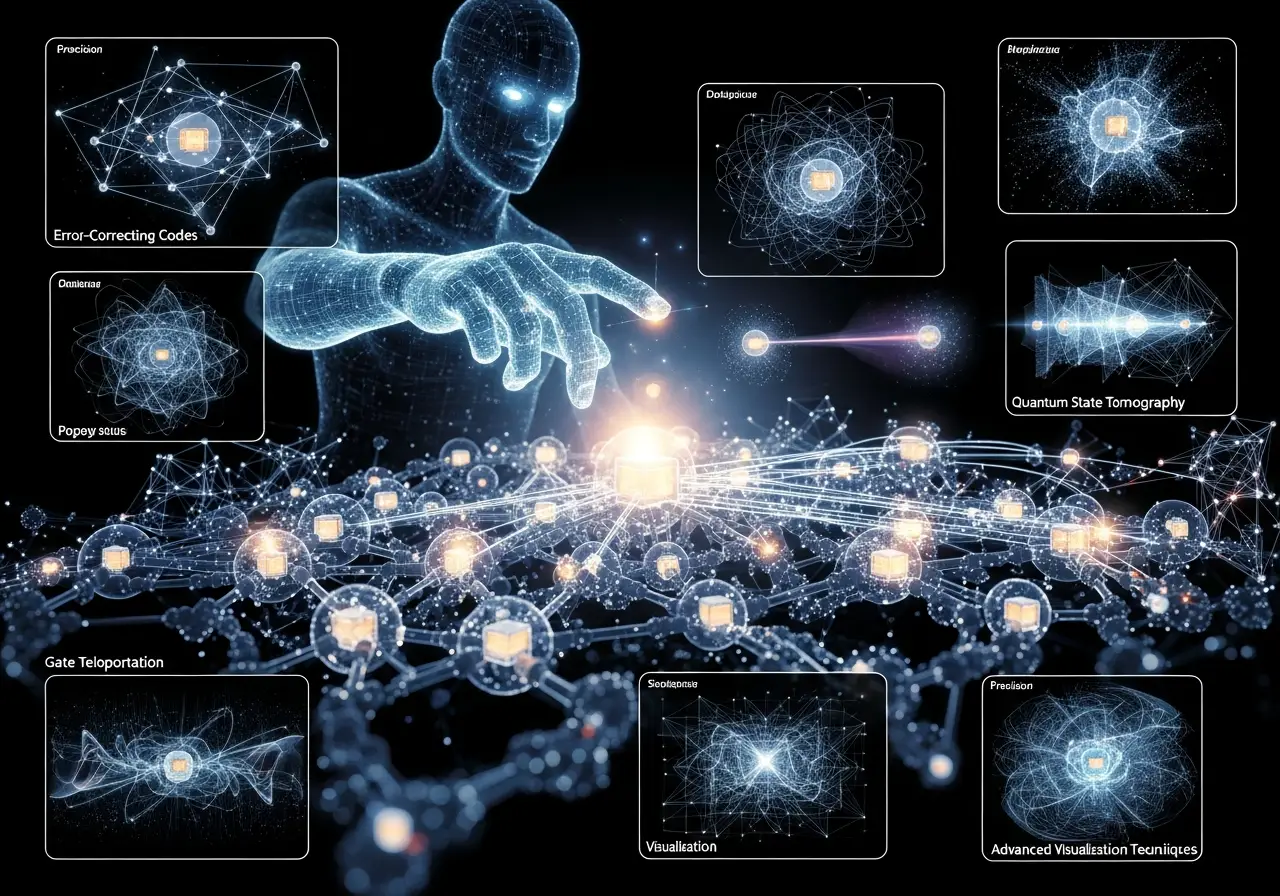
Picture each quantum program as an intricate tapestry woven with threads of superposition and entanglement. Our mission? To maintain the coherence of this delicate weave. The methods at our disposal are as fascinating as the challenges we face. “Error-correcting codes” are our steadfast allies, allowing us to identify and mend disruptions in the quantum fabric, much like enhancing a storyline by ensuring every thread is in place.
Through “quantum state tomography,” we channel our inner explorers, taking snapshots of our systems to reveal hidden truths about qubit states and their interactions. This approach offers a deeper comprehension of the delicate balance between coherence and distortion—a balance crucial for the success of any quantum computation.
Then, there’s the art of “gate teleportation,” which lets us sidestep errors by rerouting quantum information. This technique empowers us to navigate around potential pitfalls, maintaining the integrity of our calculations. It’s similar to finding an alternative path when the usual road is blocked, ensuring that our journey continues smoothly.
Our journey into network theory reveals unexpected allies in mapping the interconnections of our quantum systems. By understanding how qubits interact and influence each other, we can manage their dynamics like curating a cosmic social network, identifying patterns that alert us before small hiccups become major hurdles.
Visualization techniques transform complex data into engaging narratives, spotlighting misalignments and inviting correction with clarity and creativity. This makes the error detection process not just effective, but also visually stimulating and easier to comprehend.
Simulations provide a playground to experiment with quantum interactions safely, identifying potential issues before they manifest in practice. It’s a bit like rehearsing a play—you get to work out the kinks before the actual performance.
Our exploration of Quantum Debugging isn’t merely about fixing issues; it’s about embracing the unpredictability and understanding more deeply how our reality is constructed at a fundamental level. So, grab your detective hat, and let’s uncover the wonders and potentials hidden within the quantum realm. As we refine these techniques together, we embark on a journey to truly connect with the mysteries of the universe.