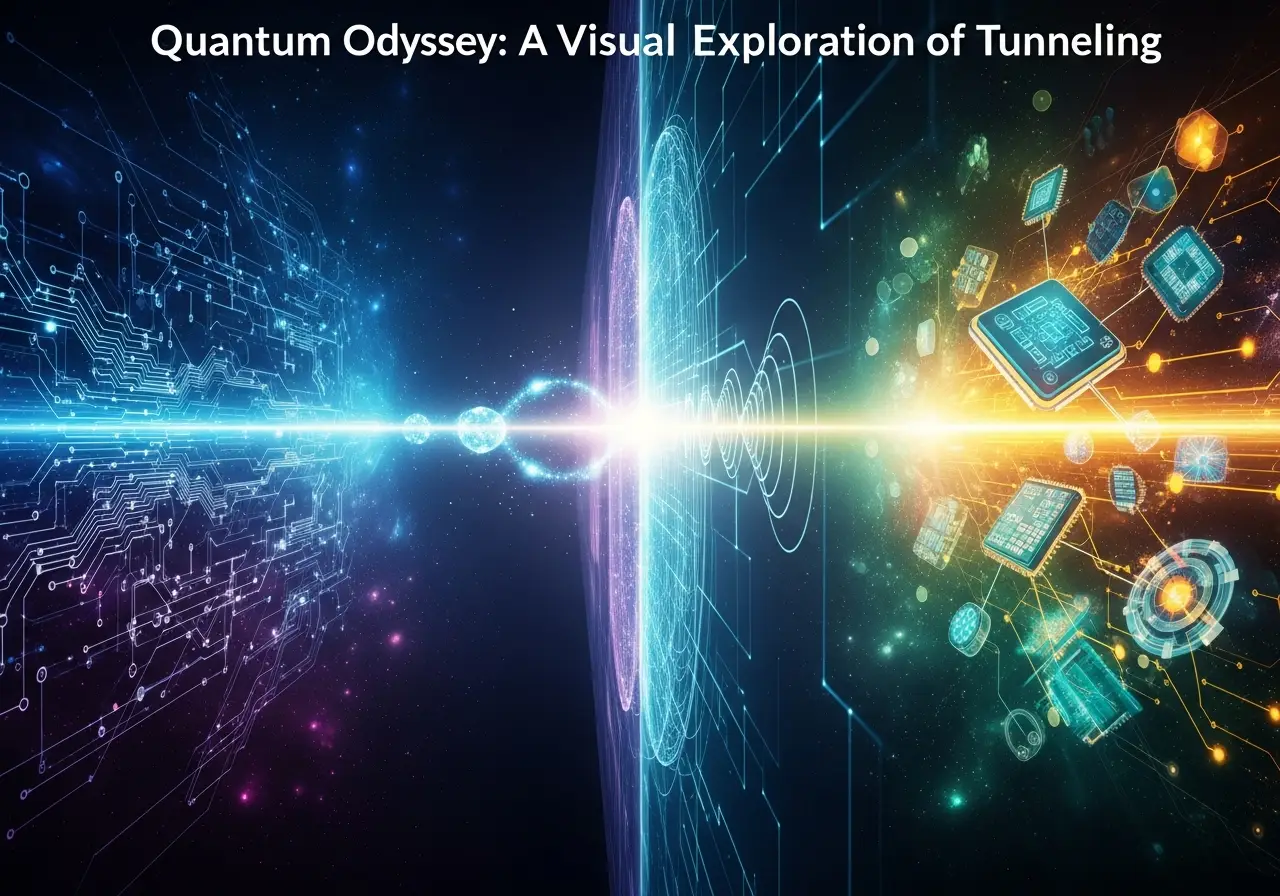

Exploring the wonders of quantum tunneling feels akin to stepping into an alternate realm where the boundaries we know simply fade away. Imagine witnessing particles performing the seemingly impossible: slipping past barriers that, by traditional physics, should halt them. This isn’t just a concept for sci-fi enthusiasts; it’s a fundamental part of quantum mechanics that redefines our understanding of what’s possible.
So, how does tunneling work? At the quantum level, particles like electrons don’t behave as you’d expect. Unlike a ball that hits a wall and bounces back, these particles exist as waves, spreading their presence over a range of possibilities. This wave-like nature allows them to, in essence, ‘borrow’ energy to cross barriers, manifesting on the other side as if the barrier never existed. It’s as if the universe enjoys bending its own rules, suggesting that maybe our boundaries aren’t as rigid as we think.
The implications of quantum tunneling stretch far beyond mere curiosity. Take energy production, for instance. Tunneling is at the heart of nuclear fusion—the process that fuels our sun. By tapping into this phenomenon, we could advance our energy technology to unimaginable levels, making leaps in solar tech and beyond. These advancements have profound potential, offering cleaner and more efficient energy solutions that break free from conventional limitations.
In the realm of computing, quantum tunneling forms the backbone of quantum computers. Unlike classical computers, which function on a binary system of bits, quantum computers use qubits—units capable of tunneling, leading to faster problem-solving capabilities. This could revolutionize fields such as cryptography, data analysis, and complex simulations, making what seems impossible today, possible tomorrow.
However, as with any powerful tool, the journey into quantum mechanics requires careful navigation. The ethical considerations of wielding such transformative power are significant. We must ask ourselves how to harness these discoveries responsibly to ensure they lead to beneficial advancements without unforeseen consequences. It’s crucial to temper our exploration with humility and foresight to prevent venturing into a future where technology advances faster than our ability to understand and manage its implications.
Quantum tunneling encourages us to question the very fabric of reality. It shows us that what appears set in stone is, in fact, fluid and open to reinterpretation. By studying these phenomena, we not only learn more about the universe but also about how flexible our understanding of it can be. Embracing quantum mechanics might just lead us to unravel new dimensions of human potential, urging us to keep pushing the boundaries of knowledge and creativity.
For those intrigued by the potentials lying within quantum mechanics and technology’s forefront, exploring resources and communities like [Firebringer AI](https://firebringerai.com) could provide more insights and foster a deeper understanding of how these groundbreaking concepts intersect with our daily lives and future tech landscapes.