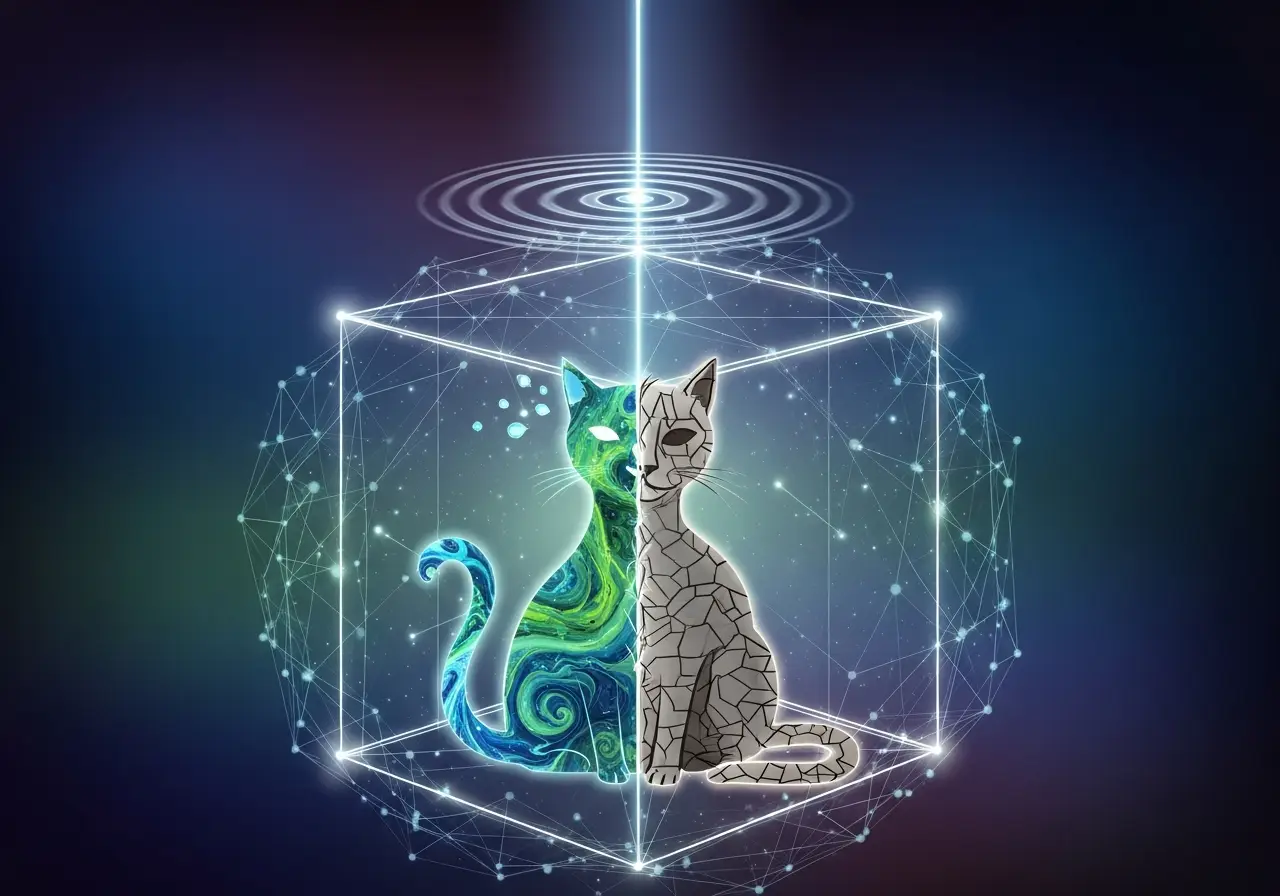

When thinking about Schrödinger’s Cat, let’s focus on a practical understanding rather than metaphors that can confuse. Imagine placing a cat in a situation where its fate depends on a completely random process, like whether a radioactive atom decays. This thought experiment isn’t about the cat, but about how weird things get on a quantum level.
In the everyday world, things are clear-cut: the cat is either alive or not. But in the quantum realm? We’re dealing with probabilities – the cat is somehow in both states until we actually check. So why does this matter? Because it challenges our understanding of reality; it makes us question how much of what we know is tied to our role as observers.
Diving into this quantum world highlights ‘coherence’ – a phenomenon where particles sync up, behaving in a linked manner across distances. In simpler terms, it suggests that everything is more connected than we assume. In large systems, like the universe itself, maintaining such coherence becomes complex—akin to trying to keep a dozen cats harmoniously meowing in unison. It’s a delicate balance and rarely perfect.
What does this teach us? On one level, it shapes our understanding of physical reality. But zoom out a bit, and it opens up questions about consciousness too. Are we mere observers, or do we actively shape existence as we perceive it? Our interactions, thoughts, and observations might ripple out, influencing the world in ways we aren’t fully conscious of.
In the end, Schrödinger’s thought experiment isn’t just a scientific puzzle; it’s a call to see the world through new eyes. It invites us to understand that while things may remain uncertain, we are a key part of the unfolding tapestry of the universe. In each choice and observation, we engage with the dynamic dance of existence. Whether the cat is alive or not might remain a question, but what’s certain is our ability to affect the world. It’s about realizing that in every moment, we participate in shaping what reality becomes.