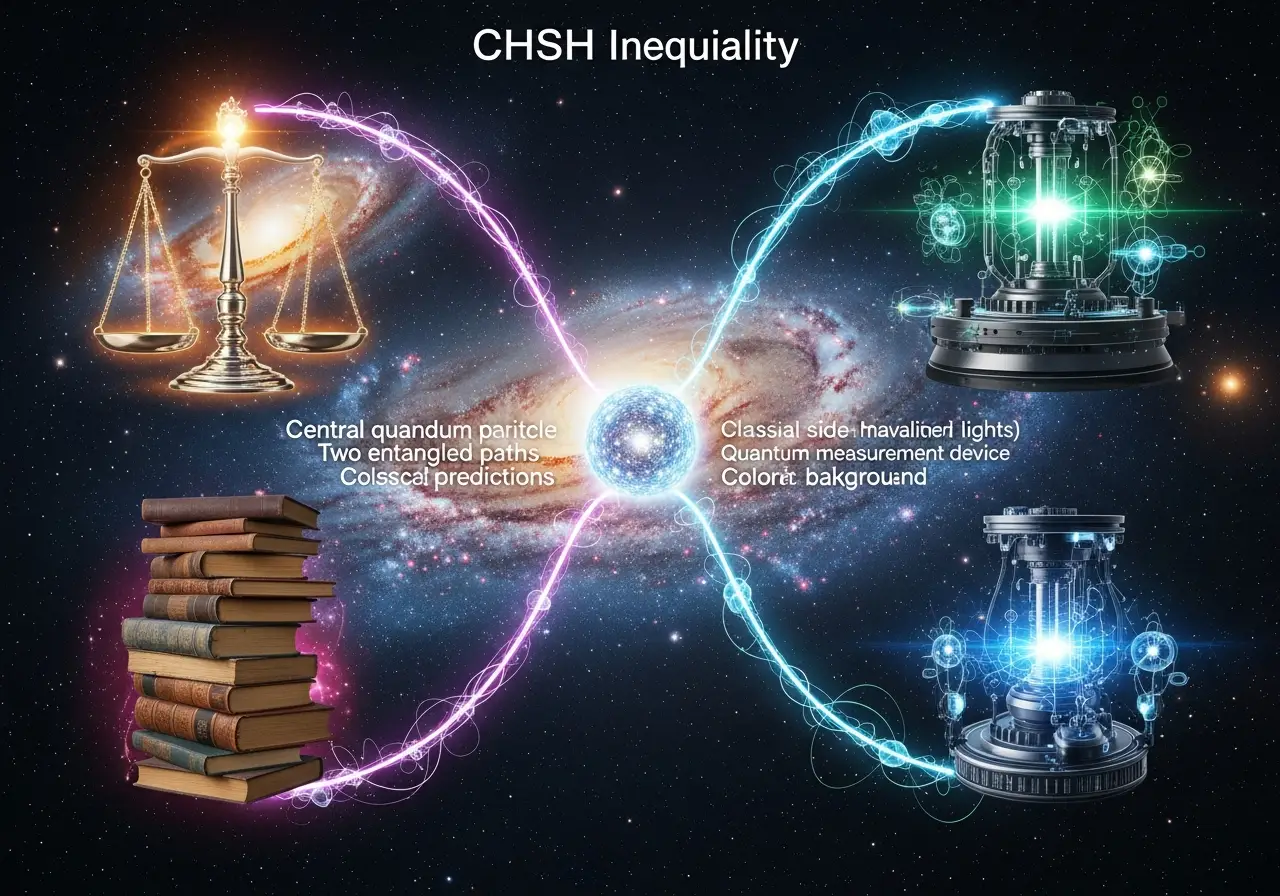

At the heart of quantum mechanics lies a fascinating concept that compels us to rethink the fabric of reality: the CHSH inequality. This mathematical construct, named after physicists John Clauser, Michael Horne, Abner Shimony, and Richard Holt, serves as a critical juncture between the determinism of classical physics and the unpredictable wonders of quantum theory. It quantifies the divergence in predictions offered by these philosophies, casting light on the intriguing behaviors of entangled particles that defy conventional wisdom.
Over the years, experimental physicists have become adept at exploring these quantum contexts, illustrating how quantum particles—with their ability to exist in superpositions—consistently outmaneuver classical expectations. Picture scientists tactfully exchanging their traditional lab coats for an artist’s palette, where entangled particles behave like mystical brushstrokes on the canvas of reality.
The measurements afforded by the CHSH inequality dramatize the stark contrast between classical anticipation and quantum reality. Classical physics, with its well-behaved determinism, assumes predetermined values—a comfortable predictability. Quantum mechanics, on the other hand, reveals a lively interplay where observing one particle instantaneously influences another, no matter the vast distance between them. It’s akin to sharing an inexplicable connection with someone far away, reminding us that our entangled particles mirror a familial bond, one that challenges our understanding of distance and independence.
This revelation extends beyond academia, urging us to reconsider our own existence and relationships. If quantum mechanics illustrates such profound interconnections, could it be mirroring deeper truths about human connections—those emotional, spiritual, and social bonds we often overlook? The experiments around the CHSH inequality reflect a universe woven with threads of interconnectedness, suggesting our reality is more intricate than previously imagined.
Despite the awe it inspires, the study of quantum mechanics is not without its skeptics. Some critics ponder whether our experiments merely showcase the boundaries of our contemporary understanding rather than unlocking the universe’s secrets. Each question propels us further into intellectual exploration, nudging us to embrace the mystery and complexity of quantum theory.
Journeying through the realms of quantum mechanics with the CHSH inequality as our guide, we are called to meditate on our role within the universe. Are we passive witnesses to a world already written, or active participants capable of shaping reality itself? With each recalibration of our worldview spurred by these experiments, we embark on a new path towards understanding.
In this journey, whether you’re delving deeply into these concepts or beginning to explore them, engaging with the CHSH inequality is more than an intellectual exercise. It’s an invitation to challenge our perceptions and connect with the universe on a more profound level. So, engage in this revealing narrative, recognizing the astonishing connections that quantum mechanics continues to illuminate.