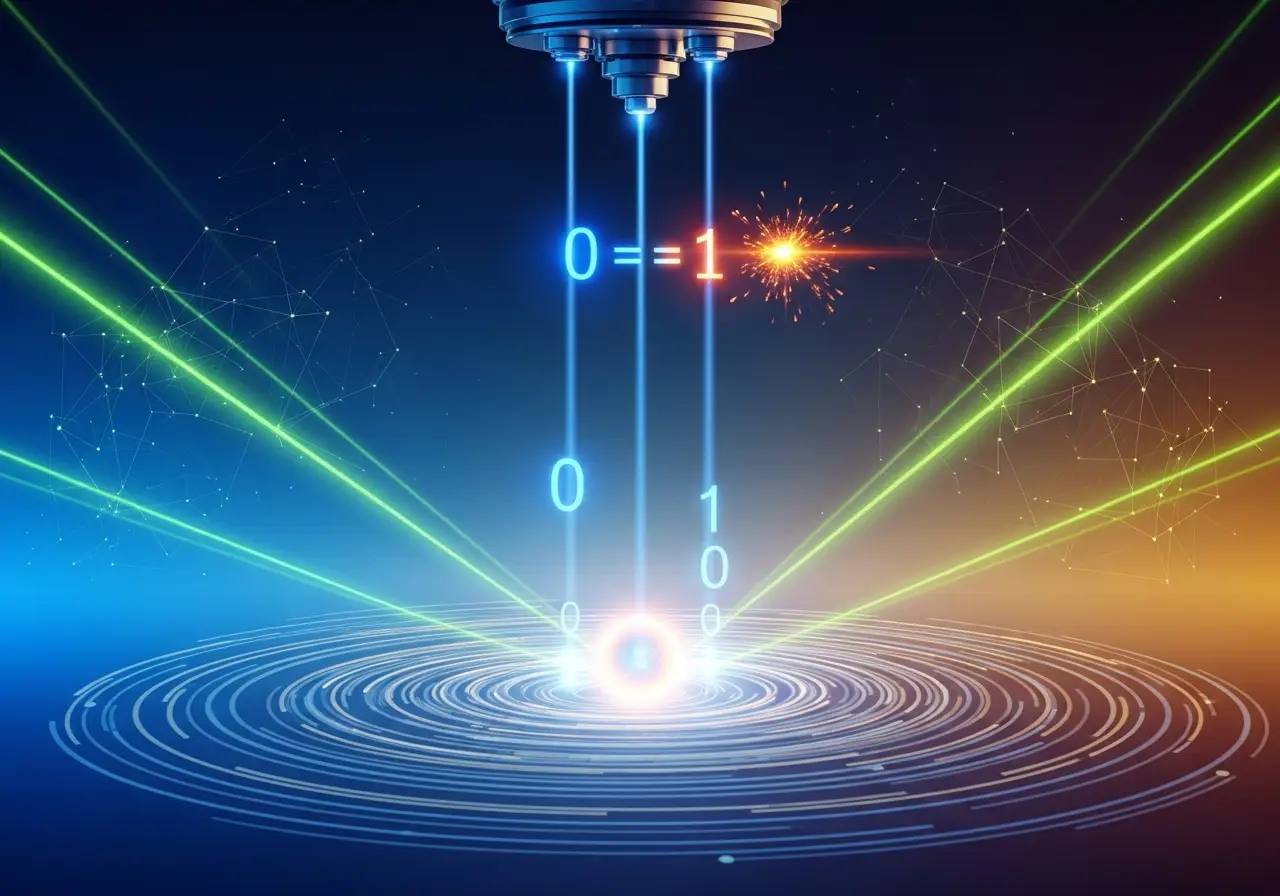

Forget the million-qubit fantasies for a second. Let’s talk about what’s actually *on* the wire today. We’ve been running ECDLP instances, yes, actual cryptographically relevant ones, on NISQ machines. How? Not by magically fixing gates or fighting decoherence at the gate level with brute-force error correction schemes that chew up qubit counts. No. We’re winning by treating the measurement outcome itself as a primary signal, not just the final, noisy byproduct. This is the core of what we call **measurement hygiene**.
Measurement Hygiene for NISQ Hardware
Think about it. Your hardware has a fingerprint. It has a set of quirks, some predictable, some… less so. The common approach is to just churn through shots, hoping the noise averages out, or to apply complex, gate-level error correction that requires more qubits and more coherence than you actually have. That’s like trying to clean a dirty window by scrubbing the entire house. It’s inefficient and misses the point. The real bottleneck? It’s the readout. It’s the latency, the crosstalk, the occasional rogue signal that completely skews your results. This is where **measurement hygiene** comes into play. It’s not about post-processing data *after* the fact as a band-aid. It’s about building the measurement discipline *into* the quantum program itself.
Hardware-Aware Circuit Design for ECDLP
Consider a benchmark: recovering a 21-qubit ECDLP key. The textbooks, the ones talking about fault tolerance, would tell you this is firmly in the “future” category. Yet, we’ve run this on actual hardware. The key wasn’t in pushing gate fidelity to absurd theoretical limits. It was in constructing circuits—recursive geometric circuits, by the way, not some flat, textbook layout—that inherently exploit hardware characteristics. These circuits are designed such that coherent errors partially cancel out. But more critically, they are wrapped in the V5 measurement discipline.
Signal in the Noise: Measurement Hygiene for NISQ Hardware
The difference is stark. Instead of treating noise as an enemy to be vanquished at the gate level, we treat patterns in the noise, particularly around readout, as *signal*. It’s about calibration-aware routing, yes, but it’s more fundamentally about understanding the *fingerprint* of your backend and designing your program to be resilient to its specific measurement noise.
NISQ Hardware Measurement Hygiene
This isn’t about reinventing quantum mechanics. It’s about pragmatism. It’s about acknowledging that NISQ hardware has limitations, and rather than waiting for a mythical future of perfect qubits, we exploit the observable characteristics of *today’s* hardware. The academic rebels and boundary-pushing programmers out there: stop waiting for the textbooks to catch up. Your next benchmark isn’t a deeper logical qubit layer; it’s cleaner, more disciplined measurement. It’s **measurement hygiene**. Test it. Adapt it. See how far you can push your current hardware. You might be surprised at what you can recover.
For More Check Out