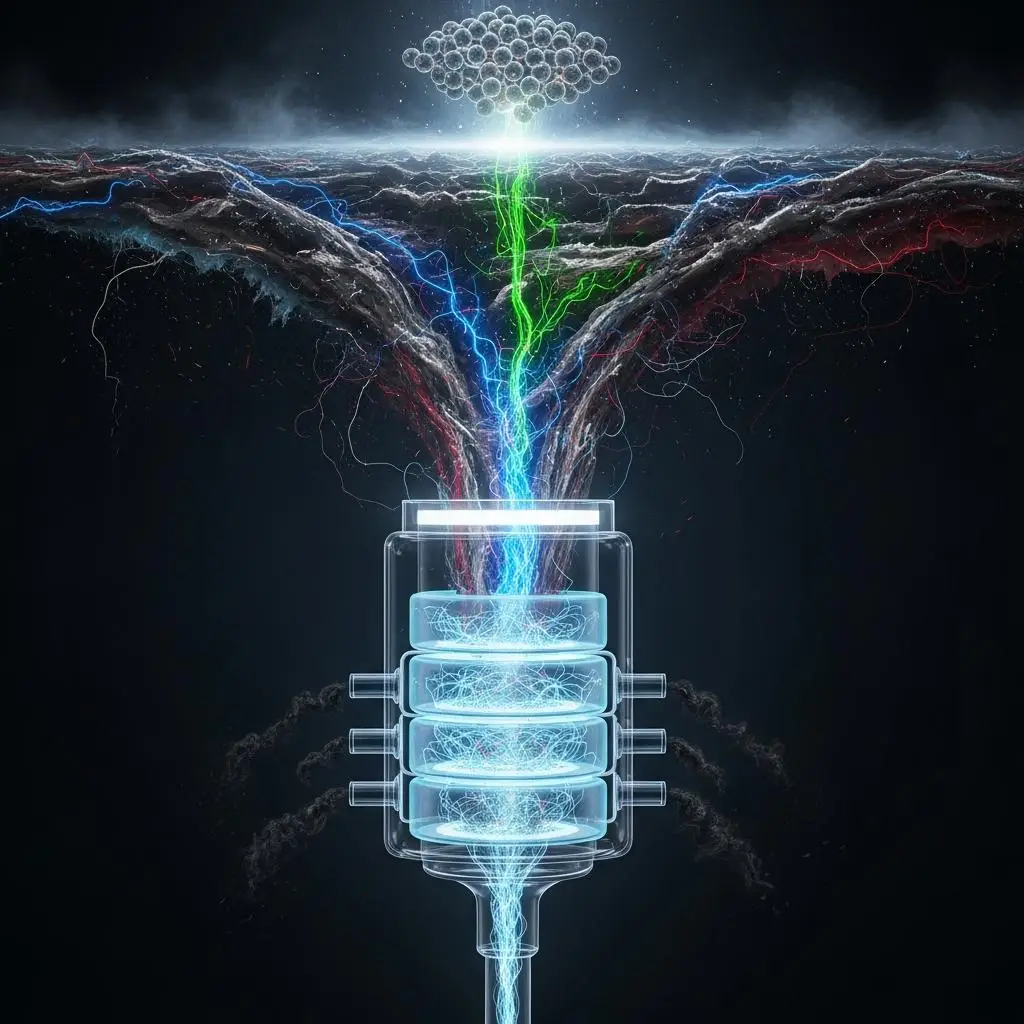

Alright, let’s cut through the noise. Everyone’s chasing quantum error correction like it’s the silver bullet for NISQ hardware, spending cycles dreaming of fault-tolerant architectures that are a decade out. But here’s the cold, hard truth from the trenches: the real bottleneck is the racket at the measurement stage.
Surgical Measurement Hygiene for NISQ Hardware
This isn’t about wishing for better hardware; it’s about *using* what we have with surgical precision. The V5 framework isn’t some abstract theoretical construct; it’s a set of pragmatic, device-aware techniques focused squarely on post-measurement data discipline. The V5 approach to measurement hygiene is about identifying “orphaned” measurement shots and filtering these out *before* they poison the pool of results.
NISQ Measurement Hygiene for Hardware Anomalies
If you isolate and filter measurement shots that exhibit statistical anomalies (orphans, unitary contamination signatures), can you achieve demonstrably higher fidelity on algorithms like Shor’s or ECDLP on your target NISQ backend, *without* resorting to heavy, resource-intensive error correction codes designed for a different era?
Rigorous Measurement Hygiene for NISQ Hardware
Our work is showing that by applying stringent **measurement hygiene** – essentially, disciplined measurement and postselection – we can drastically improve the effective SPAM fidelity. We’re seeing benchmarks that should, on paper, require an astronomical number of logical qubits, resolved on actual, physical machines.
Measurement Hygiene: Unlocking NISQ Hardware Potential
See how that impacts your results. Because if you can clean the signal at the source – the measurement – you might find that the perceived limits of NISQ hardware are, in fact, just a symptom of messy data.
For More Check Out