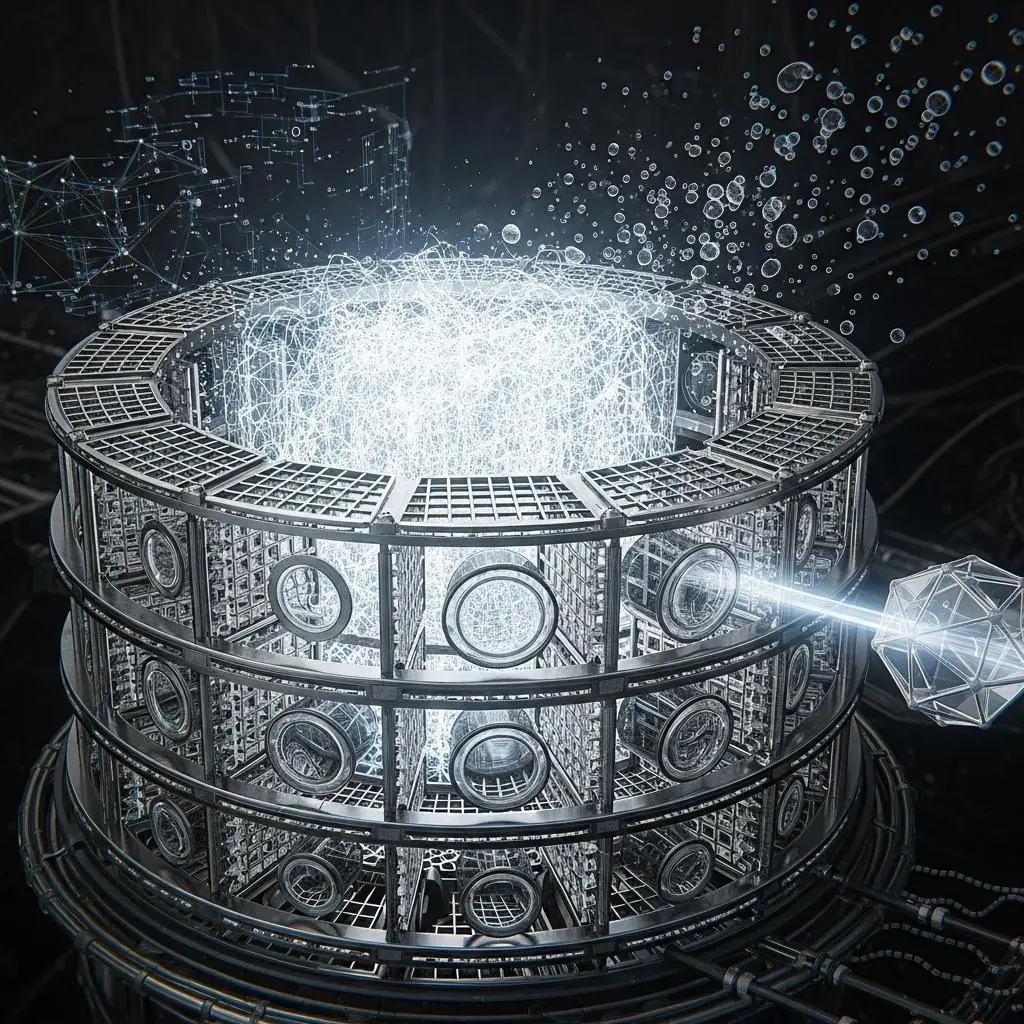


Alright, let’s cut through the noise. The reality is, fault tolerance isn’t arriving on my doorstep next Tuesday. The textbooks still harp on about topological quantum error correction like it’s the silver bullet, but let’s be honest, that’s some serious 2035 slideware we’re talking about.
Beyond Topological Quantum Error Correction: Embracing Imperfect Qubits
So, what if I told you we’re pulling real, tangible value out of quantum systems *today*? And not by pretending the noise isn’t there, but by treating it as… well, as a signal we can actually use. Stop chasing phantom perfect qubits and stop waiting for the mythical promise of topological quantum error correction. The immediate payoff is staring you in the face: understand the hardware you *actually* have. Grasp its limitations, its weird quirks, its unique *fingerprint*, and then build techniques that weaponize that noise for a quantifiable edge. We’re pushing these NISQ boxes past their assumed boundaries, not waiting for some idealized future state. This isn’t about academic purity; it’s about what’s *working* on the actual silicon, right now.
Topological Quantum Error Correction: Embracing Imperfect Qubits
Consider this: Your circuit runs. You get a readout. Most folks just see errors and throw out the shot. But what if those “errors” – those anomalous measurement outcomes, those slight deviations from the expected stabilizer structure – are actually telling you something specific about the hardware’s current state? We’re talking about the V5 orphan measurement exclusion strategy. It’s not about correcting errors after the fact with complex, resource-heavy schemes. It’s about building measurement discipline *into* the programming model itself. You identify those shots that just don’t fit the pattern – the ones where a few qubits are doing something… off. Instead of just discarding them blindly, you’re actively *down-weighting* them based on their statistical inconsistency. This isn’t about tweaking noise models; it’s about designing your computation to *detect* and *isolate* measurement noise.
Recursive Geometric Circuits for Topological Quantum Error Correction
Now, how do you leverage this? Think about recursive geometric circuits. Forget flat, one-shot layouts. We’re embedding computations within self-similar structures of entangling operations. The idea is that symmetry within these motifs means calibration errors tend to anti-correlate across layers. Partial substructures can act as built-in benchmarks for local error, giving you real-time intel for dynamic transpilation. These aren’t abstract, theoretical constructs; they’re practical ways to make your gate operations more robust against the *actual* noise profile of a specific backend. The benchmark? We’re pushing non-trivial Elliptic Curve Discrete Logarithm Problems (ECDLP) on hardware that the textbooks would deem utterly insufficient. We’re implementing Shor-style period-finding, yes, but using Regev-inspired, more noise-tolerant subroutines. The key is mapping those elliptic curve group operations onto the *recursive-geometric*, error-mitigated patterns. So, each curve operation is algorithmically correct, but physically realized in a way that cancels a significant fraction of coherent errors. Wrap that whole process in the V5 measurement discipline, and you discard the shots that signal anomalous behavior. You reconstruct the hidden period from the surviving, higher-fidelity data.
Topological Quantum Error Correction: Pushing Practical Limits
This isn’t a pipe dream. This is how we’re resolving ECDLP instances on current devices that, under standard assumptions of flat circuits and conventional noise models, would look *beyond reach*. The takeaway for you, the quantum programmer looking to push boundaries: careful quantum programming – geometry, recursion, and measurement logic – extends the practical edge of what today’s hardware can do. You don’t need to wait for a million logical qubits. Start with what you have. Analyze its fingerprint. Build your program to exploit the signal within the noise. Prove it. Set the new benchmark.
For More Check Out