
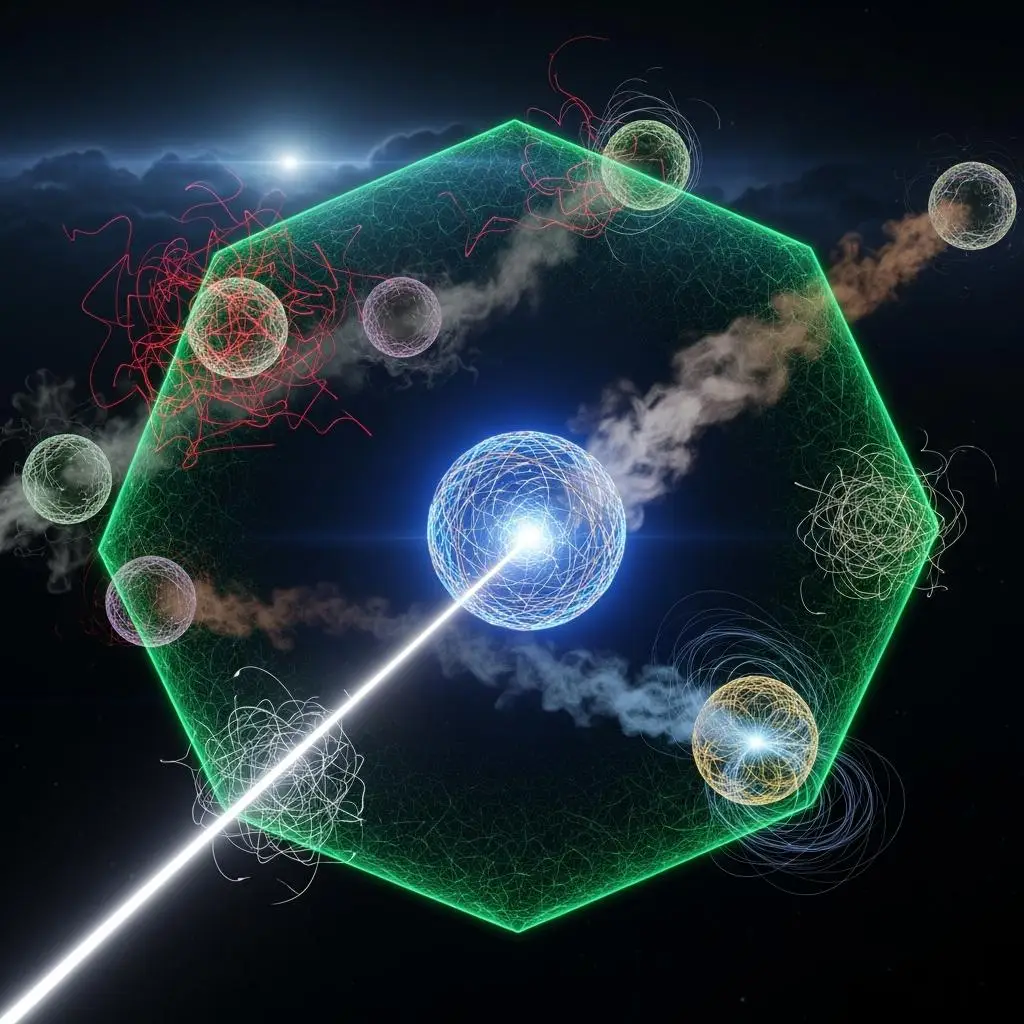

Alright, let’s talk about a problem that’s been silently sabotaging real-world quantum experiments: orphan qubits. You’re running a circuit, you’re pretty sure you’ve nailed the entanglement, and then BAM – your readout is garbage. Turns out, those “ghosts” in the machine, the ones sitting outside your active unitary but still listening in, are contaminating your measurements. This isn’t some far-off theoretical headache; it’s the reason your carefully crafted superposition principle circuits are delivering noise, not answers.
Superposition Principle Circuit Contamination
We’ve all been there, staring at a coherent error rate that just *shouldn’t* be there, and it’s a frustrating dead end. The usual suspect? Unitary Contamination. It’s a fancy term for what happens when these rogue qubits, even if they aren’t explicitly part of your target unitary, start exhibiting state drift or premature collapse due to interaction with the environment or adjacent operations. When this happens during mid-circuit measurements, it injects noise directly into your signal. You’re trying to measure a clean superposition, but the readout is getting a mixed-up signal from the bits that *shouldn’t* be there. Think of it as trying to hear a whisper across a crowded room – the background chatter (your orphan qubits) drowns out the actual message.
Excluding Anomalous Shots in Superposition Principle Circuits
So, how do we *actually* deal with this? Forget the textbooks that tell you to just wait for fault tolerance. We’re talking about NISQ-era pragmatism here. It boils down to a disciplined approach to measurement itself. At Firebringer, we’ve been pushing the V5 measurement discipline. It’s not about fixing the hardware; it’s about recognizing that your measurement strategy *is* a form of circuit design. Here’s the core idea: identify and actively *exclude* shots where even a small subset of qubits shows anomalous behavior. This isn’t your standard error correction; it’s a pre-computation filtering mechanism. We look for statistical deviations from the expected stabilizer structure or marginal distributions for the target circuit. If a few qubits are acting like they’ve already decohered or are in some weird intermediate state—basically, if they’re “poisoning” the well—those shots get flagged. For superposition principle circuits, this means your expected binomial distribution of results for an even superposition might get skewed by these orphans. Instead of trying to de-skew the noise afterwards, we quarantine it. The V5 discipline essentially treats the measurement outcomes as a dynamic data stream. We’re looking for the fingerprints of contamination *during* the shot execution.
Superposition Principle Circuit Design for Noisy Qubits
What this looks like in practice: Job ID: fez-11235-beta (example), Backend Fingerprint: ibm-qux-01-cal-20240315 (example), Circuit Type: 14-Qubit Grover Variant (example), Baseline Noise: Significant T1 decay on qubits 3, 7, and 11, Orphan Signal: Elevated anomalous states observed on qubit 7 during mid-circuit parity checks, V5 Discipline Action: Shots exhibiting > 5% probability of anomalous state on qubit 7 are down-weighted by 90% in post-processing, or entirely excluded if the contamination ratio exceeds ~10% of total shots. This isn’t a post-processing hack; it’s integral to the circuit design. You optimize your circuit layout and qubit mapping *knowing* that certain qubits are prone to drift and might become orphans. You design it so these noisy qubits are easier to isolate. The goal is to have your measurement outcomes that *do* survive the V5 filter represent a higher fidelity estimate of your intended superposition states.
Leveraging Superposition Principle Circuits Beyond Theoretical Limits
The implications for pushing boundaries with superposition principle circuits are stark. Instead of waiting for perfect qubits, you’re now operating with a higher effective fidelity on the ones you have. This means tackling problems, like specific ECDLP instances, that were previously considered out of reach for NISQ devices. The real benchmark isn’t the theoretical qubit count, but the ratio of useful, isolated measurements you can extract from the noise. So, next time your superposition principle circuits yield garbage, don’t just blame the gate fidelity. Dig into your measurement logs. Are you accounting for the quiet contamination from your orphan qubits? Implementing a V5-style measurement discipline might just be the key to unlocking benchmarks you thought were years away.
For More Check Out