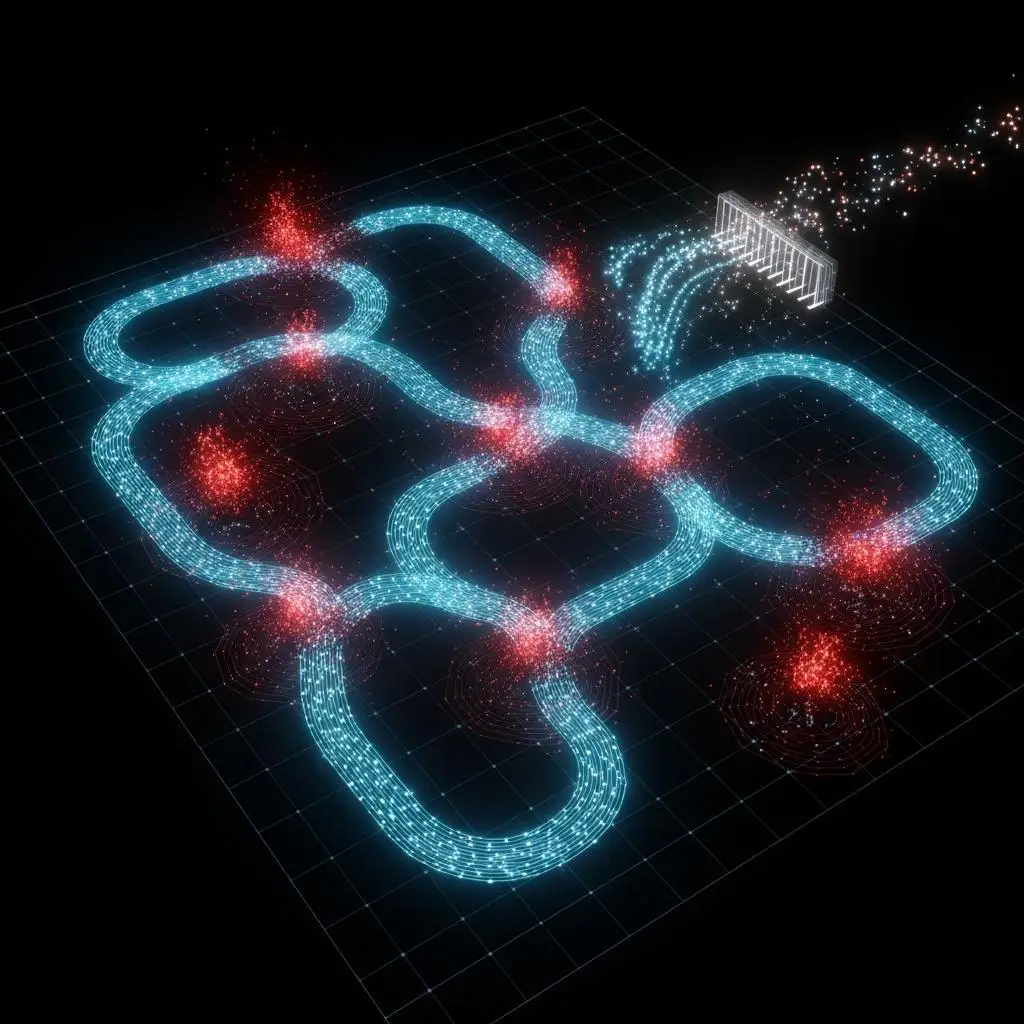

Alright, let’s talk about those pesky “Orphan Qubits” during mid-circuit measurements, especially when you’re deep in the weeds with superposition principle circuits. You’re fiddling with your quantum circuits, trying to get a handle on mid-circuit measurements, and then BAM – Orphan Qubits. They’re the ghosts in the machine, the ones you can’t quite shake, messing with your results and making you question everything you thought you knew about superposition.
The Superposition Principle Circuits and the Orphan Qubit Bottleneck
We’ve been wrestling with this noise floor, the kind that makes your V5 backend look like it’s broadcasting through a tin can. The standard narrative tells us to just add more qubits, stack layers of error correction, and wait for the fault-tolerant utopia. But that’s a decade out, and frankly, we’ve got work to do *now*. The real challenge, the one that’s killing production-scale quantum jobs, isn’t gate fidelity in a vacuum. It’s the **Bottleneck**: V5-scale measurement latency and readout constraints, exacerbated by the insidious Unitary Contamination from these Orphan Qubits.
Optimizing Superposition Principle Circuits: HOT Framework and Orphan Measurement Exclusion
So, what do we do? We stop treating noise as an abstract enemy and start treating it as an input. That’s where the **H.O.T. Framework** comes in. It’s a three-layer system built for the Quantum Present: **Hardware-Optimized Techniques (HOT)**, **Island-based Calibration Awareness**, and **Multi-Pass Post-Processing with Orphan Measurement Exclusion**.
Superposition Principle Circuits: Recursive Error Mitigation
Let’s talk concrete. We’ve successfully run **21-qubit ECDLP instances** on IBM Fez, achieving **14-bit ECDLP at rank 535/1038**. These weren’t toy problems. These were computations that, by standard resource estimates assuming flat circuits and no measurement discipline, should have failed spectacularly. The circuits weren’t “geometric” or “topological” in the sci-fi sense; they were recursive, leveraging symmetry to make coherent errors anti-correlate across layers.
Superposition Principle Circuits: Hardware Fingerprints and Poison Qubit Ratios
The key takeaway? Stop waiting for the million-qubit, fully fault-tolerant future. The practical boundary of what NISQ hardware can do is being pushed *today* by disciplined quantum programming: understanding your hardware’s **Fingerprint**, intelligently routing around weak qubits, and implementing robust measurement exclusion. If your current superposition principle circuit benchmarks are failing, look first at your readout and your poison qubit ratio. The ghosts in your machine are not imaginary; they are quantifiable, and they can be excluded.
For More Check Out