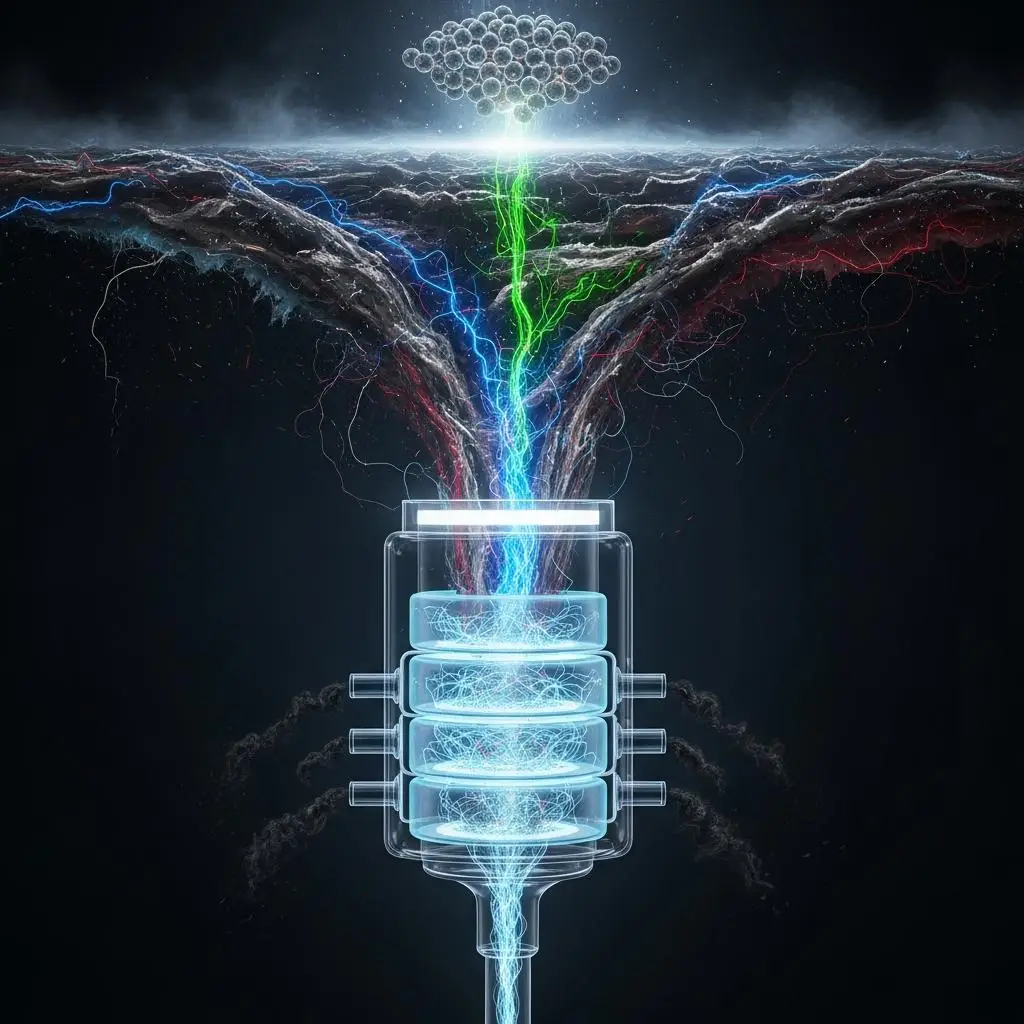

Your results look like a Jackson Pollock painting after meticulously calibrating gates, optimizing qubit connectivity, and watching your fidelity numbers tick up. The textbooks will tell you it’s gate errors, maybe decoherence. But you’re likely battling unitary contamination, a bleed-over from qubits that aren’t quite dead, subtly poisoning your computation during readout. If you’re not accounting for this, you’re fighting a phantom limb of coherence sabotaging your signal.
Unitary Contamination in Deep NISQ Circuits
Standard error correction models typically assume discrete errors or smooth decoherence. They don’t usually account for the complex interference patterns introduced by partially entangled or partially measured qubits. These aren’t simple bit-flips; this is coherent leakage that amplifies in deep NISQ circuits. We’ve observed this directly on backends like IBM Fez and others in the V5 scale.
Orphan Qubits: Unitary Contamination in Deep NISQ Circuits
Consider running a 21-qubit ECDLP instance with recursive geometric circuits, aiming for error cancellation. You anticipate success. During measurement, results become chaotic. The textbook answer is poor gates or high decoherence. However, what if a handful of “orphan qubits” retained coherence, subtly nudging the outcome of your entangled qubits? This is unitary contamination in action, a coherent error interfering with your signal.
Deep NISQ Circuits: Mitigating Unitary Contamination with Orphan Measurement Filtering
We’ve developed techniques like V5 orphan measurement exclusion to address this. It’s not just discarding bad shots; it’s identifying measurement outcomes where qubit statistics are inconsistent with the *intended* stabilizer structure of the computation. By down-weighting or excluding these contaminated shots *before* inference, we can significantly improve SPAM fidelity, treating measurement filtering as a core programming construct.
Navigating Unitary Contamination in Deep NISQ Circuits
Recognize this and stop assuming circuit failures are solely due to gate fidelity. Ask if unitary contamination, the ghost of coherence from semi-collapsed qubits, is the true bottleneck. Your benchmarks need to account for this. Your circuit design needs to actively route around or mitigate this specific type of signal poisoning. The next leap in NISQ utility won’t come from waiting for better hardware, but from understanding and engineering around the subtle, coherent errors that plague the hardware we have *today*. The fight against unitary contamination is the fight for signal in deep NISQ circuits.
For More Check Out