
You’ve got a circuit that should be working, a job ID that’s spitting out garbage data, and a growing suspicion that your quantum backend is haunted. Everyone talks about quantum error correction like it’s some far-off salvation, but what if I told you that a solid 90% of that “mystery quantum noise” you’re wrestling with isn’t some deep, fundamental flaw in quantum mechanics, but just a bunch of *orphan qubits* silently poisoning your results? Yeah, I said it.
The Mystery of Silent Quantum Noise Elimination
It’s not your algorithm. It’s not even that the gates are *that* bad. It’s the silent assassins on the chip, the ones your calibration sheets ignore, that are doing the real damage. This isn’t about fancy new error correction codes that are still vaporware. This is about *disciplined measurement* and understanding that your calibration report isn’t the whole story.
Quantum Mystery Noise Elimination: The Orphan Qubit Enigma
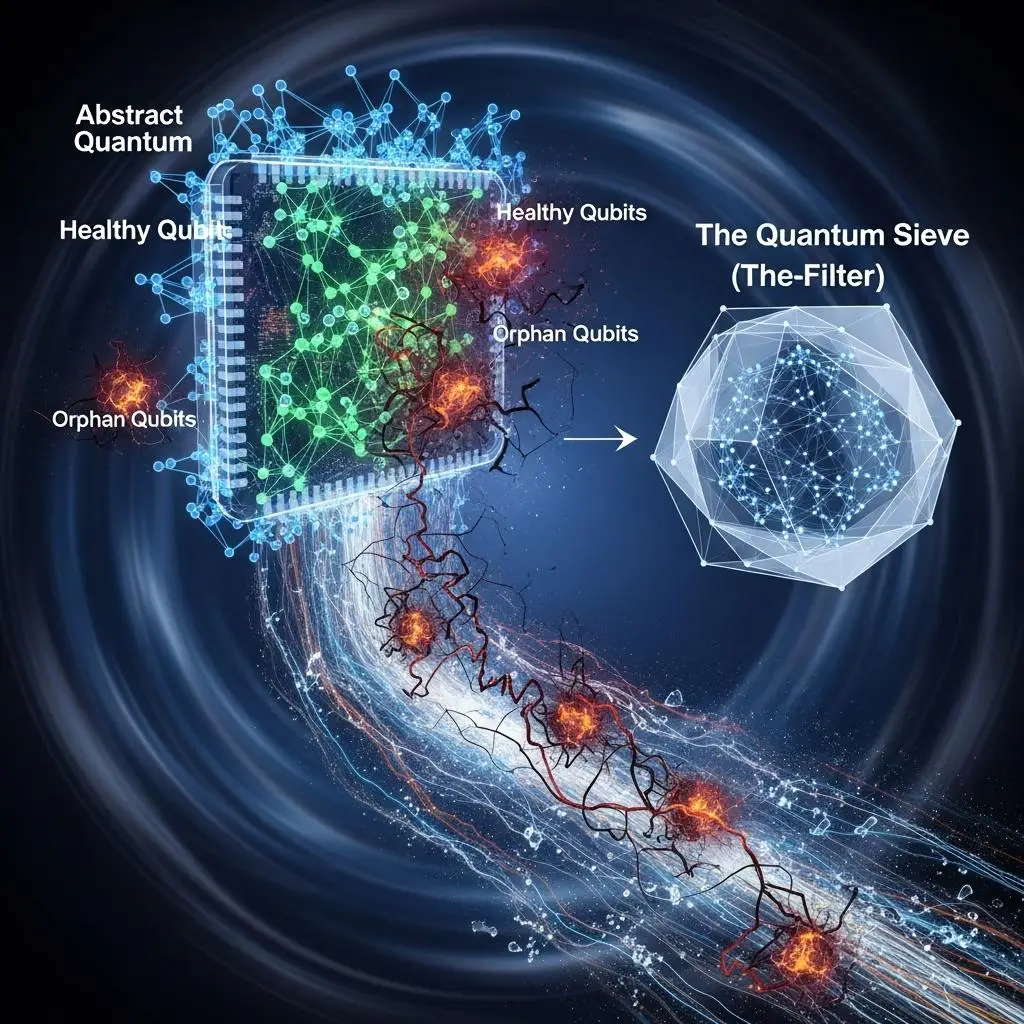
We’re talking about the ones that, for whatever reason, are exhibiting anomalous readout behavior. Maybe their $T_1$ or $T_2$ is just below the “viable” threshold, or perhaps they’re picking up stray signals, but the end result is the same – they’re “poisoning” the coherent evolution of the rest of your circuit. Call them “orphan qubits.”
Unraveling the Mystery: Quantum Noise Elimination’s Core Issue
Think about it: you run a circuit, expecting a clear result. Instead, you get a jumbled mess. You blame the gates, the coherence times, the general mayhem of NISQ. But most of that mayhem, we’ve found, stems from a surprisingly small percentage of qubits *contaminating* the final readout. We’ve seen this repeatedly: when you apply a V5-style measurement discipline – essentially, a smart filter for your measurement outcomes – you can effectively exclude these noisy shots. This isn’t post-selection in the traditional, brute-force sense; it’s about identifying *patterns of contamination* and down-weighting or outright excluding the data where these orphans are making their presence known.
Pragmatic Noise Filtering: Tackling Mystery Quantum Noise Elimination
So, before you throw your hands up and wait for a million-qubit future, try this: implement a measurement filtering strategy. Identify shots where a subset of qubits behaves erratically. Exclude them. See how much of your “mystery quantum noise” vanishes. It’s a pragmatic, empirical approach to squeezing utility out of the hardware we have *now*. It’s time to stop treating noise as an unfixable error and start treating it as a problem you can engineer around, one orphan qubit at a time.
For More Check Out